Mosaic Biosciences, based in Tampa, Florida, has announced the launch of Renuvis Enzara, a residue management product designed to help growers accelerate the natural decomposition of crop residue and support more consistent, plant-ready field conditions.
As higher-yielding hybrids, no-till practices and continuous corn increase residue levels, growers face challenges that can narrow planting windows, reduce operational efficiency and hinder profit potential. Heavy residue can lead to additional tillage passes, reduced planting capacity and yield losses caused by uneven emergence and inconsistent seed depth, the company said.
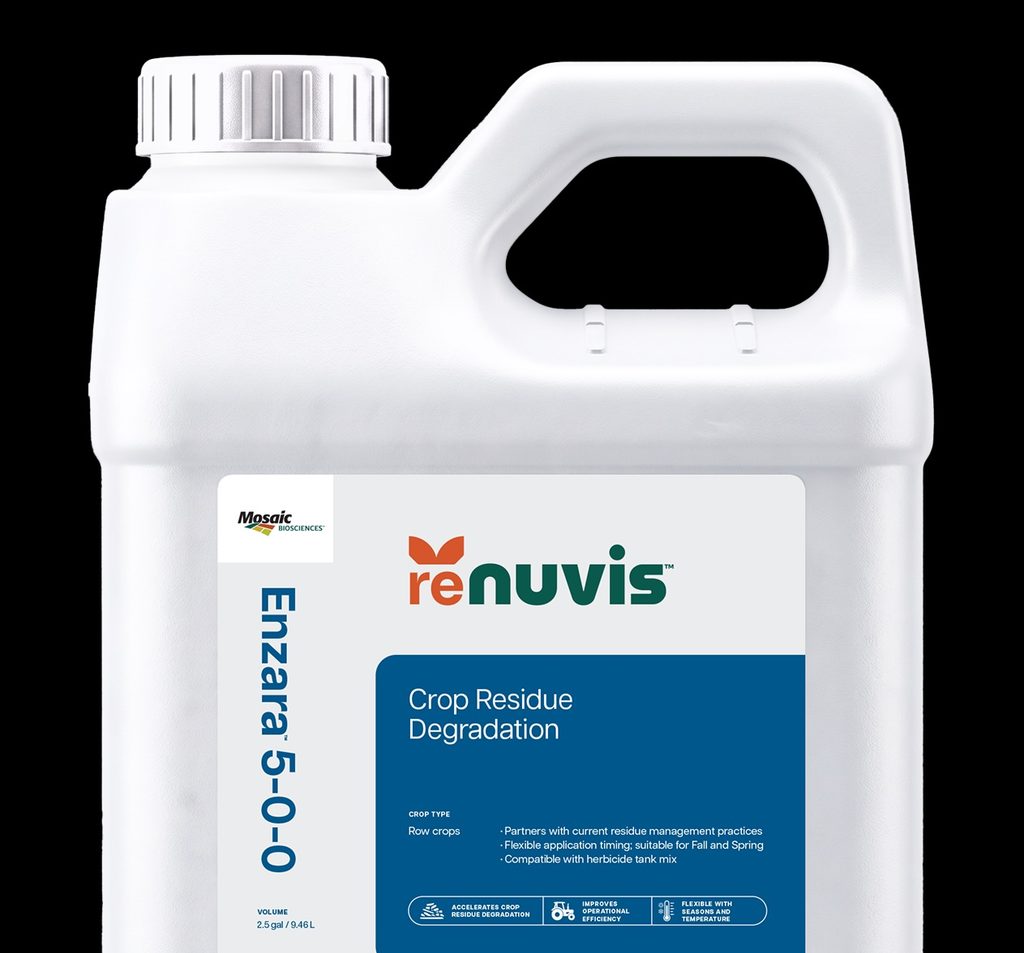
Mosaic said Enzara uses targeted enzyme technology to help break down residue faster and more efficiently. The company says this supports more consistent field conditions and may improve machinery performance at planting. According to Mosaic, faster residue decomposition with Renuvis Enzara can improve seed-to-soil contact and conditions for early growth and establishment and allow earlier planting.
Enzara also can improve tillage effectiveness, Mosaic said. Less residue may reduce equipment wear and tillage intensity over time. The company said this may contribute to lower fuel costs and improved erosion control.
“Farmers are managing more residue than ever before and that creates real operational friction during an already tight spring season,” said Matt Sowder, director of global solutions at The Mosaic Company. “Renuvis Enzara helps accelerate residue breakdown so growers can improve field conditions to create a wider planting window, enable improved machinery operations such as planting or tillage, and give every acre a better starting point.”
Unlike mechanical residue management approaches or microbial-based products that require time to colonize, Enzara uses endoglucanase enzyme technology that begins breaking down residue, even in cold conditions, including temperatures as low as 32 degrees Fahrenheit. According to Mosaic, the product targets structural fibers that hold crop residue together, creating more entry points for naturally occurring soil microbes to continue the decomposition process.
Research-backed residue management
Mosaic said Enzara has been evaluated in laboratory studies and on-farm trials.
In 2025 on-farm trials, Mosaic reported improvements in residue decomposition with Renuvis Enzara in both corn-on-corn and soybean-after-corn systems. Mosaic reported that spring applications of Enzara improved emergence, stand count and uniformity in corn and soybeans.
Enzara fits existing crop production systems
Mosaic said Enzara can be used with current residue management practices and existing crop production systems. It can be applied in fall or spring and is tank-mix compatible with fertilizer and herbicide applications, requiring no additional pass, according to the company. The product is suited for corn-on-corn acres, no-till and reduced-till systems, heavy residue zones and conventional tillage acres following high-yield crops.
“Every acre with residue can benefit from more efficient decomposition,” Sowder said. “Enzara fits the way growers already farm.”
For more information, see a representative or visit enzaraworks.com.
To contact us: hpj.com/contact/