Kansas State University has announced a collaboration project in which it will lead a group effort to work on the world’s challenges related to the production of sorghum and millet.
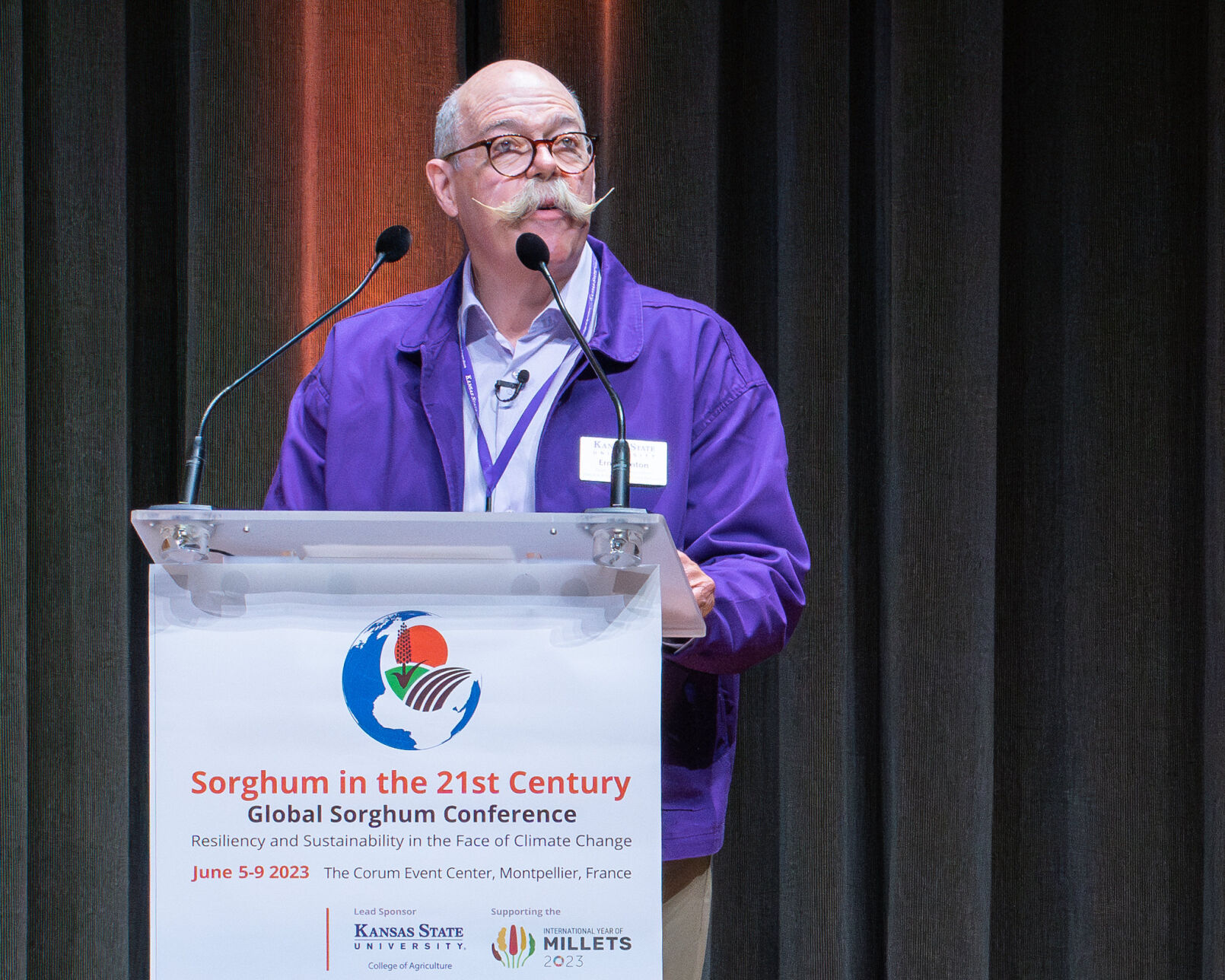
Ernie Minton, the Eldon Gideon Dean of K-State’s College of Agriculture, officially launched the Global Collaboration for Sorghum and Millet during the opening day of the Global Sorghum Conference in Montpelier, France, where K-State is a lead sponsor.
Minton said the partnership formalizes the university’s long-term global focus on improving the resiliency and sustainability of sorghum and millet in the face of climate change.
“We have found that with these crops, we need to collaborate and share information, research and resources whenever possible to support these orphan grains,” Minton said. “It is a crop that takes a lot of coordination and collaboration between individual scientists because there isn’t the same level of investment as there is in other crops.”
Located in the center of the United States, Kansas State is uniquely positioned to support this global collaboration, Minton said.
“With this investment in collaboration and sharing, we feel we can move the crop forward and work on problems that are global – such as diseases and other kinds of challenges – that may be in Kansas next year,” he said.
Minton added that K-State’s focus on sorghum is two-fold:
- Kansas is the No. 1 sorghum producer in the United States. As a land-grant university and home to the Center for Sorghum Improvement, K-State supports farmers, agriculture and related industry through research, extension and teaching capacity across the sorghum value chain.
- The Global Collaboration on Sorghum and Millet expands the work conducted from 2013 to 2022 through The Feed the Future Innovation Lab for Collaborative Research on Sorghum and Millet, commonly known as SMIL, which is hosted by K-State.
Related coverage and resources
- Related on HPJ: Cash Bids
- Related on HPJ: Grain Report
- Outside resource: USDA