Newsmaker panel discusses animal health, markets and policy
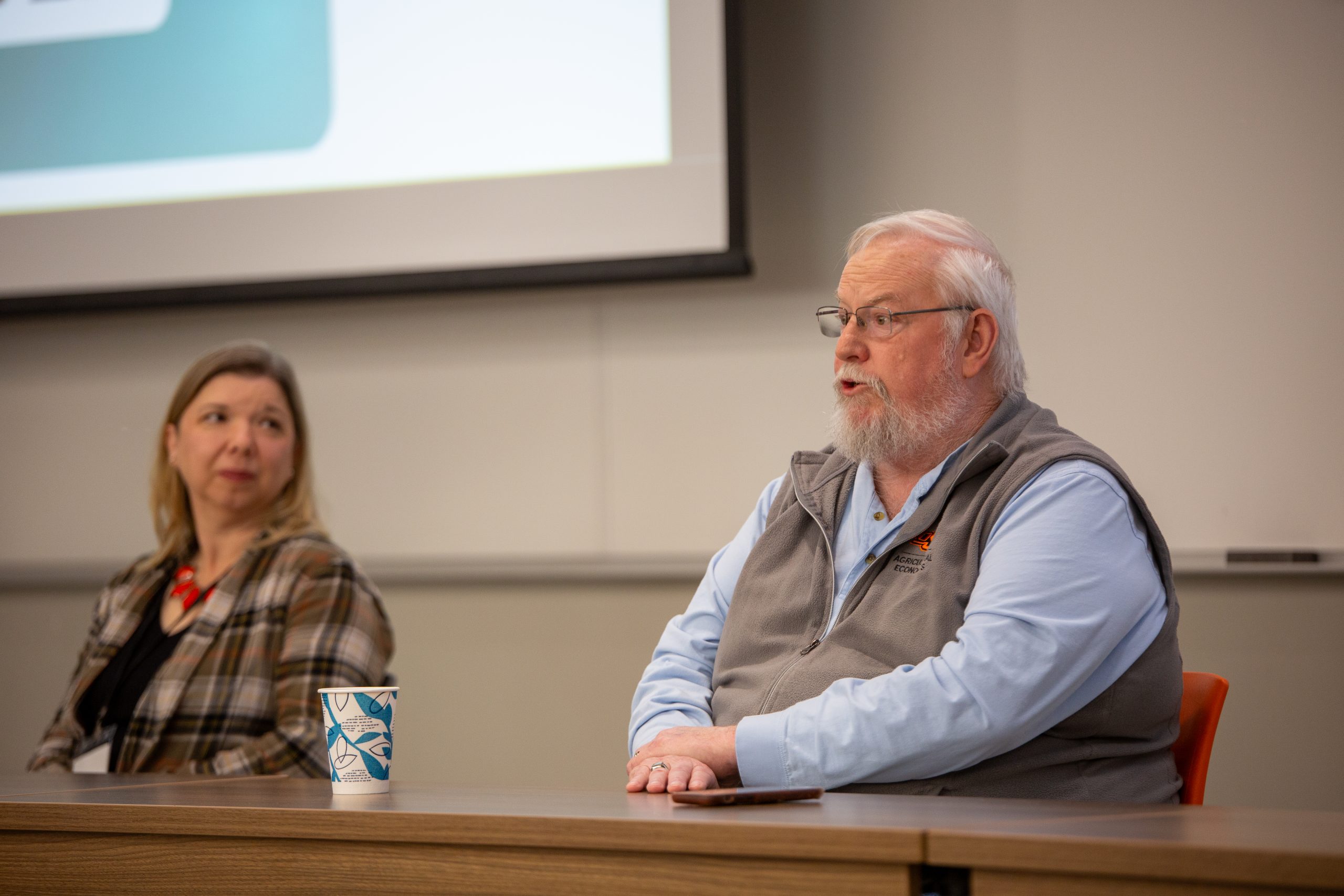
Risk in agriculture is real. It’s important for farmers and ranchers to know and understand it and what it can do to markets, policy and animal health.
The Livestock Publications Council recently hosted a regional workshop for members and students at Oklahoma State University in Stillwater, Oklahoma. The newsmaker panel tackled those topics surrounding the current climate of ag.
Featured on the panel was Amy Hagerman, associate professor of ag economics at OSU and Extension agriculture and food policy specialist; Darrell Peel, Charles Breedlove Professor of Agribusiness and Extension livestock marketing specialist; and Dr. Rosslyn Biggs, veterinarian and Extension beef cattle specialist, and director of continuing education at OSU’s College of Veterinary Medicine.
The question of what one risk they’re watching over the next 12 months kicked off the session. Hagerman said her primary role is centered in agricultural and food policy, so she’s watching policy risk.
“We think about policy often in terms of mitigating risk, creating opportunities to reduce risk for production agriculture,” she said. “But when you have a big shift over at the federal level, policies can change fairly rapidly, and at that point, you think about it in terms of the risk that policy can actually infuse into markets as well.”
It’s been that way for at least the past two years, maybe even all the way back before COVID, that there’s been some balance when there are announcements that help mitigate risk or infuse risk in the markets too, she said.
As an economist, Peel follows and analyzes markets. He tries to provide producers with insight, and he looks at factors that might be affecting the markets.
“In terms of risk, obviously there’s a million pieces that affect markets,” he said. “One of the challenges in for the industry and for analysts right now is the fact that most of those million pieces are moving at once, and that’s not always the case.”
But the past 18 to 24 months the cattle industry has faced even more.
Supply and demand are at the center of the cattle market fundamentals, he said.
“There’s lots of components to both of those, and they’re in pretty good shape,” he said. “The market is at record levels essentially because of where we are with supply and demand fundamentals.”
External factors have created volatility in the markets and caused significant risk for cattle producers.
“Those come from all kinds of sources, everything from politics to animal health issues, trade issues, policy issues, all of those things are external to the underlying market fundamentals,” Peel said. “That’s created a lot of challenges for everybody to try to get a handle on.”
Biggs, putting her veterinary hat on, said several challenges are top of mind. New World screwworm, theileria and the Asian long-horned tick, and veterinary shortages.
“From an animal health perspective, we have a lot of discussion about theileria, and as it relates to Asian long-horned tick. I’m probably more concerned about theileria and its spread,” she said. “Additionally, because of what I do within Extension as well as a veterinary school, I have some particular interests, and it relates to these disease incursions.”
She has a different take on rural veterinary shortage and under service in veterinary deserts.
“I think it’s important to note that I actually really prefer a food supply veterinary shortage versus a rural because of the needs really along the entire chain,” she said. “We’ve got veterinary impact from before conception all the way through harvest, and we need veterinarians to deal with policies.”
Biggs has continued concern with funding at the academic level, especially for ag research and Extension programs.
Driving beef prices
Peel was tasked with a question about what’s driving cattle and beef prices.
The current market started about four years ago, according to Peel, and it’s been a long-run bull market.
“Basically, we’re very close to record prices, and we’re not done with that yet,” he said. “But on the supply side, we’ve got a multi-decade low in cattle inventories. We have the smallest beef cow herd since 1961, and so that leads to smaller calf crops for the last eight years, decreased beef production and all of those things that on the supply side indicate that we’re tight.”
That’s not going to change any time soon. The demand side has seen “extremely strong consumer demand,” that’s been very robust.
“We have record high retail beef prices, and yet, despite the fact, there’s lots of alternatives out there that consumers could choose, they’re still choosing beef,” he said. “If you look at beef prices relative to pork and poultry, they’re at record levels essentially, and so both supply and demand are supplying the market very well.”
Hagerman said it’s been fascinating to watch external forces that are impacting demand. The usage and adoption of GLP-1 drugs has influenced demand for high-quality protein. Good protein, from beef, helps meet that demand.
Pork and poultry industries are also benefiting from protein demand too, she said.
“You might not think of that piece of the story as being impactful for livestock markets, but there’s an interrelationship there,” Hagerman said. “I think you can look at the fact that the United States inverted their food pyramid a few years ago. This was a very purposeful change to encourage the demand for proteins.”
There’s softer influences in agriculture that affect general trends, the panelists said.
Animal health plays a part, Biggs said, for example, NWS has impacted the cattle market because of the halting of imports from Mexico until recently.
Policy-makers need to address protocols and disease risk, Biggs said, and communicate that policy to trade partners.
Finding the right policy for East Coast versus West Coast or even the High Plains, can be hard. NWS has shown why it is important to widely share information and education.
“We want to make sure that producers, consumers, the general public is aware of these things without being scared to influence markets,” Biggs said.
Watch list
When asked what she’s watching for in the next year, Biggs said in Oklahoma and regionally, there needs to be more acknowledgment of preparedness. She thinks about producers in the pork and poultry industry are much better prepared for a disease or other outbreak.
“From a biosecurity standpoint and preparedness standpoint, I have concerns, most specifically for cow-calf, but really all sectors of the beef industry,” she said.
The reason is few cattle producers have faced a large-scale risk in a long time, she said.
Biggs said it’s not just about understanding, but a “real lack of familiarity” and how that could impact individual operations and daily practices.
“Plus, if we’re talking about things like New World screwworm, I mean, frankly, lots of operations—you’re not set up to treat cattle and inspect cattle,” she said. “So, I say that not all of the places that we have access to run cattle on are set up to handle cattle in in a more regular way that will be necessary if we see New World screwworm in Oklahoma.”
Cattle market complexity
Peel said the cattle industry is extremely complex.
“There’s been a lot of influences on all sides of the market, and so I think one of the challenges for all of us when we pick a specific topic that we’re interested in is to have the correct perspective on that topic in isolation from all the other things,” he said. “Or maybe we can’t isolate it from all the other things.”
Peel said risks can cover animal health, policy or trade and sometimes only one or it can be a combination of all that influences the market. It’s never simple.
“That’s the challenge: Is to have some perspective on the whole breadth of things that are going on, even if you can’t talk about them in a particular communication,” he said. “But to at least have the perspective of where does this particular topic fit into that broader set of issues.”
Hagerman believes trade dynamics have been oversimplified. She said discussions about a trade deficit, often do not define the meaning of trade deficit or how ag factors into trade negotiations.
“It’s like lumping everything together, and not really an understanding that, for example, our largest import category with audience participation. What is our largest import category by value, for in terms of agricultural products for the U.S.?” she said.
Wines and distilled liquors are the country’s top import by value, followed by fruits and vegetables.
“What do we export? We export core commodities: soybeans, wheat, beef, pork, and chicken,” Hagerman said.
Beef is the U.S.’ top export by value and is some of the best quality in the world. It’s hard to compare wines and distilled liquors to beef.
“Those are products we just don’t have the capacity to produce here in the U.S., and what other countries are really good at producing or according to labeling laws, the U.S. simply can’t label it the same way. Trends on social media have made things challenging across the board.”
What else with trade?
Panelists were asked if there’s anything that is concerning when it comes to trade.
Hagerman said there are challenges in every commodity in the trade space since it is a global market.
“These things do matter more so for some commodities than others,” she said, adding that knowing what matters is important.
For example, dairy as a commodity in terms of trade importance compared to pork are two very different stories and dynamics.
“Especially when we start thinking about animal health, trade restrictions, and vulnerabilities to animal disease,” she said. “I’m even thinking about HPAI and dairy and some of the consequences as compared to pork.”
She said she thinks understanding the importance of trade for any commodity is a good place to start. The follow-up question is who are the customers on the global market? Then, what do those relationships look like? Bilateral trade is an important consideration.
“It’s about the relationships between customers. It’s about what’s going on in that other country, and how is that influencing trade dynamics at any given time?” Hagerman said. “I think that’s part of it, and then we can’t forget cost. We can’t forget the strength of the U.S. dollar and the cost of our product to a global consumer as compared to our competitors. I think those three pieces are really critical for any given commodity, but they’re going to be different for every commodity.”
Kylene Scott can be reached at 620-227-1804 or [email protected].