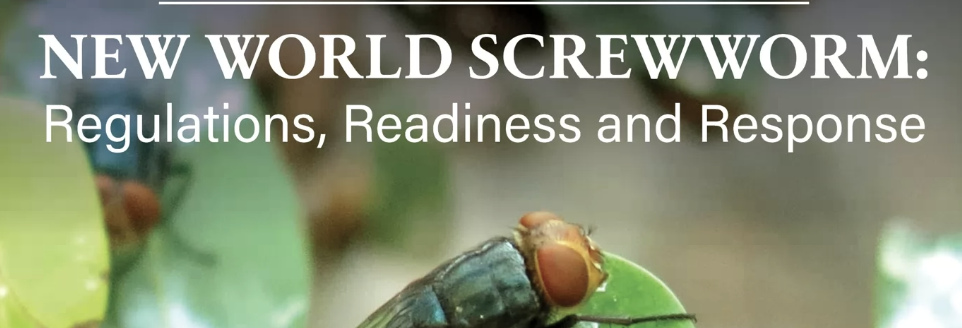
Rollins aims to stop spread of misinformation about NWS
U.S. Secretary of Agriculture Brooke Rollins said the New World screwworm needs to stay at the top of everyone’s radar and she plans to host calls more frequently to keep misinformation at bay.
Rollins, Undersecretary Dudley Hoskins, Animal and Plant Health Inspection Service Associate Administrator Michael Schmoyer, and Texas Animal Health Commission Executive Director Dr. Bud Dinges hosted a call about NWS on June 2.
“Our plan is to again do these every other day,” Rollins said. “We may get on a Monday, Wednesday, Friday rotation for a while.”
She hopes the live updated conversations will be helpful as new information comes in with new cases in Mexico.
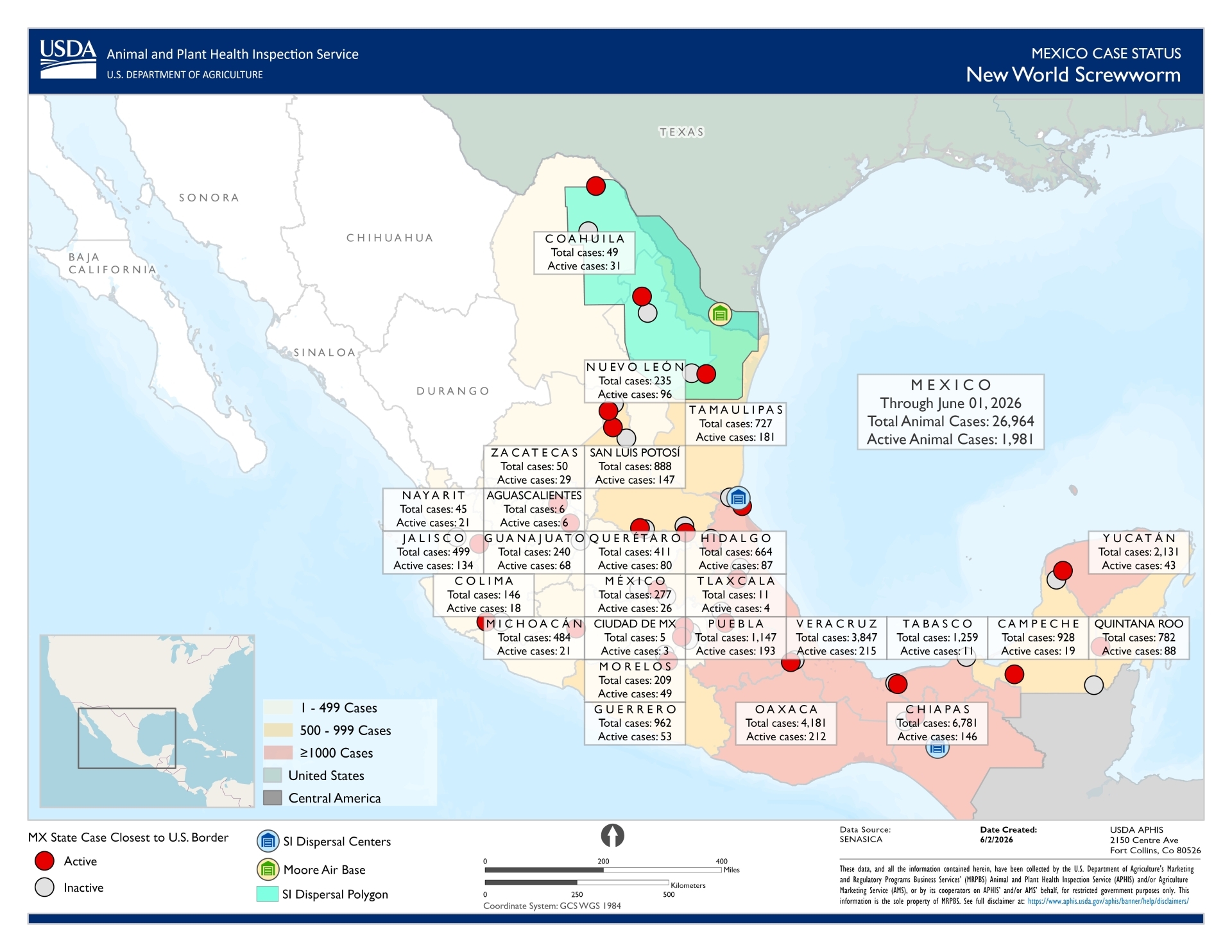
“The reason we wanted to start doing these regularly is that Mexico reported eight new detections of New World screw worm late last week,” she said. “These should all be on the screwworm.gov website, so I don’t think this is new news.”
The newest case is in a 5-year-old goat in Coahuila, approximately 25 miles from the Unites States-Mexico border.
“This is the closest we’ve seen it,” she said. “I know we’ve had one last fall, about 60 miles from the U.S.-Mexico border, and we surged information. At that point we’re able to push it back a little bit, so we certainly been working around the clock, but the fact that this one is only 25 miles—we thought it was probably time to start ramping up communications efforts. This is, of course, our closest confirmed detection to date.”
Rollins said this is no-doubt a serious threat to “our livestock.” She reiterated what NWS is—a parasitic fly larvae that can burrow into the flesh of a living animal, causing serious complications and even death in an untreated animal.
“They can infest livestock, pets, wildlife, and in very, very, very rare cases, humans. To be clear, at the outset, the current risk to public health in the U.S., is extremely low,” she said. “The real risk, and obviously why I’m running this call and not Secretary (Robert F.) Kennedy (Jr.) or someone else, the real risk is obviously to our livestock and our wildlife population.”
NWS was eradicated from the U.S. in 1966 and was eliminated from Mexico in 1986. Panama was the biological barrier, and the strategy then was to push the pest as far from the U.S. as possible. For years, that worked, she said.
“The Darien Gap, the dense jungle separating South and Central America, served as both a geographic and a biological barrier,” she said. “Limited movement of people, livestock, wildlife, and commerce through that region slowed the northward spread of pests and diseases and helped keep the new world screwworm largely contained in South America.”
As time went on, increased cartel activity and other political pressures lessened the control officials had on the area. Rollins said between January and November 2024 that dominance escalated northward. The economic collapse and political instability in Venezuela also contributed to the movement of NWS northward.
Rollins said the biological barrier that had protected North America for decades had been breached. Beginning in 2025, USDA changed the inspection process.
“The stringent and strengthened import inspection process allowed us to both increase the size of the U.S. herd, then, and to protect it, but in May of last year, USDA was forced to again suspend the imports of live animals through the U.S. ports of entry along the southern border, Arizona, New Mexico and Texas.”
Rollins said Mexico was unable and often unwilling to effectively implement “in-country animal movement protocols.” Planes carrying sterile flies couldn’t consistently land and drop the insects.
USDA announced its five-pronged NWS strategy in June of 2025. It focuses on detection, containment, eradication, preparedness, and sterile fly production.
“That strategy spurred us to dramatically increase our involvement inside Mexico,” she said. On Aug. 14 of last year, we signed a $20 million action plan with Mexico’s USDA equivalent, meaning surging funding our funding into the northern part of Mexico.”
Since then, funding has been helping strengthen surveillance controls, trapping, reporting, and enforcement. Field teams of USDA have deployed to conduct repeated audits of Mexican operations. Millions have been invested in long-term defenses against NWS, including conversion of a plant to become a sterile fly dispersal facility. A new sterile fly production facility is being constructed in south Texas and will be the only U.S.-based sterile fly production facility.
“We will continue to battle this for years to come, and our livestock producers, our ranchers, will struggle as their grandfathers and great-grandfathers did in the 50s and 60s,” she said.
Detection methods have also been ramped up. Thousands of traps have been placed along the border.
“By the end of last month, USDA had deployed more than 8,000 traps along the border, examined more than 58,000 fly samples, and inspected more than 19,000 wildlife specimens,” she said. “Every single sample and specimen tested were negative for the new world screwworm. Needless to say, the scale and technological prowess of our response to new world screwworm, as I mentioned, has been unprecedented.”
Rollins said USDA and others have been doing everything possible on our side of the border to keep NWS out.
The discovery of the 5-year-old goat with NWS did not catch Rollins off guard, and she wanted to take the time to explain the situation to “especially those elected officials and government officials in Texas, New Mexico and Arizona, to ensure that you all have the information,” she said.
USDA has set up an email that will be monitored 24/7 to keep getting information out about NWS. The website, www.screwworm.gov, has the most up to date information about any new cases and how to prevent spread, as well as the playbook.
“That updated new world screwworm response playbook includes detailed protocols and procedures for precisely the situation that we may face, and that is, if our border, the southern border of America, is breached,” she said. “We are preparing to implement the very moment the fly makes it into our country. If we have a domestic detection, USDA and relevant state animal health officials will immediately put in place quarantines and movement restrictions to limit the pest spread.”
Kylene Scott can be reached at 620-227-1804 or [email protected].