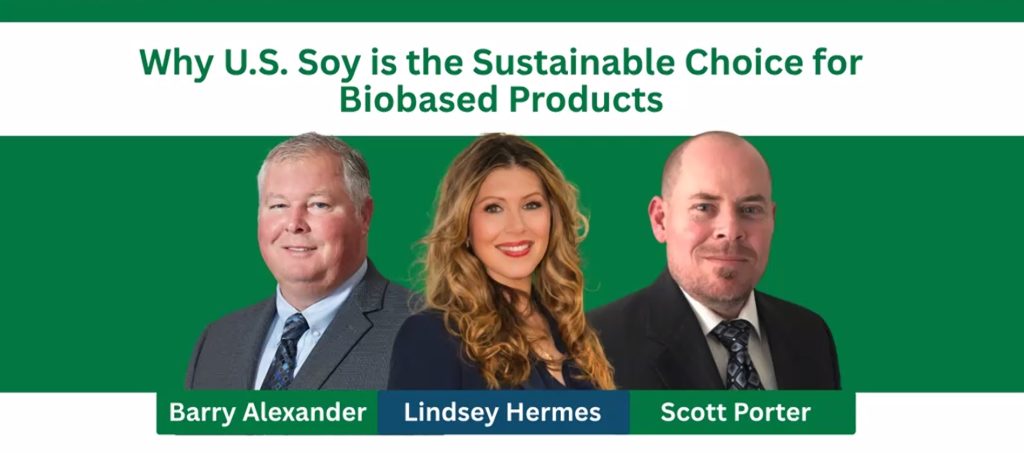
Panel discusses why U.S. soy is the sustainable choice for bio-based products

Soy-based products are finding their way into manufacturing, sustainability and innovation roles, according to panelists during a webinar July 9 hosted by Agri-Pulse.
During the event, Barry Alexander, United Soybean Board director and Kentucky farmer; Lindsey Hermes, CEO, BioSpan Technologies; and Scott Porter, founder and CEO, Dynamic Green Products, explored how soy is finding new uses beyond food and feed, what’s driving demand for these products, and what opportunities lie ahead for growers, manufacturers and customers.
Alexander, who farms in western Kentucky, raises double crop soybeans, winter wheat, corn, dark fire tobacco, and beef cattle.
“We’re actually harvesting two crops in one season off those acres,” he said. “The wheat-bean rotation is very beneficial for us as far as helping with weed resistance, weed control, also dual revenue on those acres every year. We do lose a little bit of yield on our soybeans due to being the double crop later in the season. However, we make up the difference with our wheat crop and overall production practices.”
He’s been on the USB board and the Kentucky Soybean Promotion Board for several years, and this year he’s involved with the industrial working group. Soybeans fit many industrial uses, according to Alexander.
“It’s 100% renewable, 100% sustainable,” he said. “Really fits into these products well, and basically anything you can use a petroleum-based oil or product for, we can move into these industrial uses just the same.”
Products like paint coatings, lubricants, surfactants, adhesives, rubbers, polyurethanes, and other plastics can have a soy component.
“Soy is basically in everybody’s life every day,” he said. “One of the neat projects that we’ve been involved with is Goodyear Tires. Goodyear has been producing a soy-based tire for several years now.”
Alexander said there’s many tires going into municipalities already in regular passenger tires. Asphalt can use soybeans and the same with surfactants in cleaning products.
“A local company here in Kentucky uses a soy-based adhesive to help bind their products,” he said. “It’s a 100% sustainable, renewable every year because it’s made with locally sourced hemp along with our locally sourced soybean products—really the best opportunity for the farmer and everyday users.”
High performance
Hermes, who’s company BioSpan was founded by her father in 1993 with a simple vision—take something renewable like U.S. soybeans and turn it into high-performance materials that can replace petroleum across the entire industry.
“It started when he discovered a soy-based compound that could dissolve asphalt and tar—a pretty big deal,” she said. “And this small, almost accidental discovery turned into something with global scale potential.”
The Missouri-based company along with partners across the country and soon globally have five product lines—asphalt, concrete, dust control, cleaning, and energy.
“All of our products include a majority component of bio-based content like soy,” she said. “I like to say we sell Botox for roads in our flagship products, Replay and Opti Seal. They don’t just sit on the surface like paint or lipstick.”
BioSpan is known for polymer technology that penetrates and rejuvenates pavement from within or below the surface.
“We build that polymer out of post-consumer recycled Styrofoam waste,” she said.
Her company also uses asphalt shingles and rubber tires they recycle.
“This is small, precise treatment, not a resurfacing overhaul that’s very costly in both money and carbon,” she said.
To change practices, Hermes said, there needs to be accessible, affordable solutions and soy offers that.
“Soy-based chemistry can do what petroleum does: cleaner and often cheaper, at a scale that’s already real,” she said. “We are literally growing the future of infrastructure and energy extraction in our fields here, because everything we source is made here in America and it’s grown here too. We’ve taken that small solution, big impact idea into energy.”
Bio-based approach
Porter said his Dynamic Green Products are bio-based, and this type of lubricant was replaced by petroleum “basically 80, 90, 100 years ago,” he said.
“What we’ve done is develop a sustainable product line focused in on soy,” he said. “As Lindsey from BioSpan mentioned, soybean is a natural and better alternative than most petroleum feedstocks. It’s great for the American bio economy. There’s really not a chemical that we can’t make out of it.”
Porter said in his case, he focuses on outdoor tools and power equipment.
“If you think of a professional operator using a chainsaw, a skid steer, a bucket truck, etc.—that’s what our line is developed for,” he said. “And in most cases, anything with a total loss, meaning it goes in the equipment or tool and out into the environment, it is wholly or majority soy.”
According to Porter, bio-based is still the exception and not mainstream because it’s “always been a check mark in the box.”
“It’s always been focused on niches. It’s always tried to compete with petroleum on price and when you get into the chemistries of additive systems, base oils, polymers, etc., you can take any plant-based material, and in particular soy, and you can actually make it work better than petroleum,” he said. “If you think of the market, market is 85% conventional base oil from crude, and we can achieve higher performance than 85% of the market.”
Soy competes with full synthetic oils and one of DGP’s pillars is performance.
“We want people to use the products because they work better than petroleum,” Porter said. “Within that performance model, you must also be 100% compatible, and of course, it’s safer for the user. What do you get on your skin? What do you accidentally breathe in? It must be safer.”
He believes his products are sustainable and better for the planet.
“Our mission as a company is to develop superior performing products that replace conventional petroleum,” he said.
The biggest challenge for bio-based products is awareness.
“What we’ve done to broaden horizons, create awareness, and go mainstream—we’re really focused on retail e-commerce, targeting 40 to 50 million professionals,” he said.
Partnering with large OEMs like Stanley and Black and Decker helps. Their products are placed next to the tools that use the oils, lubricants, and synthetics.
But the obvious part of the company’s mission is supporting American soybean farmers.
“I take it as the CEO, a privilege to be partnered with U.S. Soy, state level soy and getting out to the farmers, meeting Barry at his family farm, working with other farmers,” he said. “But that’s a big part of our mission: We must connect the consumer to the farmer.”
Customers expect bio-based products to be sustainable, so it’s obviously important to all three panelists in some form or fashion. For farmers, sustainability goals are creating new market opportunities.
“Everyone’s looking at their carbon scores now, from the shipping companies to the manufacturers,” Alexander said. “We are the best for that. We have the best carbon option on the market now. We do it more sustainably.”
Alexander said the easiest way to see the world’s No. 1 environmentalist is to look at a farmer.
“We’re trying to do nothing but make our land better, make the soil better, and have a better product to pass on to the next generation,” he said. “It just makes sense. We’re renewable. We’re going to grow it every year. It just it’s just what makes sense and truly makes us the most sustainable option in the market.”
Kylene Scott can be reached at 620-227-1804 or [email protected].