Cattle prices still have room to go up, said a Texas A&M AgriLife Extension Service expert.
With smaller supplies of cattle on hand and good demand for beef continuing, prices could hold and go higher yet, said David Anderson, Ph.D., AgriLife Extension livestock marketing economist and professor, Texas A&M Department of Agricultural Economics, who spoke at the Texas A&M Beef Cattle Short Course.
“We are going to produce less beef this year and next year and maybe into 2028,” Anderson said. “We can’t expand the herd in a drought, and the whole Great Plains area has been and is still dry. Expansion is going to happen slowly due to the drought, higher input costs and interest rates, and the market volatility — tariffs, trade, screwworm and other pests — we are still seeing.”
Expansion might be starting, but takes time
Anderson said the slow movement to herd expansion means increases in beef production will also be slow.
“One way to increase beef production will be the cattle from Mexico, with the planned border openings later this month,” he said. “But that will also depend on the speed of the port openings and the number of cattle coming into the U.S.”
The Santa Teresa, New Mexico, port west of El Paso is the largest entry point for Mexican cattle, with more than 500,000 head moving through annually. That port will be the second or third of the various ports to open, with the Douglas, Arizona, port opening first.
“We’ll start importing feeder cattle; my expectation is it will slowly ramp up, and we won’t get as many as we were in 2024 and before,” Anderson said. “These numbers will add to our supply of feeder cattle, but it won’t really depress prices. We’re still going to have high prices.”
That’s because those cattle won’t become beef in the store until mid-2027. So, Anderson said, not much impact is expected on prices in the near term.
In the market
Calf prices will still have room to go up, he said.
“We will have tighter supplies with good demand, and that’s a recipe for higher prices,” Anderson said.
Anderson said fed cattle are selling for an average of $230 per hundredweight now, but by next quarter, they could move to $243-$245 per hundredweight. In 2027, that price could go as high as $250-$256 per hundredweight. Prices for lightweight cattle or feeder calves, 500-600 pounds, have dropped slightly in the past few weeks, from $476.24 to $437.44 per hundredweight, but are expected to climb back as high as $459-$467 per hundredweight in the second quarter of 2027.
He said producers have stopped culling cows as much as they were, but they haven’t been holding back heifers.
“Right now, their dilemma is ‘do I sell the heifers today and get good money or hold the heifers and count on their offspring to make me money?’” Anderson said. “For the most part, the check in hand has been more attractive than the check from future offspring.”
The U.S. Department of Agriculture July cattle report indicated 100,000 heifers had been held back, so that is not huge, he said, but it is an indication that the process has started.
“It’s hard to grow a herd if you don’t keep numbers back,” he said. “However, the trend on the beef side is more pounds of beef per head, so we don’t have to have as big of growth to get back to the same supply as before.”
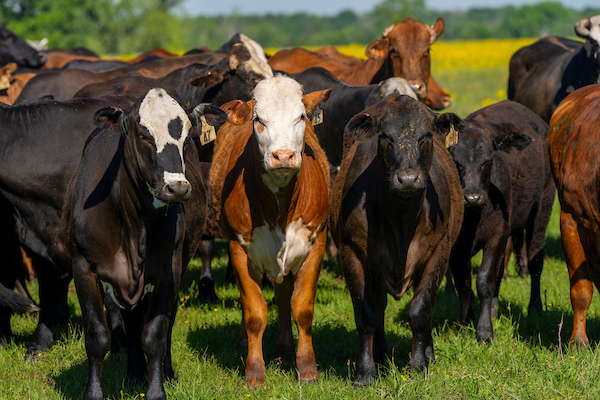
PHOTO: Beef cattle prices have not reached a ceiling, according to a Texas A&M AgriLife Extension Service beef economist. (Michael Miller/Texas A&M AgriLife)