Preparation key for New World screwworm
Livestock producers and those who are around wildlife need to be aware of the threat posed by the New World screwworm.
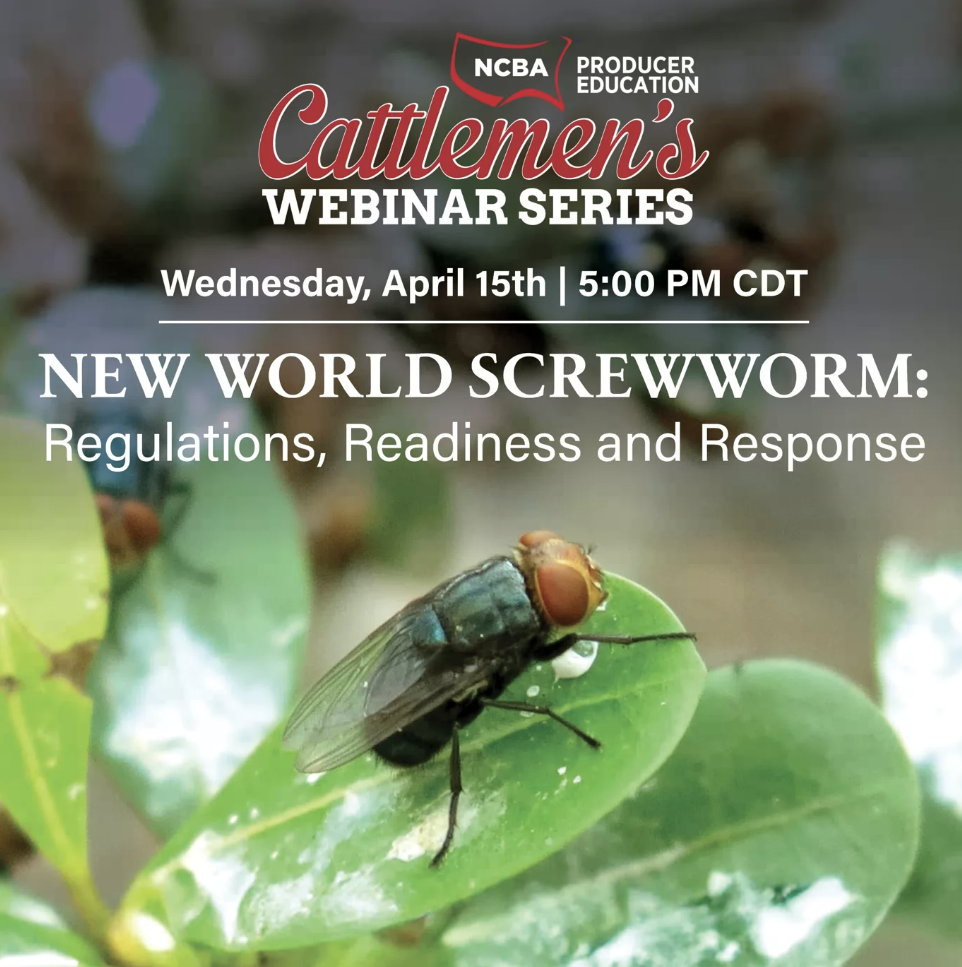
National Cattlemen’s Beef Association recently hosted a webinar that discussed regulations, readiness and response to NWS and featured Julia Herman, beef cattle specialist veterinarian, and Sigrid Johannes, senior executive director of government affairs at NCBA. Herman broke down what NWS is, how it affects livestock, and the treatment and management options producers need to know. Johannes gave a regulatory update and outline what changes may impact producers in the months ahead.
Herman said those on the ground are the ones who need to be aware of what to look for, thus they must know the basics of NWS. She also talked about biosecurity and some practical steps and concepts to think about if NWS makes it into the United States.
NWS starts as a fly and she lays her eggs on or in wounds or living flesh of warm-blooded animals.
“The larva feed on live tissue, but after feeding, the larva will drop to the ground, bury into the soil to pupate and then emerge as adult flies,” she said. “Females only mate once, which will be really key when (talking about) some of the control measures we have.”
The life cycle begins with adult flies mating. Again, females can only mate once, while males multiple times.
“Lifespan of these pests is only 10 to 14 days,” she said.
Once the female lays her eggs, it occurs when she places them on a wound area. Eggs will hatch in 12 to 14 hours if the temperature is around 80 degrees Fahrenheit.
“A lot of this is environmentally dependent, so the life cycle can be as short as 30 days. Or the life cycle of the fly could be as long as three to four months, depending on the external temperature,” she said.
The larval stages are the most damaging, and the larva will feed on live tissues for five to seven days, and the wound progressively gets worse, attracting more flies and perpetuating the infection. When the pupa reaches the L3 stage, the larvae fall to the ground, bury themselves, and then pupate. This can take about 6 to 8 days.
“If it’s a lower temperature, it takes longer,” she said. “After that, the fly will emerge, and the cycle continues.”
Herman suggested thinking about where stop gaps can be introduced.
“Because stopping this life cycle is one of the best ways that we can, one, interrupt the flies breeding, but also interrupt them from reproducing and causing more damage to animals, the industry and the environment,” she said.
NWS is considered a foreign animal disease that is endemic to Central and South America. Producers in those areas have been managing it or living with it for a long time.
“Prevention is the preferred method of control over treatment,” Herman said.
Sterile fly techniques, integrative pest management, and being proactive are cornerstones.
“It is a reportable disease in all states, and is required to be reported,” she said. “If you suspect this, we need you to report because the quicker we can get to these animals and kill those eggs, kill those larvae.”
NWS is a welfare concern for animals and will cause many problems.
“This will have immediate interstate commerce and international trade impacts for live animals, and the primary response strategy out of this playbook is preventing contact between New World screwworm flies and non-infested animals and stopping that production cycle and establishment of flies in our system,” Herman said.
Integrated pest management is multi-factorial, and it is not just chemical control like pesticides and different medications available, but also biological control, environmental or cultural control and sanitation—it’s mechanical and physical control too.
“There’s a lot of ways that we can use integrated pest management to manage not just the New World screwworm, but also the parasites that we already deal with,” she said.
Regulatory
Johannes said NWS is yet to be an outbreak in the U.S., and as of the April 15 webinar, there hasn’t been any positive cases “on our side of the border.”
Since April 15, Mexico has registered more than 20,000 total cases in this outbreak since it first hopped the border from Guatemala to southern Mexico, Johannes said.
About 1,240 of those are active cases, which means the rest have been inactivated, either through treatment or through the animal dying, she said.
Most cases in Mexico have showed up in bovines, and quite a few cases in equines, and a minor number in dogs, cats, some wildlife, humans and birds.
Efforts to get sterile flies produced and distributed is essential for control of NWS.
That is the powerful tool for pushing the pest away from the border or even if cases wound up being detected in the U.S., Johannes said. “We are in a much stronger position today in terms of sterile insect outlook than we were this time a year ago.”
According to Johannes, there are three main facilities that are in play for sterile flies. The main location of sterile fly production continues to be the location in Panama, which produces anywhere from 100 to 115 million sterile insects a week.
“They have for a long time been our partners in this, and kind of been the only facility in the world producing this type of sterile fly for screwworm, and they are continuing to keep up that production,” she said.
Mexico and the U.S. rely heavily on this location, and that is a little concerning for Johannes. She said when you look at the rate of spread for NWS, only having one main production facility is a tough pill to swallow.
“When the United States was eradicating screwworm from our borders the last time in the late 60s, we needed anywhere from 300 to 400 million flies per week to drop on our southern border,” she said. “(The Panama facility) only does 115, so we have a deficit there of sterile fly production that we need to fill again to be completely prepared to aggressively respond if we have a detection on our side of the border.”
A facility in the Mexican state of Chiapas, is getting U.S. Department of Agriculture funding and that facility is going to be a retrofitted sterile fruit fly facility that is pivoting to be able to do screwworms.
“And they expect that will be producing sterile flies in July,” Johannes said. “But it is a very positive sign that we are potentially going to have a couple million additional sterile flies per week coming out of that facility in Mexico sometime this summer, potentially as early as July.”
A third facility in south Texas will house the USDA’s own sterile fly facility.
“The dispersal capabilities there have actually already been completed,” she said. “That’s not insignificant. That’s not nothing, because these things have a shelf life.”
Johannes said if there was a detection tomorrow in the U.S. and there was a need to drop sterile insects on our side of the border, it would be “pretty difficult” to get them from Panama to the United States at the conditions they require.
“Having a place in the U.S., where those planes can set down, re-chill those flies, figure out their dispersal pattern, go back up, and then drop the flies, is an improvement,” Johannes said.
The location in Moore, Texas, is going to be better equipped to disperse flies in the U.S., but the completion dates is still anywhere from 12 to 18 months away from actually being able to produce sterile flies.
“That’s going to take some time, but it is a positive that we’re moving forward with that project,” she said. “The contract has been awarded. They’ve broken ground there. They are moving ahead now at a decent pace.”
NovoFly, a product of USDA-Agriculture Research Service, is showing promise, she said.
“It is technically considered a pesticidal product, so they have to register it with the EPA,” she said. “This is a modified fly that has a protein in it that kills the females. That would be a really big leap forward for us.”
There are several treatments also in protocol.
“We did not have the options that we have today and that was really concerning, because if it had jumped by some horrible happenstance, it had jumped the border back then, we would have been really hard pressed to deal with it,” she said. “But we now have four options that are operating, either under an emergency use authorization or a conditional approval to treat screwworm in cattle.”
Johannes said those include Ivermec, Dectomax, Exalt CA and F10. The most recent one is a topical spray that’s multi-species but also works on cattle. Having a working relationship with a veterinarian will provide the best course of action.
Kylene Scott can be reached at 620-227-1804 or [email protected].