Finding a way to increase the value of wheat is always on the minds of wheat breeders.
Brett Carver, regents professor and wheat genetics chair at the Oklahoma State University Department of Plant and Soil Sciences, said bakers and millers have been seeking ways to get more dough strength in wheat. Traditional hard winter wheat, the most common wheat grown in the Southern Plains, does not always produce sufficiently strong gluten and as a result additives are needed.
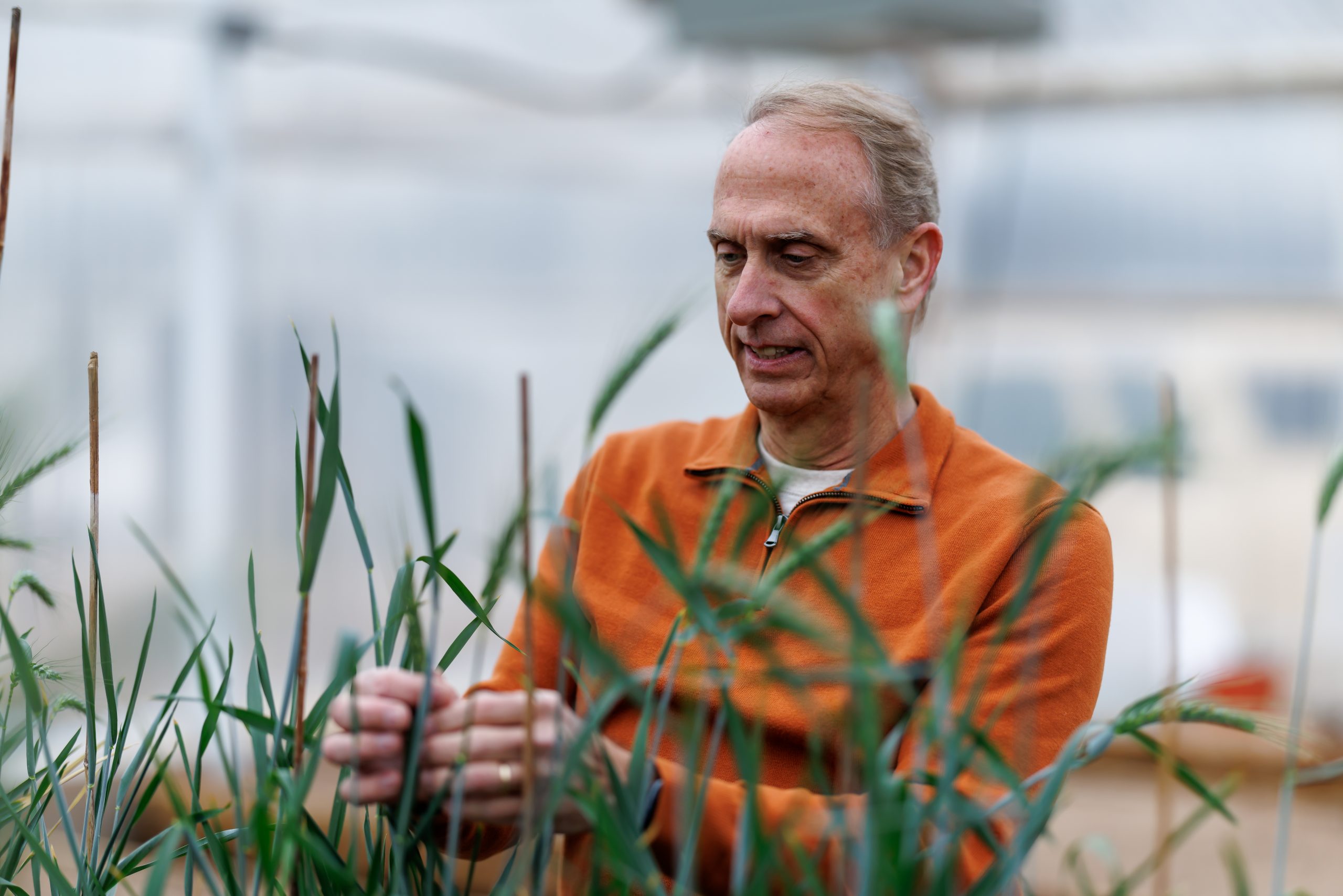
Carver said OX is an example of where Oklahoma Wheat Improvement Team researchers are collectively pooling resources to meet a new demand. Carver is pictured above as he is working to bring added value to the wheat industry. (Photo credit to Mitchell Alcala, OSU Agriculture.)
If the bread can be made with fewer additives, it will provide the market with a more natural bread, and consumers have indicated they believe it has higher health benefits and will purchase the product, he said.
Flour from the OSU varieties Paradox, Breadbox and Firebox (tagged as the OX varieties) appear to provide an uncommonly high level of dough strength while maintaining varying levels of extensibility, according to a news release from the college.
Increasing dough strength
The challenge is to increase dough strength while keeping other properties sought by millers.
“This is just the beginning of more efforts to improve and increase the value of the crop we grow right now and we’re doing it with unique dough strength,” Carver said.
A clean and less complicated label is a plus for OX and that means fewer additives.
“Major food companies know it too,” Carver said. “OX feeds right into a demand that’s tailor made.”
He also credited other researchers from neighboring states, including Kansas and Colorado, for doing similar work.
Carver knows hard red winter wheat is a staple in the Southern Plains, but when he has attended wheat quality improvement tours, millers and bakers don’t usually favor it. He said they had given him the impression that once milled, hard red winter wheat is considered a filler-type grain because it lacked the dough quality millers were seeking.
“I thought to myself I have to be a better wheat breeder,” Carver said.
Collaboration key
Further collaborations started 10 years ago with Kansas State University and Colorado State University. Carver’s early research started with Duster, Endurance and Doublestop CL Plus with limited results. His goal was to hit a quantifiable mark on gluten strength in hard red winter wheat.
Carver said the bakers and millers are going to take the OX wheat and blend it to produce the flour to make the bread.
Grain production of OX wheats released by K-State and OSU will be contracted through Farm Strategy, whereas certified seed production will be handled by respective licensees, Kansas Wheat Alliance and Oklahoma Genetics Inc. OSU has partnered with Oklahoma-based Shawnee Milling Company and Farm Strategy, a food supply chain partner, to research the potential of the Ox varieties as a natural flour-based alternative to wheat gluten additives, such as vital wheat gluten, the university said.
Farm Strategy
Andrew Hoelscher, with Farm Strategy, said the firm is building a program with aligned origins that helps to execute the wheat into the greater supply chain. Millers have responded positively in the Southern Plains region.
Carver said that also includes farmers who grow the wheat to meet miller expectations and that means working on a contract basis.
Those specifics will be spelled out, and growers will need to establish a relationship through the supply chain.
“We will never stop breeding for yield, but sometimes you have to go beyond yield. You hope to find more revenue for the farmer and anybody else in the supply chain,” Carver said. “I think this is just beginning of more efforts to improve and increase the value of a crop we grow here.”
Hoelscher said Farm Strategy is working within the system to enable minimal changes for the grower’s typical supply chain through incentivizing traditional market participants to be a part of the system.
While it is a bit premature, Hoelscher said there is potential for commodity level volumes that can support more opportunities.
“This is still in discovery as different markets have different logistics and costs of doing business that needs to be solved over a period of time to speak confidently about the total value capture,” Hoelscher said. “The short-term target is for 50 cents a bushel to farmers and that has the potential to change over time.”
OX has been released on a limited basis. In 2023, it generated more than $300,000 in revenue for the state. Carver expects the revenues to increase in future years.
Besides OSU, other universities and private breeding firms are in discussions about future arrangements, Hoelscher said.
If a grower has an interest in the opportunity, Hoelscher said Farm Strategy can help him or her figure out the current economics and genetics to see if it is a fit. Additional information is available at farmstrategy.com.
Dave Bergmeier can be reached at 620-227-1822 or [email protected].