K-State food scientist outlines steps to preparing and storing dried foods
Dehydrated foods are gaining in popularity as the costs of home equipment become more affordable, said Kansas State University food scientist Karen Blakeslee.
“There are many options in tabletop food dehydrators,” said Blakeslee, who also is coordinator of the university’s Rapid Response Center for Food Science. “The cost of the equipment needed to dry foods depends on the features of each appliance, and its size.”
Blakeslee said a food dehydrator uses heat and circulating air to reduce the food’s moisture content to about 20 percent.
“This allows the food to be stored at room temperature,” she said.
Dehydrated foods stored in airtight containers and in a cool, dry, dark place can be stored for up to a year at 60 degrees Fahrenheit, or six months at 80 F. Dried vegetable have about half the shelf-life of fruit, according to Blakeslee.
“Fruit leathers should keep for up to one month at room temperature,” she adds. “To store any dried product longer, place it in the freezer.”
Foods should be rinsed and prepared properly before drying.
“Most vegetables will need to be blanched first for best results,” Blakeslee said. “This is done by steam or water blanching, depending on the vegetable. Blanching stops the enzyme action, which could cause a loss of color and flavor during drying and storage. It also shortens the drying and rehydration time by relaxing the tissue walls so that moisture can escape, and later re-enter more rapidly.”
She adds that many fruits need a pre-treatment to prevent browning.
“If not pre-treated, fruit will continue to darken after it has dried,” Blakeslee said.
Examples of pre-treatments include using ascorbic acid, fruit juice (such as lemon juice), honey or sugary syrup, and steam blanching. The type of pre-treatment varies by fruit.
Meat jerky must be heated to 160 F to kill any possible E. coli bacteria that may be present. Instructions for safely drying meat is available online from the K-State Research and Extension bookstore.
The choice to dry foods or can them “is a personal preference, and it may depend on your storage options,” Blakeslee said. “Dehydrating foods typically takes less space, but it does take more time to dehydrate foods, though there is not as much equipment requirements.”
Blakeslee said freeze drying is another option for preserving and storing food. Compared to dehydrated food, freeze-dried food maintains more of its nutrients throughout the process, and once rehydrated, is similar in nutritional value to its fresh counterpart.
However, she cautions that freeze drying does not kill bacteria that may be present: “So, if contamination is present before the food is freeze dried, it will remain. But freeze-dried foods are very dry, as 90-95% of the moisture is removed and the food can be stored for as long as 20-30 years.”
More food safety tips are available online from K-State’s Rapid Response Center for Food Science. Blakeslee publishes a monthly newsletter, called You Asked It!, with timely tips for safe food in and out of the home.
More information is also available at local extension offices in Kansas.
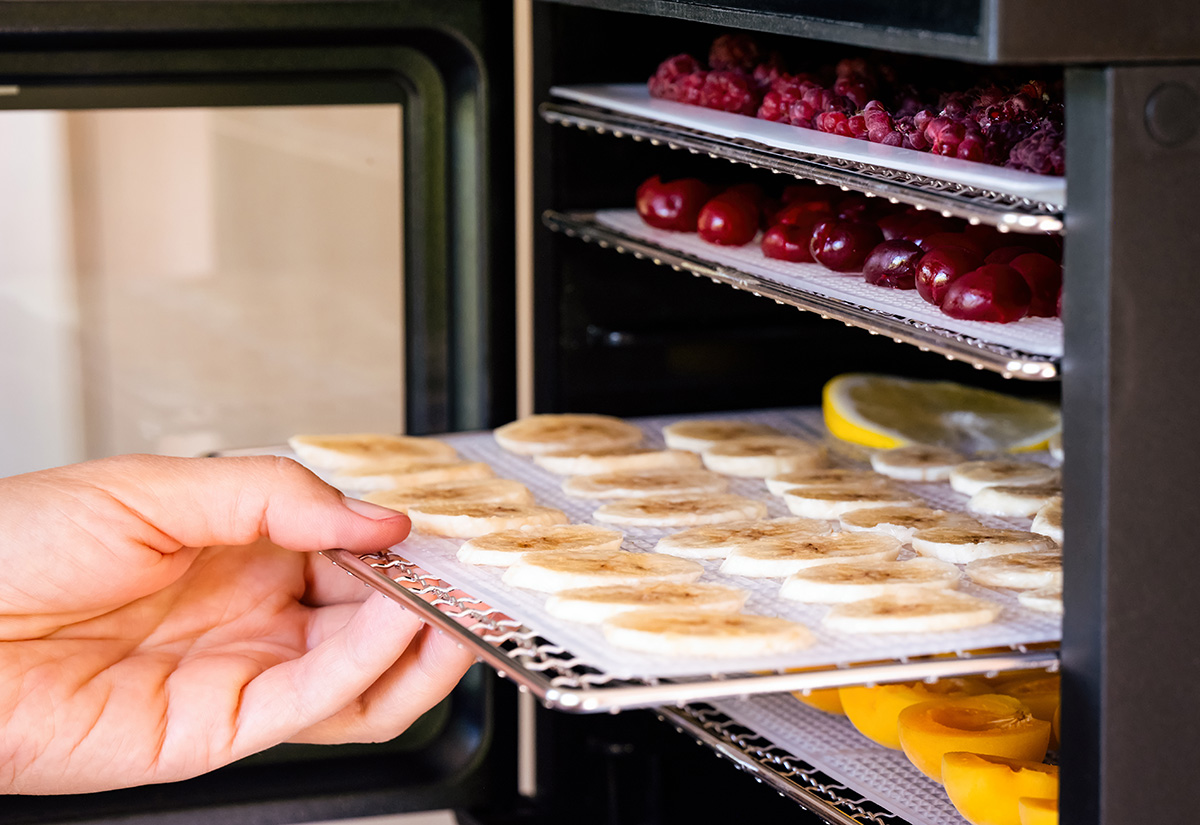
PHOTO: Person hand putting a tray with banana slices into a food dehydrator machine. (iStock │ #1332723385 – Ekaterina79)