Although it is the shortest month of the year, February can feel like one of the longest, at least to the grazing animal. During the depths of winter, green growing forage can be in short supply. Annual cereals can help to fill this forage gap at this time of the year.
While there are similarities between fall seeded cereal crops, there are differences as well, so today we will look at some pros and cons to each. Planting window is likely too late for fall-planted crops this year, but honestly, we aren’t too late to consider spring planted cereal crops who have much the same benefits.
When grazed from early April to early May, forage quality of cereal rye, winter triticale, and winter wheat is similar. Under proper management, growing calves can gain 3 to 4 pounds per day on these high-quality crops. Cereal rye can have greater growth during cooler conditions compared to wheat or triticale.
This is the reason it can often provide earlier spring grazing. On the other hand, triticale retains its feed value better into late spring since it does not mature as quickly. This makes it well-suited for hay and silage, or for grazing well into the start of summer. If planning on harvesting hay after heading, make sure to choose an awnless variety to increase palatability.
To optimize performance of grazing cattle with high nutritional requirements, such as growing calves or lactating cows, the key is to keep the grass from becoming overly mature. Lactating cows need to be on a steady or an increasing plane of nutrition as they move into breeding. Managing forage maturity is key to maintaining availability of high-quality forage. Small cereal forages grow fast and mature rapidly, so it is important to actively manage the grazing to ensure the plants are not allowed to become overly mature.
Target beginning grazing height is when the plants are about 5 to 6 inches tall and should be managed to keep the maximum height at 8 to 10 inches. Rotational grazing with higher stocking densities can assist with keeping the plant maturity more uniform and reduce selective grazing. These forages grow fast and recover from grazing fast as well. The most common mistake when spring grazing small cereals is letting the plant get ahead of the cattle.
It is important to increase stocking density as the spring progresses to ensure the cattle can keep up with the rapid forage growth. This can be achieved by either adding more cattle or reducing the number of acres being grazed. A good starting point is about half a cow or one stocker calf per acre in early spring and increasing from there.
Like most cool-season grasses in early spring, small cereal forages are also high in potassium. This means there is a need to provide supplemental magnesium as potassium interferes with magnesium availability to the animal. Grass tetany can be a real issue when grazing lush growing cereals because of this potassium content. A free choice mineral with a targeted 4 oz per day intake should contain at least 10% magnesium to prevent grass tetany in lactating cows and 5% magnesium to increase gains in stocker calves.
The key to getting the most out of grazing small cereal forages is managing the maturity by having the “right” amount of grazing pressure. K-State has a good publication discussing cereal grain crops called Small Cereal Grains for Forage MF-1072 to learn more about this topic. Visit the online bookstore to access all the Extension publications.
Ross Mosteller is a district Extension agent for Livestock and Natural Resources with K-State’s Meadowlark District.
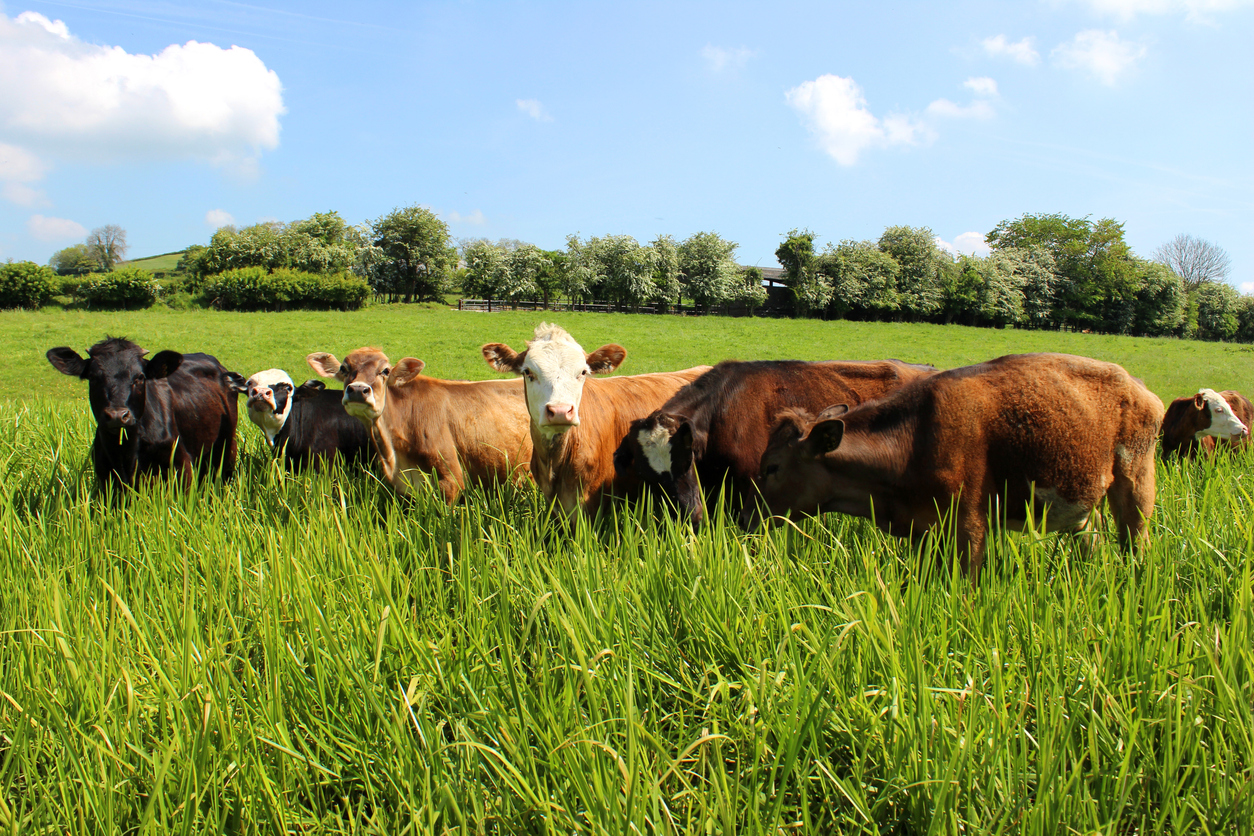
PHOTO: Small herd of young Angus, Friesian, Guernsey and Jersey in a particularly lush green field. (Adobe Stock │ #493635647 – mtreasure)