Tar spot tops Kansas corn disease concerns in cool, wet 2026 season
A cool, wet start to the 2026 growing season has pushed tar spot to the top of Kansas corn growers’ disease concerns, according to Kansas State University row crop specialist Rodrigo Onofre.
Onofre said tar spot, a relatively new but increasingly familiar disease in Kansas, has already been confirmed in three northeast Kansas counties.
Spring weather conditions – including daytime highs hovering in the 60s and low 70s, high humidity and prolonged leaf wetness — are prime for the disease to spread.
“Tar spot does like this wet weather and cooler temperatures,” Onofre said. “We have reports of tar spot now in Washington, Republic and Brown counties, but I expect to see more counties being highlighted in the next few days and weeks.”
Listen to an interview by Shelby Varner with Rodrigo Onofre on the weekday radio program, Agriculture Today
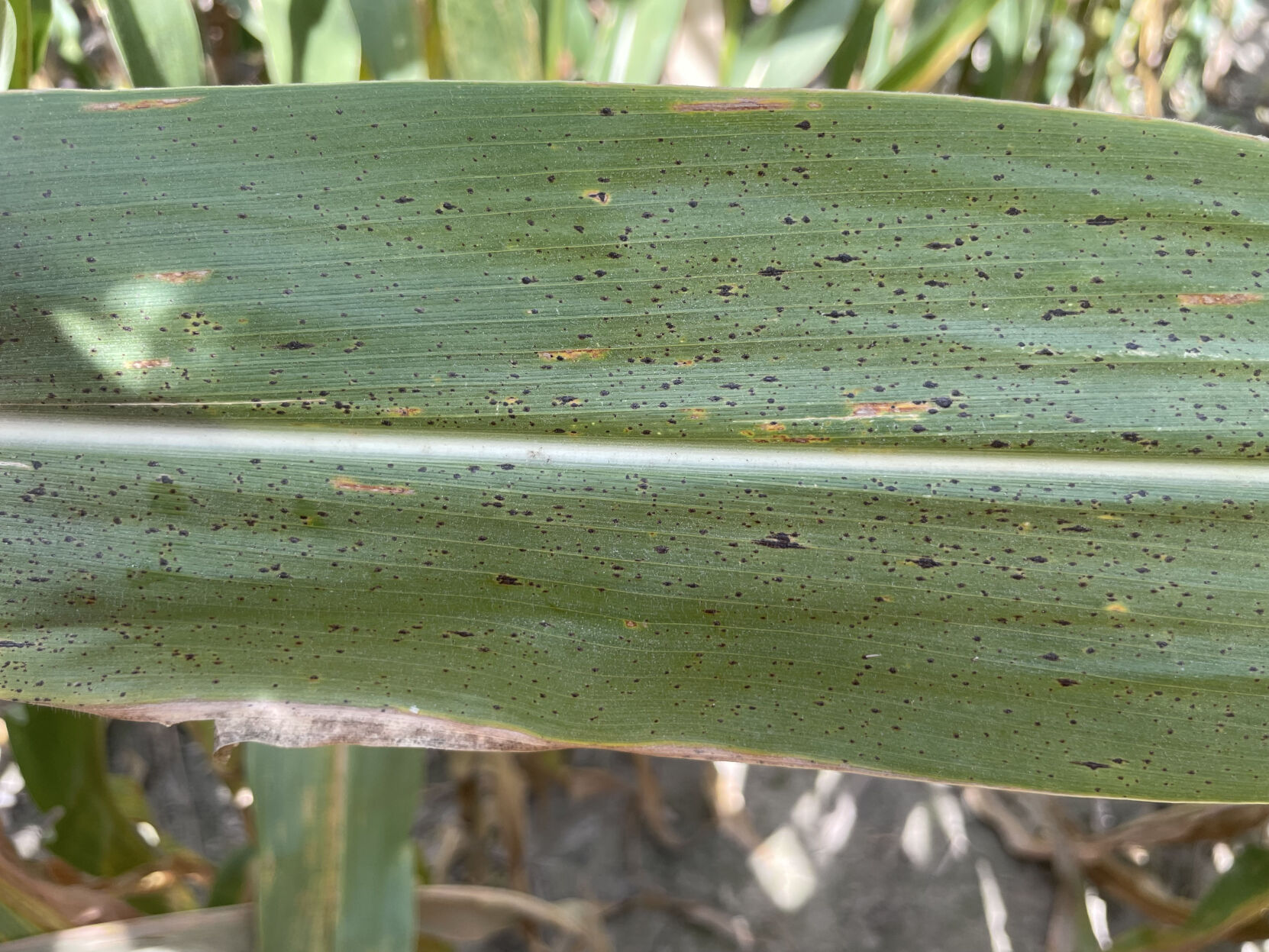
Tar spot produces distinctive, black, raised lesions on corn leaves — sometimes round or elliptical — that resemble flecks of tar. In susceptible hybrids, Onofre said the disease “can be a threat” and, in a bad year, can strip as much as 56 bushels per acre from yield.
“This is a tough year in terms of grain price,” Onofre said, “but we still need to actively monitor what’s in our field.”
Onofre urged growers to scout fields weekly and understand the disease ratings of the hybrids they plant.
“Just know what you’re planting (and) understand what type of hybrids you’re growing, especially for tar spot and southern rust,” he said. “Just don’t assume that you’ve got a tolerant hybrid. Keep monitoring weekly so that you can see the progression of the disease and make sure that we’re hitting the right time” for treatment.
The history of disease in a field is another key risk factor, according to Onofre. Tar spot, along with gray leaf spot and bacterial leaf streak, can survive in crop residue, increasing the odds of problems where these diseases have appeared before.
“Especially for tar spot, if you had it in the previous years, you should be keeping a close look at those fields specifically,” Onofre said.
Foliar fungicides remain an important tool, but Onofre cautioned that their timing is critical. For tar spot, he said, research indicates the first fungicide application should be considered between the V10 and VT/R1 growth stages, with a potential second application between R1 and R3 if disease pressure remains high.
“It’s going to be really hard (for a fungicide application) to pay off if it’s applied before V10 or after R3,” he said.
Many products on the market are rated good to excellent not only for tar spot, but also for gray leaf spot and southern rust, Onofre said, so choosing a fungicide that covers multiple diseases can improve the odds of an economic return.
While tar spot is an immediate concern, Onofre noted that Kansas producers must also prepare for southern rust, which typically moves north into the state from Arkansas, Oklahoma and Missouri later in the summer. Unlike tar spot, southern rust prefers hot and humid weather, generally when temperatures top 80 degrees Fahrenheit.
To help track tar spot and other diseases, K-State and industry partners have launched the Kansas Corn Disease Network, a collaboration between Kansas Corn, the K-State Department of Plant Pathology, extension agents, crop consultants and Corteva. The network currently is monitoring 35 counties and providing timely updates to producers.
“With the weather conditions, crop development and disease movement, things can change quite rapidly,” Onofre said. “So having this network and awareness is extremely important for our producers.”
More information also is available at local K-State Extension offices in Kansas.
PHOTO: Tar spot on corn. (Photo by Mandy Bish)