Simple advocacy explained during Stockmanship & Stewardship event
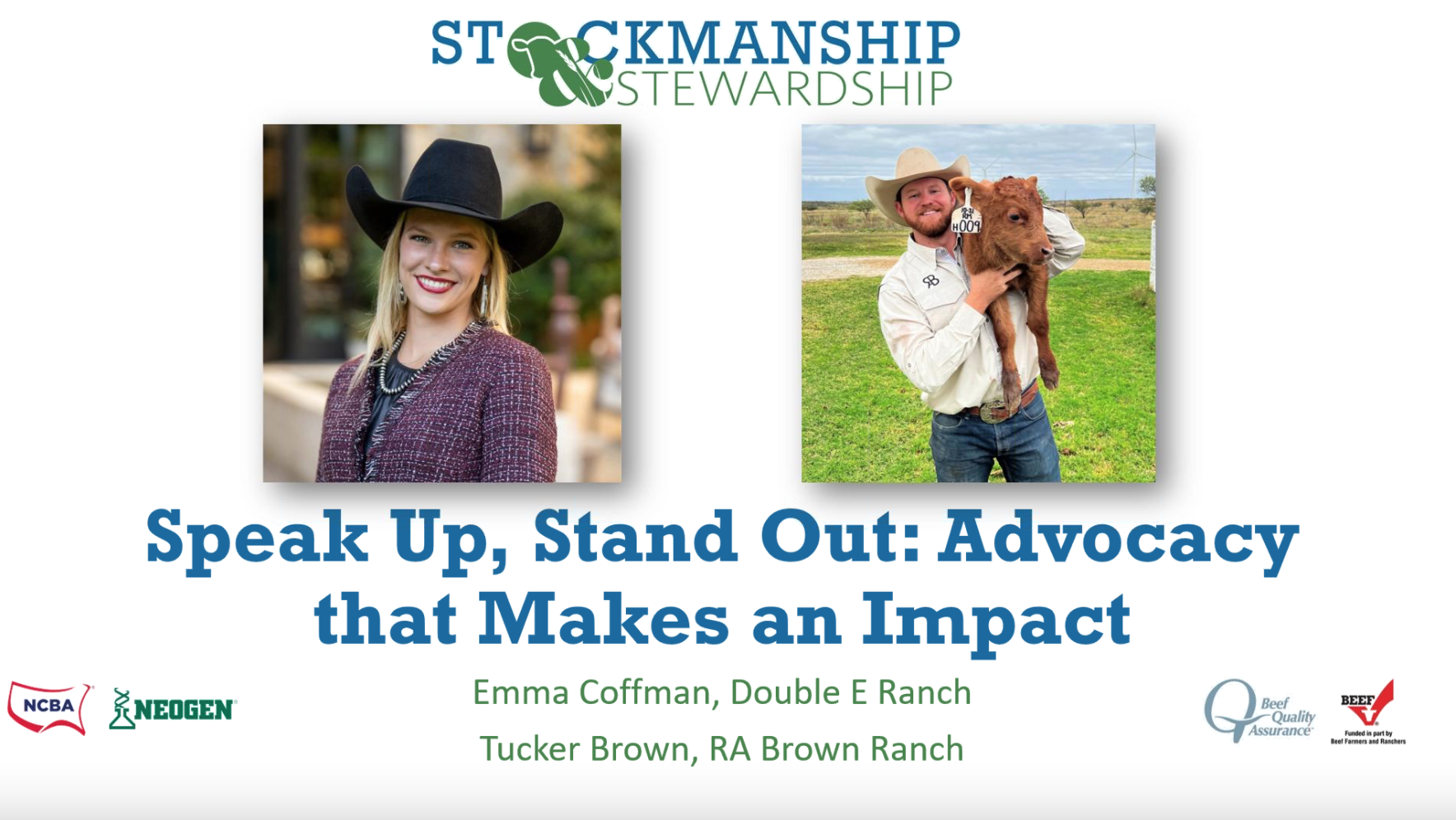
Emma Coffman of Double E Ranch and Tucker Brown of RA Brown Ranch discussed their secrets on how beef producers can best share their story during a virtual segment of Stockmanship and Stewardship Nov. 19.
Titled Speak Up and Stand Out: Advocacy That Makes an Impact, the pair described how a simple start in talking about agriculture on social media has turned into much more. Brown, the family storyteller, said his first experience with video was about working as the sixth generation on the family ranch in north Texas.
“From the top of our heads, it seems like social media is a bad thing, but what Emma and I love to share about is how we do use it for good, and the reason why we think it’s important to be an advocate for agriculture,” he said. “We use social media and other ways to share that.”
He blends entertainment and education by just sharing what he does on the ranch every day.
“And from that, I saw a lot of trust being built, which was really not my intention at first. At first, it was just to help me sell more registered bulls,” Brown said. “But what ended up happening was there were more consumers watching my stuff than bull customers, and so this trust was being built between consumers and myself and other ranchers.”
Coffman experienced a much different childhood than Brown’s as no one in her family was directly involved with agriculture.
“I’m a first-generation agriculturalist, meaning that my family was not originally in agriculture,” she said. “And so, the reason that I got into the advocacy space was when I started getting an interest in the ag through 4-H and FFA, I had a lot of questions.”
Lessons first hand
As her education progressed, she realized a lot of things in agriculture weren’t cut and dry.
“I realized there were a lot of, I thought, was very simple, basic, one on one, information about how our food is grown and the labeling behind it that we weren’t talking about to consumers,” she said. “My parents had no idea, and therefore I didn’t know what questions to ask.”
Her motto behind Double E is bridging the gap between urban and rural communities, and it helps she’s more a “numbers” person and can back her statements with data and facts.
“My content is targeted, not just toward consumers, but also educating producers,” she said.
She works to help educate consumers by showing them the faces of who’s growing their food, why they’re growing it the way they do as well as providing an avenue for producers to gain technology and resourcesand education to hopefully become more sustainable and profitable.
On the same page
Despite them coming from differing backgrounds, Brown believes they’re sharing the same story.
“And we’ve seen this—in agriculture—if we don’t tell our story, someone else will, and they’re not telling it right,” he said. “We’ve seen that over and over again, whether it’s a certain party that’s trying to tell our story, or a different company or a federal agency that’s speaking for us, and even though we know it’s not true.”
Brown said there is a large gap between producers and consumers who maybe two or three generations removed from production agriculture. When consumers ask questions, sometimes it’s hard not to feel like it’s an attack.
“They’re asking about the things that they hear from whoever is telling our story, whether that’s on news or on another social media platform,” he said.
They will ask about animal welfare, if they used hormones and the difference between a bull and a steer.
Producers feel attacked and often try to defend themselves. Brown said this is the perfect time to speak up, and rather than resorting to name calling; it allows producers to be the ones answering the questions.
“Our consumers are more interested in learning about their food than ever in my lifetime,” Brown said. “We want to be the ones to answer the questions.”
Coffman said many consumers get their information about beef online, but not all information is accurate or correct. Some of the loudest voices do not support animal agriculture.
Consumers are willing to pay more for quality food that is labeled and locally sourced, she said.
“Just because you may not be in a production standpoint with dirt on your hands or mud on your boots, doesn’t mean you can’t advocate for the industry,” she said. “My background has been predominantly in the livestock and cattle industry, and I’ve been in different sections of the industry, which allows me the chance to give a full circle picture of why and how each section of the industry relates to each other.”
Speak with authority
Coffman said to stick with what you know and share accordingly.
“Neither Tucker and I can be an expert in everything, and I don’t think either one of us claim to be, but we heavily rely on other people and specialists in the industry to help tell the story,” she said. “The big thing is trying to get consumers to see us, and if you’re not from agriculture, like me. I had to learn all the terminology. I had to learn how the industry worked together.”
Building a baseline
It’s about taking complex subjects and bringing them down to a baseline level, Coffman said, and build advocacy from that.
“And don’t be afraid to repeat yourself,” she said. “Tucker and I both try to take very intensely complex subjects and simple it down for the everyday consumer to understand.”
Despite how Brown or Coffman approach subjects, there’s more than one way to succeed, according to Brown.
“But as far as agriculture, really, all you have to share is the what and why,” he said. “A lot of times we will tell them what, but we forget to tell the why. That’s where our consumer is really curious about.”
Consumers want to hear the why from producers, and by using his phone to make videos he can do just that. He doesn’t spend much time editing and wants them to not sound overdone and to be relatable.
It can be as simple as feeding cattle in the winter, explaining why one would drop hay off for the cows. And the why would be because of the dormant grass. Brown said he can explain nutrition and care the animals receive.
“But there’s lots of times where we forget just how cool it is what we do, because we do it every day,” Brown said. “We forget how cool it is what we do that our viewers are wanting to hear from us and then use your personality. People will connect to the human well before they connect to the information that you’re sharing.”
It does matter
Brown said it doesn’t matter what you say, but it matters how much you care and how viewers start to connect with you and the information you’re sharing.
“I enjoy trying to put a story behind the skit, but you don’t have to do any of that,” he said. “If you enjoy it, that’s a road you can go down.”
Brown encouraged listeners to consistently post.
Some people after a couple weeks will decide they don’t have enough time and that’s OK. If after six months they don’t have the engagement they seek or enjoy doing it then it might not be meant for them to do.
Brown said as an advocate for the industry it also adds a monetary value for his family. His wife has been able to stay at home with their three girls and step away from teaching.
Coffman agrees about value it provides.
“Don’t chase the views, because you will see other accounts just slowly lose their grip on their authenticity, trying to chase trend and clout,” she said. “I would definitely recommend just be authentic to yourself. People are craving authenticity now more with the presence of social media.”
Brown said it matters to share and be an advocate for the beef industry. Consumers are buying more beef and have talked about in surveys how vital trust is with those producers raising their food.
Producers shouldn’t be scared of saying something wrong or in a certain way, because when they share the truth, ranching wins, according to Brown.
“You don’t have to come up with a story,” he said. “All you have to do is tell the truth.”
Coffman said there’s many resources to take advantage of, and she’s happy she did.
“I will say that getting involved in the advocacy on social platforms has connected me to people across the globe in ways that I never would have had before,” she said. “There’s a lot of people within the country, but also on an international spectrum that I’ve learned a lot from.”
Brown even connected her with people in Ireland, who in turn were able to connect her with more people when she visited.
“We always say that the ag industry is a very small world, and it gets smaller every day, but the social media adds to that,” she said. “And just because they may not be commenting in the comment section doesn’t mean that people aren’t watching.”
Coffman only has one thing she wishes she’d done differently.
“Just looking back. I wish I had started this sooner than I did, and it’s been a wild journey, but it’s been absolute blessing,” she said.
Kylene Scott can be reached at 620-227-1804 or [email protected].