Snow in Sierra Nevada but wildfires in Plains
Stormy, briefly colder weather in California and elsewhere in the West helped to improve previously meager mountain snowpack, with an average of approximately 6 inches of snow-water equivalency being added to the Sierra Nevada.
However, 4- to 8-foot snowfall totals in the Sierra Nevada also led to travel disruptions through mountain passes and contributed to the nation’s deadliest avalanche—northwest of Lake Tahoe—in 45 years. Meanwhile, the nation’s mid-section faced several days with record-setting warmth and gusty winds. Portions of the central and southern High Plains endured a rash of wildfires, starting on Feb. 17, with the largest—the Ranger Road Fire—quickly consuming more than 280,000 acres of cured vegetation in northwestern Oklahoma and southwestern Kansas.
Initial reports indicated that there were also livestock losses and property destruction. In contrast, several rounds of storminess affected the eastern U.S., culminating in a late-winter blizzard along the middle and northern Atlantic Coast on Feb. 22 to 23.
The winter storm deposited more than a foot of snow in major East Coast cities from Philadelphia to Boston, with a single-storm record of 37.9 inches measured in Providence, Rhode Island. Earlier, an early-season outbreak of severe weather occurred on Feb. 19, when as many as a dozen tornadoes were reported in Illinois and Indiana.
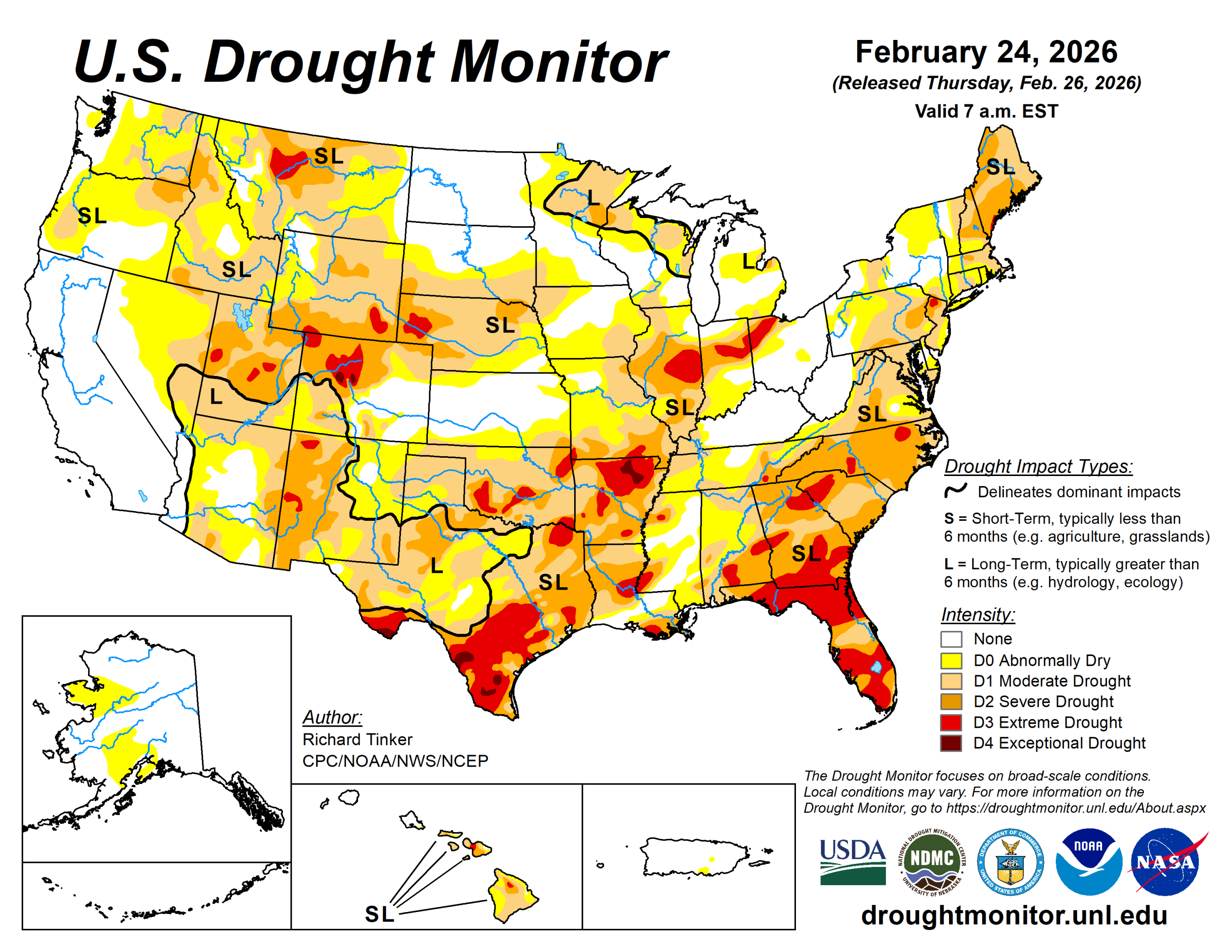
The U.S. Drought Monitor is jointly produced by the National Drought Mitigation Center at the University of Nebraska-Lincoln, the U.S. Department of Agriculture and the National Oceanic Atmospheric Administration. (Map courtesy of NDMC.)
South
The southern High Plains endured a historic day of wind and wildfires on Feb. 17, when the Ranger Road Fire was ignited in Beaver County, Oklahoma.
The Ranger Road Fire soon scorched more than 280,000 acres of grass and brush, expanding into northwestern Harper County, Oklahoma, and parts of three counties in southwestern Kansas. Meanwhile, the Lavender Fire burned more than 18,000 acres northeast of Vega, Texas, and reportedly destroyed at least 18 structures. On Feb. 17, the day of ignition, peak gusts included 73 miles per hour in Lubbock, Texas, and 67 mph in Guymon, Oklahoma.
Due to deteriorating conditions and diminishing topsoil moisture reserves, moderate drought was broadly introduced across northern and western Oklahoma and the northern panhandle of Texas.
Farther east, gradually worsening drought conditions were also observed from the western Gulf Coast region to the Mississippi Delta, with several new areas of extreme drought being introduced and others being expanded. Coverage of exceptional drought increased slightly in southern Texas.
Midwest
Continuing a recent theme, improving drought conditions in the vicinity of the Great Lakes contrasted with ongoing drought farther south and west. Notably, patchy extreme drought persisted from southern Missouri into northwestern Ohio.
Some locations in the lower Ohio Valley and neighboring areas may soon complete their driest meteorological winter (December-February period) on record. From December 1 – February 24, precipitation in Paducah, Kentucky, totaled 3.21 inches, just 28% of normal. Even lower season-to-date totals were observed in Springfield, Missouri at 3.13 inches; Poplar Bluff, Missouri (2.44 inches); Joplin, Missouri (2.16 inches); Gape Girardeau, Missouri (2.09 inches); and West Plains, Missouri (1.75 inches).
High Plains
Gradual drought deterioration was noted in several areas, except North Dakota, which remains free of drought.
In Nebraska, a mostly dry, windy winter has adversely affected winter wheat, which at the end of January was rated just 24% in good to excellent condition—down from 54% in late-November 2025. Snowfall that blanketed parts of Nebraska on Feb. 19 provided only temporary relief from overall dryness.
Farther south, parts of Kansas and Colorado contended with high winds, grassfires, and blowing dust, especially on Feb. 17. On that date, wind gusts in Colorado were clocked to 79 mph in Colorado Springs, 72 mph in Burlington, and 71 mph in Pueblo. South of Pueblo, on I-25, chain reaction collisions due to low visibility in blowing dust resulted in five fatalities and involved approximately three dozen vehicles.
West
There were few overall changes in the West, as most of the heavy precipitation fell in areas—such as northern and central California—currently experiencing no drought.
Farther inland, brief bursts of precipitation in drought-affected areas prevented worsening conditions, but provided little overall relief. In Utah’s Wasatch Range, Alta received 31.2 inches of snow in a 24-hour period on Feb. 17 to 18, but will likely end the month with below-average snowfall.
Below-average snow-water equivalency remains a concern in much of the West, even in drought-free areas such as the Sierra Nevada. According to the California Department of Water Resources, the Sierra Nevada snowpack contained an average snow-water equivalency of 16 inches—up about 6 inches from earlier in the month, but less than three-quarters of normal for late February. In much of Arizona, New Mexico and Oregon, snow-water equivalency values were less than 50% of normal.
Looking ahead
Fast-moving, loosely organized disturbances will traverse the country during the next five days. Dry weather will prevail during the next five days in the nation’s southwestern quadrant, from southern California to the central and southern High Plains.
Record-setting warmth will accompany the dry weather, with temperatures routinely topping 90 degrees Fahrenheit in southern Texas and the Desert Southwest. Farther north, a new plume of Pacific moisture will arrive on Saturday across southern Oregon and northern California. That moisture will race eastward, sparking wintry precipitation by Sunday and Monday from the central Plains into the mid-Atlantic, including the Ohio Valley and neighboring regions.
The National Weather Service’s 6- to 10-day outlook for March 3 to 7 calls for the likelihood of warmer-than-normal weather nationwide, except for near- or below-normal temperatures in parts of New York and much of New England. Meanwhile, near- or above-normal precipitation across most of the country should contrast with drier-than-normal conditions in coastal North Carolina and portions of the Far West, including California and the western Great Basin.
Richard Tinker is with the National Oceanic Atmospheric Administration, National Weather Service, National Centers for Environmental Prediction, and Climate Prediction Center.