
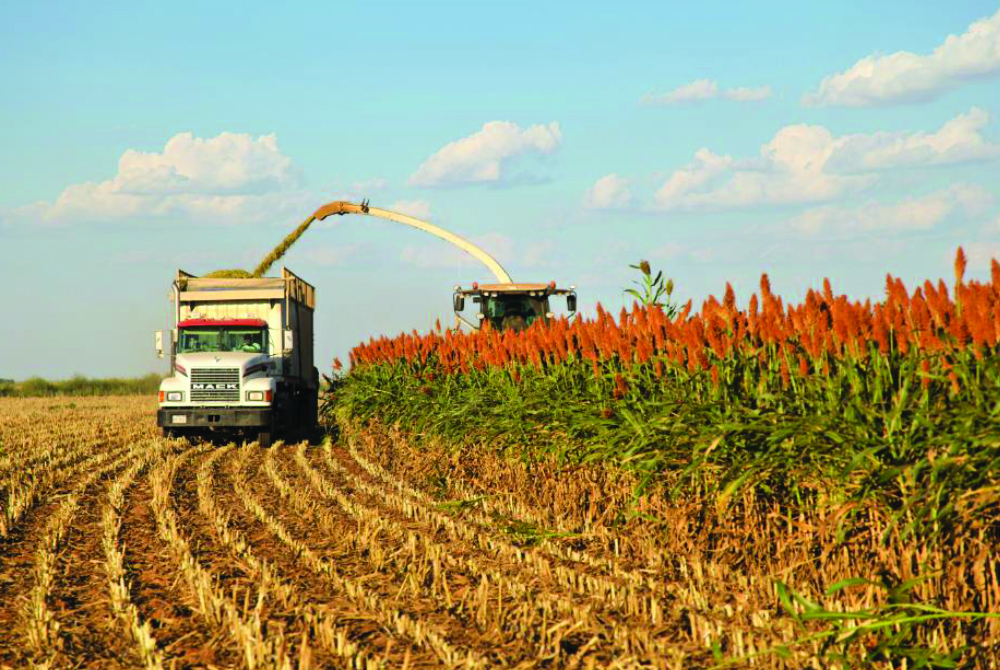
Decreasing availability of irrigation water in the southern High Plains and western United States has led dairies and feedyards to increasingly look to sorghum to meet their silage needs.
Silage sorghum hybrids have come a long way since I first started conducting variety trials in 1999. Back then, we were just starting to introduce brown mid-rib hybrids to the market, and brachytic hybrids were still several years away.
Something we have learned over the years is that, unlike corn, sorghum hybrids for silage can differ greatly from one another. When choosing a hybrid, consider the intended use and water availability.
The first question to consider is the quality of the silage needed for its intended use. For a feedyard where the silage portion of the ration may be minimal, quality may be secondary to its value simply as a roughage. In this case, choosing a hybrid that produces a high yield at the best cost may be what is most important. For nonlactating dairy cows, an intermediate-quality silage may be adequate, while milk-producing cows require high-quality silage.
In assessing quality, nutritionists all have their favorite forage analysis measurement that they utilize in forming a ration. These are usually based on their experience with corn. Increasingly, we are finding that what works with corn does not necessarily work with sorghum.
If we go back to the basics, simply examining neutral detergent fiber may be as good as any factor in predicting the digestibility of the sorghum fiber. Percent starch of the hybrid will greatly influence NDF as well as the total energy value of the silage. In the past, nutritionists tended to largely discount the starch component of silage sorghum because much of the grain kernels tended to pass through the cows without being digested.
With the new sorghum kernel processors being used, that is no longer the case. When these processors are properly set, and the silage sorghum is harvested at the correct stage (late soft-dough), starch will be utilized by the cows. Research conducted by Juan Pineiro, with Texas
A&M AgriLife, has shown that, following 90 days of ensiling, in-situ seven-hour starch digestibility increased from 26 to 66%, which is only 12% below the 75% average reported for corn. Research has also shown that hybrids with larger kernels are easier to process and effectively increase starch availability in the rumen.
In choosing a silage sorghum hybrid, considering the amount of irrigation water that is available is critical. If water is limited, medium-late and late-maturing hybrids should be avoided. Although these hybrids typically produce higher yields, they can easily require as much as 5 inches more water prior to harvest.
In summary, in choosing a silage sorghum hybrid, consider the quality of the forage needed. Quality can most readily be assessed by considering percent NDF and starch of the forage. In addition, choose a hybrid with a large kernel size when possible. Finally, choose early- to medium-maturity hybrids when water is limited.
Editor’s note: Brent Bean is the director of agronomy for the United Sorghum Checkoff Program.



