Wheat tour confirms dismal expectations
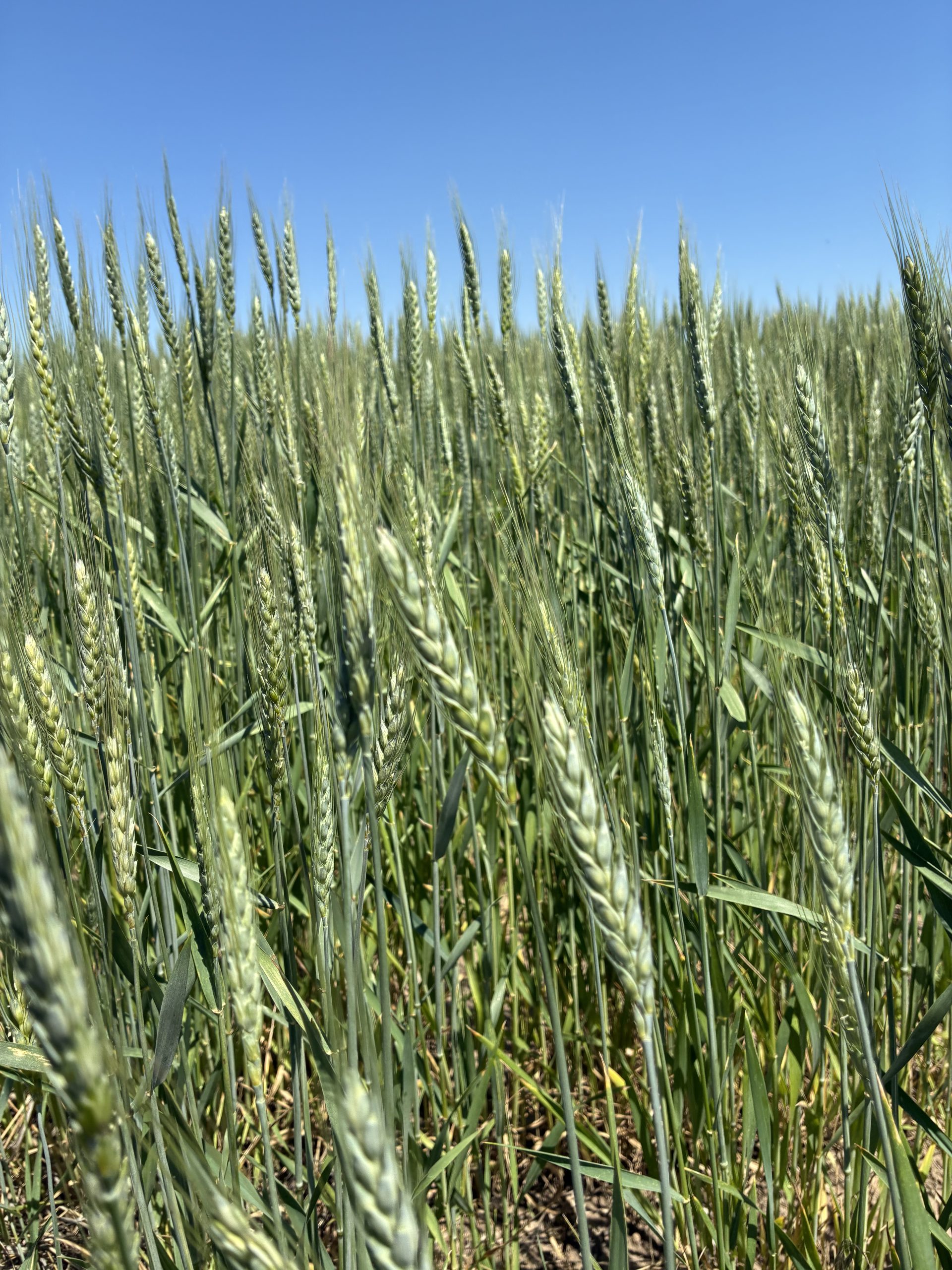
Harvest expectations for 2026 were low, and the recent Wheat Quality Council Tour confirmed those findings.
Aaron Harries, vice president of research and operations at Manhattan-based Kansas Wheat, said it is going to be a well-below-average crop in the Sunflower State as tour-goers projected a composite of 218 million bushels, which was about 130 million bushels less than in 2025. The five-year average is about 315 million to 320 million bushels.
“We had a poor crop in 2023,” he said. “This year is not as bad, but unfortunately it is pretty close.”
The common theme is drought across the state and extreme weather, Harries said.
“There was freeze damage all across the state.”
Growers had several freeze events, he said. One was in late March when single-digit temperatures killed many of the fall tillers. The plant responded by sending up secondary tillers, and unfortunately there was little follow-up moisture. When a late-spring freeze occurred, growers could see scattered sterile white heads throughout the field.
“It was a double-whammy with the freezes and drought, so it is no wonder we are where we are at,” Harries said.
He did see some decent wheat along the Interstate 135 corridor from Wichita to Salina. He considered that wheat an average crop, and with few exceptions outside of that region it was below average.
Any wheat that was under fallow conditions was better and, conversely, any double-crop wheat looked bad, which makes sense based on growing conditions, Harries said.
Sometimes growers can get a premium from millers with a higher protein, but there are variables this year that will make it more difficult. If timely moisture occurs, that raises potential, but if hot and windy weather prevails it makes it tougher on the plant, he said.
“If it is dry and 95 and windy, we’ll have sunken kernels, and that is unfortunate,” Harries said. “We’ll have to see how the genetics play out.”
Even if the kernels are smaller, they can still fill, he said. There is good news because there is carry-over stock, so millers can meet customer needs with blending.
Crop insurance adjusters have been busy, Harries said. Sometimes they will take a second look and the wheat is not harvestable because it is too short.
The concern is seed availability for fall planting, he said. Farmers may have saved their own seed, but growers wanting to buy new certified seed should not wait too long.
“Let your dealer know what you are thinking. They are resourceful and they can track things down. There will be a short supply on the varieties you might want.”
Wheat streak mosaic pressure in western Kansas remains a concern, Harries said. Kansas State University Extension agronomists are worried because it can cause insult to injury and put more pressure on plants.
The overall story shows little upside for the Kansas wheat crop, he said.
“Let’s bring it to an end, get out of the field and move on.”
For now, growers also need favorable weather, and there is optimism that an El Niño will change the pattern, which could mean more moisture, particularly from fall to spring, which would be what the doctor ordered for a 2027 wheat crop.
The May 10 crop condition report showed grim news: 51 percent of Kansas wheat was poor or very poor; 76 percent of Nebraska wheat was poor or very poor; 51 percent of Oklahoma wheat was poor or very poor; 60 percent of Texas wheat was poor or very poor; and 52 percent of Colorado wheat was poor or very poor.
The three-day average yield for the tour fields were calculated at 38.9 bushels per acre, according to Kansas Wheat. An estimated 7 million acres of wheat were planted in the fall, and the U.S. Department of Agriculture’s National Agricultural Statistics Service estimated 5.8 million acres will be harvested this summer.
Texas
Steelee Fischbacher, executive director of Amarillo-based Texas Wheat, said producers expected a tough year.
“Our wheat crop has seen very challenging conditions this year. USDA earlier estimated 47 million bushels, which is slightly over half our production,” she said.
Historically, the Lone Star State raises about 85 million bushels.
During a recent field day, discussions included other production challenges, she said. In the Panhandle there are concerns about the wheat streak mosaic complex, farther east in the Blacklands, the story was about freeze damage and in other areas Hessian fly and rust pressures.
“The larger story is drought and then they were hit with the other stressors,” Fischbacher said.
In the Panhandle, silage harvest will be limited, too. If those growers had water availability they will have “decent production.”
“We have seen significant acres being used for grazing,” Fischbacher said. “We are going to run a lot of our crop through ruminant animals.”
Meanwhile, producers are checking on and asking questions about insurance, she said. She expects many adjustments in the Panhandle as wheat is being sampled for diseases because that information is needed.
Producers are also talking about the possibility of a change in weather patterns to an El Niño, which could mean more favorable conditions for planting wheat in the fall.
“We’ll hopefully be in better shape then,” Fischbacher said. “Our spring crops and rangeland are also waiting on more moisture.”
Colorado
Brad Erker, executive director at Fort Collins-based Colorado Wheat, said the USDA’s estimate of 33.6 million bushels would be a historic low for the Rocky Mountain state.
“I was pretty shocked,” Erker said. “It was a terrible crop in 2022 at 36 million bushels.”
He said it is not a given the 2026 crop will hit the low point, but when he visited with growers and saw estimates it was hard to disagree.
“I know the 2022 crop went down to 35.7 million bushels, which was the lowest since 1965. If we go below 33 that goes down farther,” Erker said May 14. “It is a multigenerational bad crop. The moisture does not look good the next 10 days. We don’t have a general 1- to 2-inch rain in the forecast. It is just a bad stretch.”
There are pockets of what he called decent wheat north of Interstate 70, including Arapahoe County.
Yuma County in the northeast to Holyoke in Phillips County shows some decent potential, although fields are scattered, Erker said.
“There are a lot of unknowns because of the late freeze.”
A significant freeze occurred in late April.
“There are fields that were getting wiped out. No heads were there. There might have been yields of 30 bushels per acre before that,” he said.
As far as growers receiving a protein premium, that is also an unknown because of the need for decent test weights and rain that has yet to arrive, he said.
“Right now, it is a short crop, and they don’t want to cut too low to the ground so they can preserve residue,” he said.
The story of the Colorado wheat crop in 2026 is about the perfect storm of challenges.
“We keep saying wheat has nine lives, but now we’re on the 10th and 11th life,” Erker said. “There is a lot of abandonment. Insurance will come in eventually to help them.”
A Kiowa County farmer told him he abandoned 90 percent of his wheat crop.
Producers for now are weighing limited options for the remainder of the year. They might consider adding sorghum or dryland corn, but if they feel they have any potential to capture wheat bushels they might do so because the price has gone up. It will be a matter of how long they can hold onto that risk-versus-reward scenario.
Usually in mid-May, producers know it is a critical time as harvest is traditionally about six to seven weeks away and some late-spring rains can boost the crop.
“It is hard for them to be optimistic,” Erker said. “They are resigned to it. Crop insurance will be their backstop. We’ll see. It is still hard for me to believe it could be only a 33-million-bushel crop.”
It is also unfortunate the crop had good moisture to have “great stand establishment in the fall for the first time since 2019,” and growers felt good about the potential only to be disappointed with no meaningful moisture throughout the remaining growing season.
During the tour, Dennis Schoenhals from Oklahoma Wheat Growers Association reported that USDA-NASS estimated the state’s production at 64.4 million bushels this year, according to Kansas Wheat. USDA-NASS estimates the Oklahoma crop will yield 23 bushels per acre, compared to 39 last year. Harvested acres are estimated at 2.3 million acres.
Dave Bergmeier can be reached at 620-227-1822 or [email protected].