Kansas Soybean honors Schapaugh for decades of service
The Kansas Soybean Commission recognized William Schapaugh for 47 years of service in soybean research, presenting him with its Pinnacle Award at the annual Kansas Soybean Celebration.
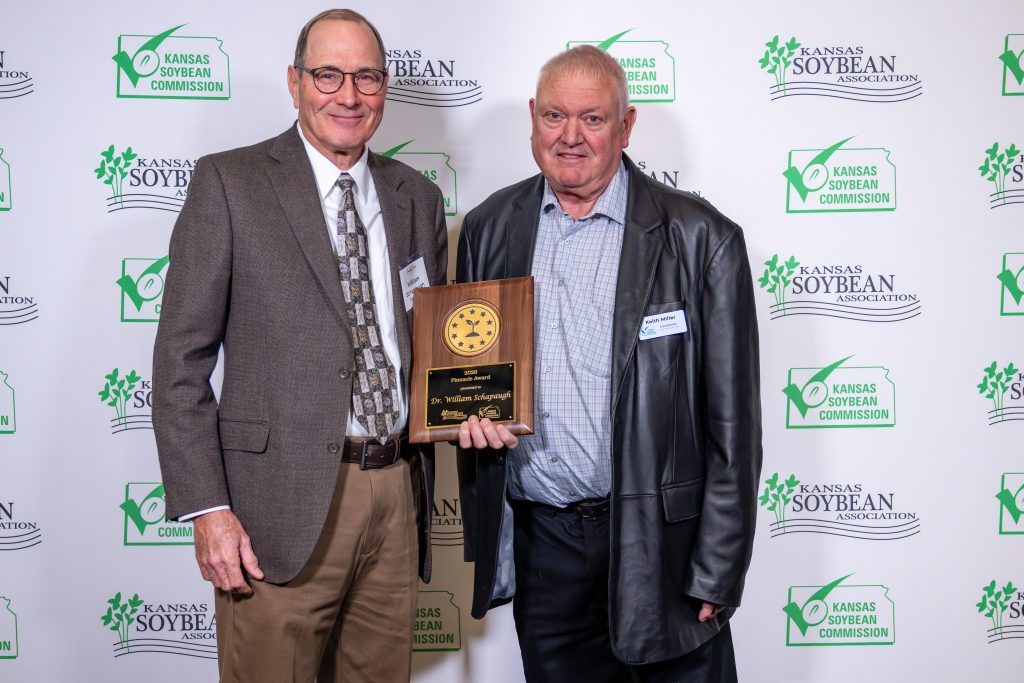
Kansas Soybean Commission Chairman Keith Miller present William Schapaugh with the Pinnacle award. (Courtesy photo.)
Schapaugh, Kansas State University’s first soybean breeder, began his career in 1979 as soybean production expanded across the state. Over the decades, he worked closely with the commission on checkoff-funded research aimed at improving soybean genetics and production.
“I just loved to work on soybeans,” Schapaugh said, recalling the early years of his career. “Soybean farming in Kansas was growing exponentially.”
Schapaugh’s career spans significant changes in plant breeding. Early work relied on manual processes and limited computing resources. Researchers could grow one population per year, with selection based largely on visual assessment and yield.
Advances in technology have since changed that process. Today, breeding programs use drones to monitor crop development, molecular markers to track genetic traits and winter nurseries to accelerate breeding cycles.
“Over time, the core goal has not changed: to develop soybean varieties and germplasm that perform well in production or are useful for breeding and research,” Schapaugh said.
During his tenure, Schapaugh contributed to the development of public soybean varieties adopted by farmers and used by other breeding programs. He also emphasized the importance of collaboration among public researchers, noting that varieties are routinely tested across state lines.
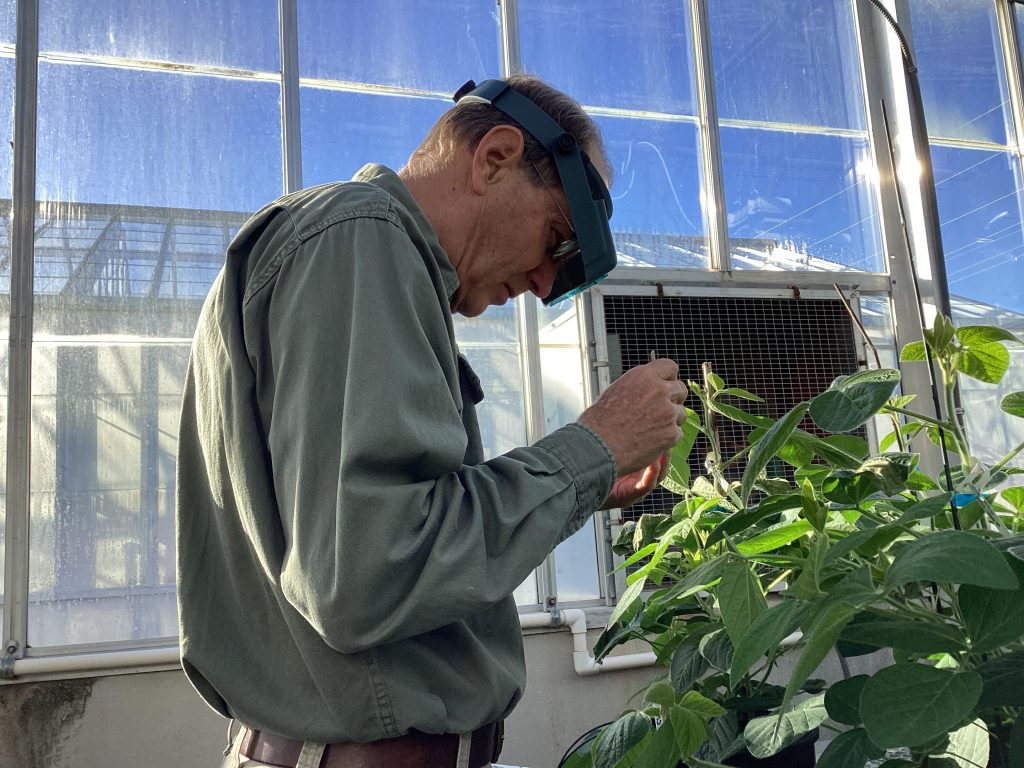
William Schapaugh examines a soybean plant in a Kansas State University greenhouse. (Courtesy photo.)
Schapaugh said public breeding programs play a distinct role compared to private efforts, focusing on regional adaptation, long-term challenges and traits that may not provide immediate returns.
“For farmers, that means continued innovation in areas that might otherwise be neglected,” he said.
Disease resistance and environmental stress tolerance have been ongoing priorities. Early in his career, Phytophthora root rot posed a major challenge. More recently, research has focused on soybean cyst nematode, sudden death syndrome, and improving tolerance to heat and drought.
Schapaugh said future progress in soybean breeding will likely rely more on predictive tools and environmental data to address specific growing conditions.
“Plant breeding is a long-term investment,” he said. “Decisions made today affect what farmers can plant a decade from now.”
The Kansas Soybean Commission said the Pinnacle Award is its highest honor, recognizing individuals who have made significant contributions to the state’s soybean industry.