Each spring, as Kansas landscapes begin to green up and temperatures rise, large, broad-winged birds can be seen circling overhead.
While the turkey vulture can pose a nuisance at times, one Kansas State University specialist wants people to consider the benefits of these birds as they enter their northward migration.
Drew Ricketts, a wildlife specialist with K-State Extension, said turkey vultures started their migration through the state in mid-March. On this path, some birds will remain within the state, while others will continue their path north.
“We’ll gradually see more and more of these turkey vultures move through,” Ricketts said. “Some of them will stick, and some will move on through the next month or two.”
Environmental benefits
While often associated with nuisance concerns, turkey vultures play important roles in ecological landscapes.
“They’re scavengers, they’re not predatory, and get almost all their calories from animals that are already deceased,” Ricketts said.
Research estimates that turkey vultures provide significant economic value through these ecological services, particularly in livestock systems.
“Based on these estimates, turkey vultures provide about $760 million annually in ecological services just from removing livestock carcasses,” he said.
Ricketts said that even though the estimates are inexact, the impact remains substantial.
“Even if that number is off quite a bit, it could still be around $250 million a year in services,” Ricketts said.
Roosting challenges
Despite their benefits, turkey vultures can create issues when they gather in large groups, particularly in roosting areas.
“The main challenges are the large roosts that they form,” Ricketts said. “These roosts tend to be on large trees, cell phone towers, water towers (and other large structures).”
Large groups of vultures can lead to a significant amount of feces in roosting areas.
“When we get anywhere from 10 to more than 50 of these birds in one spot night after night, we can see large accumulations of feces,” he said.
Turkey vulture droppings contain uric acid, which can cause property damage.
“Their feces are acidic and can damage finishes on cars, boats or even structures like water towers,” Ricketts said.
In addition to property damage, roosts may create odor issues and potential health risks due to bacterial buildup.
Management options for landowners
Because turkey vultures are a protected species, management options are limited and typically involve non-lethal deterrents.
“We tend to use a multi-tiered approach,” Ricketts said. “We might hang a fake dead vulture, called an effigy, and pair that with pyrotechnics to scare them away.”
“The effigies by themselves don’t work very well, and the pyrotechnics alone don’t either, but together they can be effective,” Ricketts said.
If preventative measures do not work, Ricketts said landowners can take a more drastic measure.
“Cutting down a roost tree can be a more practical option for some situations,” he said.
As turkey vultures continue moving through Kansas this spring, Ricketts encourages producers and landowners to weight their potential benefits and impacts.
More information on managing wildlife is available at local K-State Extension offices in Kansas.
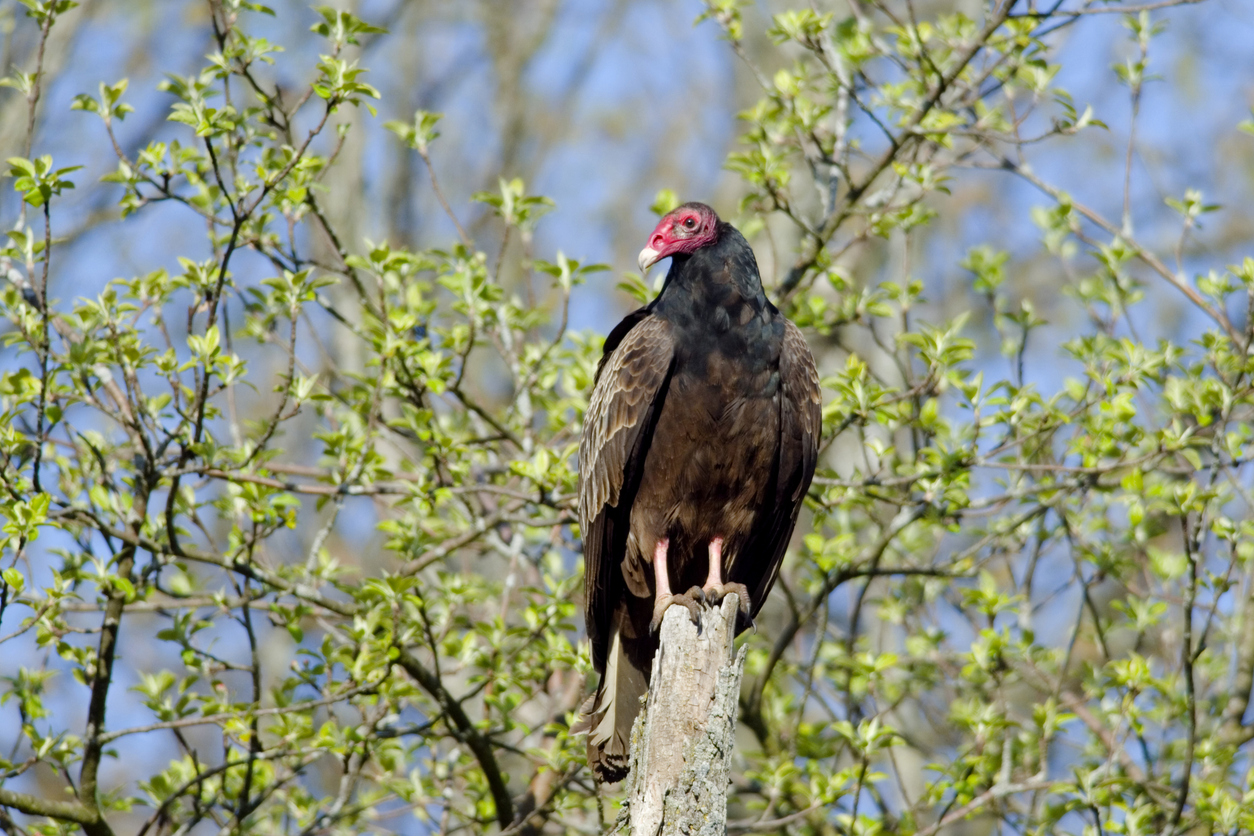
PHOTO: Turkey vulture. (iStock-#91047801 │ jeminijoseph)