Remember the days when you are horseback at calving time and you are looking for a calf or two that you know were born yesterday and you just want to lay your eyes on them again?
Along the way you find something, maybe another calf, maybe a hole in the fence or maybe a cow with a foot that needs to be treated. This story I am about to share is exactly like that. I thought it would be timely to talk about the dangers of the political party system. Just like the pasture ride, instead of finding what I am looking for I am led back to the same topic that I seem to focus on each week.
Private property ownership is being targeted by the global elites, in my opinion, and we must recognize that water, land and cows are the keys to our survival.
My go-to guy for all things from a “Founding Fathers” standpoint is President Martin Van Buren. It is most relevant because he was a Democrat and was then instrumental in the creation of the Free Soil Party. While it lasted less than two years, it led to the formation of the Republican Party. It turns out that he thought the good outweighed the bad in “party politics,” but the bad involved consolidation of banking and ultimately business ownership.
The late economist Milton Friedman always seems to be a good barometer for financial movements and particularly inflation and the value of money. Now we must ask the question what is money? Today we use the U.S. dollar and we are willing to take dollars in payment because we know someone else will want them. In addition to the fact that they are convenient.
Let me share something that Friedman said:
Anything can serve as money that habit or social convention and successful experience endow with the quality of general acceptability, and a variety of items have so served—from the wampum (beads made from shells) of American Indians, to cowries (brightly coloured shells) in India, to whales’ teeth among the Fijians, to tobacco among early colonists in North America, to large stone disks on the Pacific island of Yap, to cigarettes in post-World War II Germany and in prisons the world over. In fact, the wide use of cattle as money in primitive times survives in the word pecuniary, which comes from the Latin pecus, meaning cattle. The development of money has been marked by repeated innovations in the objects used as money.
OK, I need other references for pecus or cattle, so this is from Merriam-Webster:
Pecuniary first appeared in English in the early 16th century and comes from the Latin word pecunia, which means “money.” Both this root and Latin peculium, which means “private property,” are related to the Latin noun for cattle, pecus. Among Latin speakers (as among many other populations, past and present) cattle were viewed as a trading commodity, and property was often valued in terms of cattle.
Of the $60 trillion in the world, only $6 trillion of that sum is made up of material currency. Over 90% of all money exists only as electronic data on computer servers.
While my original goal was to stay from artificial intelligence data centers and land grabs that are currently coming along with their construction, I got pulled right back there. For those of us who own land and property such as cattle, potatoes, wheat or pork bellies, we possess true wealth. When paper and digital money have no value, people need what we have to survive. Let’s go one step farther and consider that our property is of no value unless we have water. Plenty of people are starting to talk about the notion that water may indeed be the next gold.
Editor’s note: The views expressed here are the author’s own and do not represent the view of High Plains Journal. Trent Loos is a sixth generation United States farmer, host of the daily radio show, Loos Tales, and founder of Faces of Agriculture, a non-profit organization putting the human element back into the production of agriculture. Get more information at www.LoosTales.com or email Trent at [email protected].
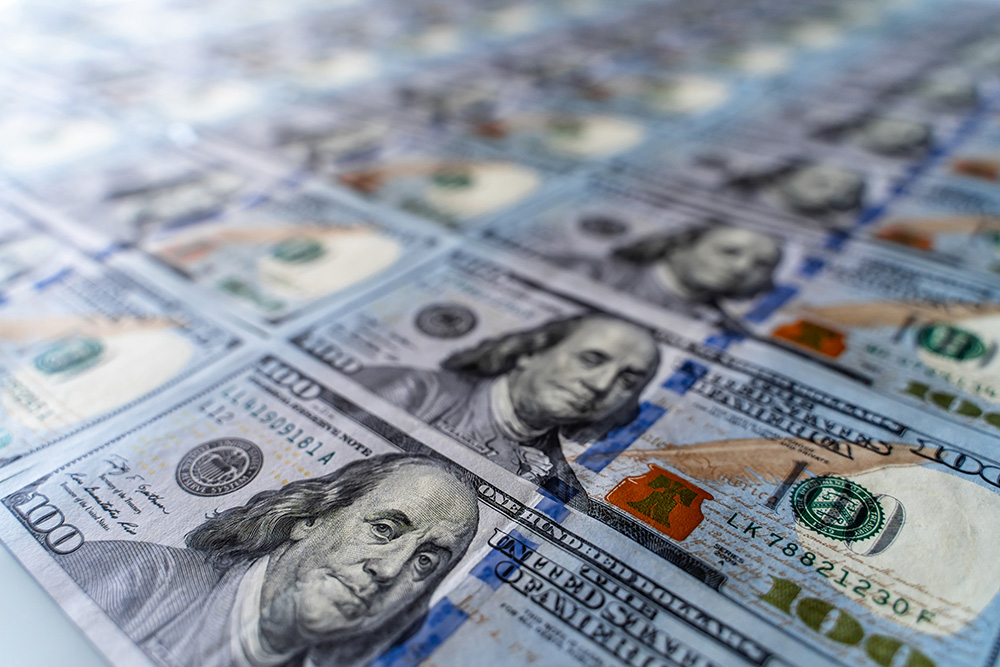
PHOTO: One hundred dollar bills. (Adobe Stock-#348572780 │ Vadim)