444 Engelke Ranch: Turning dreams into reality
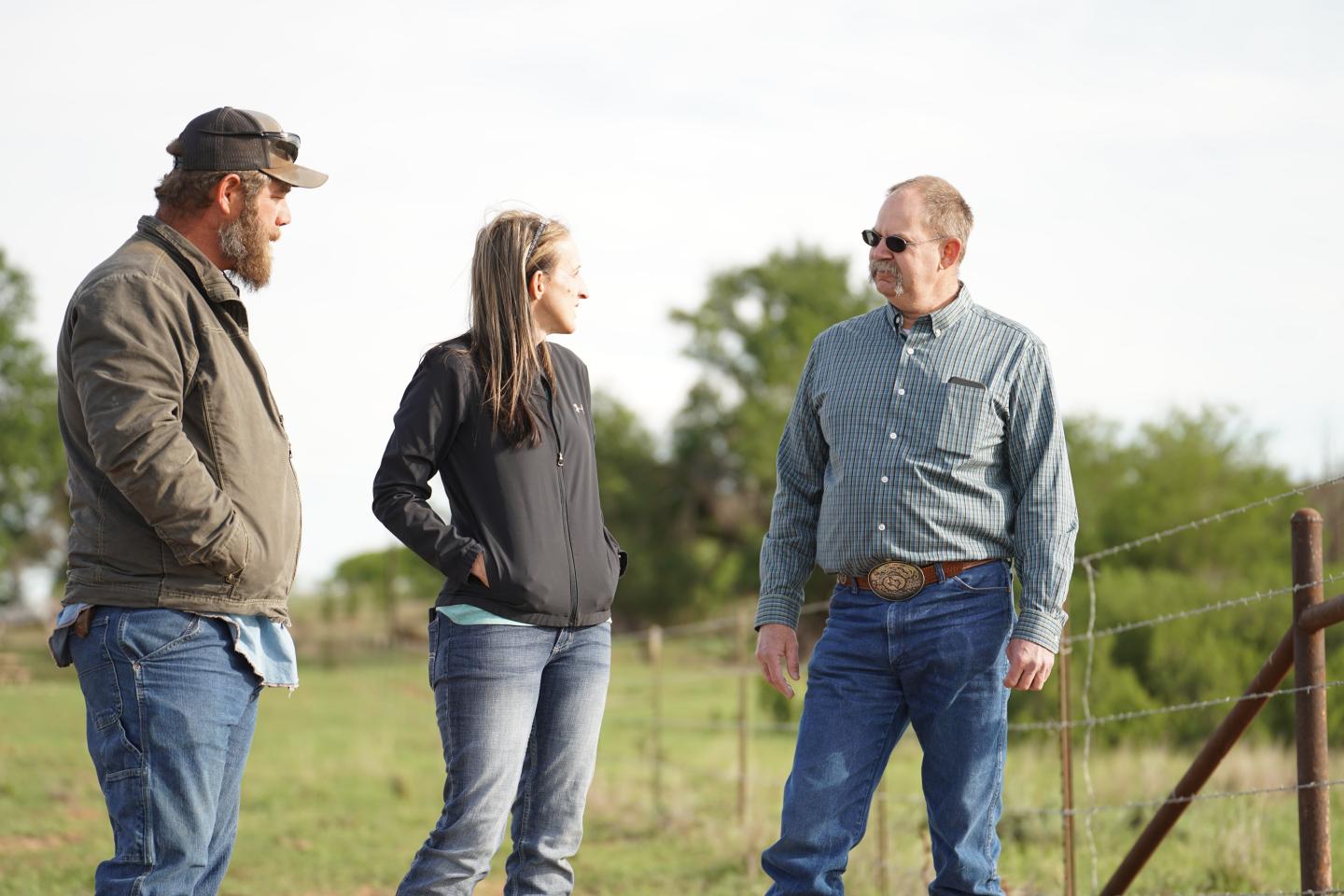
Beginning ranchers Landon and Shannon Engelke started their commercial cow operation in 2020 when they purchased a neighbor’s land that was coming out of the Conservation Reserve Program (CRP). With the support of NRCS, the Engelke family is building a sustainable, thriving operation.
Beginning ranchers Landon and Shannon Engelke started their commercial cow operation in 2020 when they purchased a neighbor’s land that was coming out of the Conservation Reserve Program (CRP).
For Landon, who grew up on a farm and always dreamed of having his own herd, this was the start of a journey toward creating that legacy.
Now, with the help of the USDA Natural Resources Conservation Service (NRCS), that dream is becoming a reality, and the Engelkes are creating a future for their family.
A Family Legacy in the Making
Landon and Shannon are not just building a ranch, they are making memories and creating a future their family can build on for generations to come. They cherish the moments spent together on the ranch, from evening feeding times to Easter egg hunts on their plateau. Shannon fondly recalls one of her favorite memories, “We took the kids out in their Easter dresses and Sunday best and let them go. Recently, we found a random Easter egg still hiding out—it was fun for the kids.”
The family’s involvement in the ranch is central to their operation. Landon revels in riding home through his cattle and seeing the calves, appreciating the fruits of their labor over the past few years. “If my family’s not here doing it with me, I’m missing something. We do everything together here on the ranch,” he says.
Their children actively participate, feeding the cows several times a week, often choosing to put down their tablets for ranch activities. Evening feeding times, particularly during warmer seasons, are a favorite of Shannon’s, as they provide a peaceful and relaxing end to the work and school day.
The Ranch: From Dream to Reality
In 2010, the Engelkes purchased a house with 4 acres and a view of land still in a CRP. Landon dreamed of owning that land, and in 2014, the opportunity arose. Shannon describes the purchase of the land as both exciting and scary, not knowing what to expect. The previous owner, ready to exit ranching, had offered to sell the land to the Engelkes. “We stared at this view for so long and thought, ‘It’ll never be ours,’ and then the landowner called and said, ‘I think we’re ready to sell,’” Shannon recalls.
“I’m looking forward to having the cattle on the place,” Landon says. For now, they run cattle on some of the CRP land but face challenges due to limited water sources and invasive weeds that could harm the cattle.
To supplement their income and support the land payments, Landon continues his day job in fencing and Shannon has a hobby in photography that allows her to have her own business. Additionally, their love for hunting, including elk and deer, contributes to their sustenance and financial stability.
Transitioning CRP land to grazing land presented significant challenges. The property had no fencing or water sources suitable for grazing. To address these issues, the Engelkes turned to the NRCS for guidance and support.
Working with NRCS
Landon’s grandad was a cattle rancher, making this venture deeply personal for him. Shannon, though new to cattle, grew up in East Texas with horses and was eager to support Landon’s dream and create something for their family.
As a fence builder and contractor, Landon learned about many NRCS programs through his work. His grandparents’ involvement with the NRCS also influenced his understanding of the agency’s benefits.
The couple approached NRCS for guidance on fencing and water sources, signing up to see what programs they were eligible for. Shannon appreciated learning alongside Landon and recalls NRCS District Conservationist Rob Self was instrumental in answering their questions.
Landon began working closely with NRCS in 2022. The work they have accomplished with the agency has involved installing two water wells and three water troughs, installing fence, and establishing a grazing plan that incorporates rotational grazing and measures to control invasive species. A livestock pipeline is also in the works to further transport water for livestock and wildlife.
Rob Self has enjoyed watching the Engelkes’ journey, saying, “It’s not often we get to start from scratch with people, and that’s exciting.” Together, they’ve walked the property and determined the best ways to address resource concerns. He finds it rewarding to see families like the Engelkes take pride in their work.
Overcoming Challenges
Not surprisingly for a CRP, the first major challenge was the lack of fencing. With NRCS’s assistance, the Engelkes built 3.5 miles of fence for rotational grazing. The second challenge was water scarcity. The operation lacked a working well, so they drilled two water wells, one with NRCS’s help, and set up water troughs for all three pastures.
Landon appreciates the agency’s support, stating, “The assistance has allowed us to get things moving a lot quicker than we would have on our own.” The NRCS’s expertise and timely responses have been invaluable in overcoming these challenges.
The Engelkes also have been proactive in addressing challenges like the invasive shin oak, which they plan to treat this year to prevent it from spreading.
Cow Operation and Future Goals
Initially, Landon started with longhorns but soon transitioned to Wagyu cattle. “When we found out we were going to have a shot at buying the CRP land, he went ahead and bought our first six Wagyu cows and our first bull. And then he just kept going from there,” Shannon says.
The Engelkes run mainly black cattle and a few F1 tiger striped crosses, with all bulls being registered Wagyu. They’re breeding Angus and tiger stripe Hereford with Wagyu, aiming to cater to different market demands.
Among their herd is a special 20-year-old cow, Pop’s Cow, or No. 42, from Landon’s grandfather’s original cows. “She’s generational,” Shannon says, hoping she can have one more baby this year to continue the lineage.
The Engelkes’ goal is to expand their operation, ensuring it pays for itself and can be passed down to their children. “Landon told me he’s shooting for the sky,” Shannon shares, as she explains they’re eyeing another CRP property to further expand their ranch.
The Engelkes’ efforts are also benefiting wildlife. By reintroducing grazing, they are revitalizing the land, increasing habitat diversity, and supporting the nutrient and water cycles. Self notes, “CRP that’s been in grass a long time almost becomes a monoculture of old growth plants. They need periodic disturbance to keep it functioning like it’s supposed to.”
A Bright Future Ahead
As the family continues to work with NRCS, they are optimistic about the future of 444 Engelke Ranch. They plan to install additional water lines and explore Conservation Stewardship programs. Their efforts are not just transforming their ranch but also setting a precedent for other ranchers transitioning CRP land.
Landon’s dream of owning a working cattle ranch is becoming a reality. With the support of NRCS, the Engelke family is building a sustainable, thriving operation that will continue for generations. “Our goal is to create something for our family and leave a legacy,” Landon says. The future of 444 Engelke Ranch looks bright, with Landon’s dream and the family’s hard work leading the way.
TOP PHOTO: Landon (left) and Shannon Engelke (center) discuss resource concerns on 444 Engelke Ranch with NRCS District Conservationist Robert Self (right). (Photos compiled by Rebecca Gresham, Public Affairs Specialist, Lubbock, Texas)