
Kansas wheat breeder Joe Martin remembered for his work
For nearly four decades, Joe Martin worked to make wheat better suited for the farmers and fields of western Kansas. Today, his influence remains planted across the state, carried through varieties, genetics and a wheat breeding program he helped shape for the future.
Terry Joe Martin, longtime Kansas State University wheat breeder at Hays, died Aug. 20, 2026. He was 78.
Martin spent 37 years at the K-State Agricultural Research Center-Hays, first as a plant pathologist and later as the center’s wheat breeder. His career produced wheat varieties that became some of the most widely planted in Kansas and helped advance disease resistance, hard white wheat development and the long-term productivity of Kansas wheat.
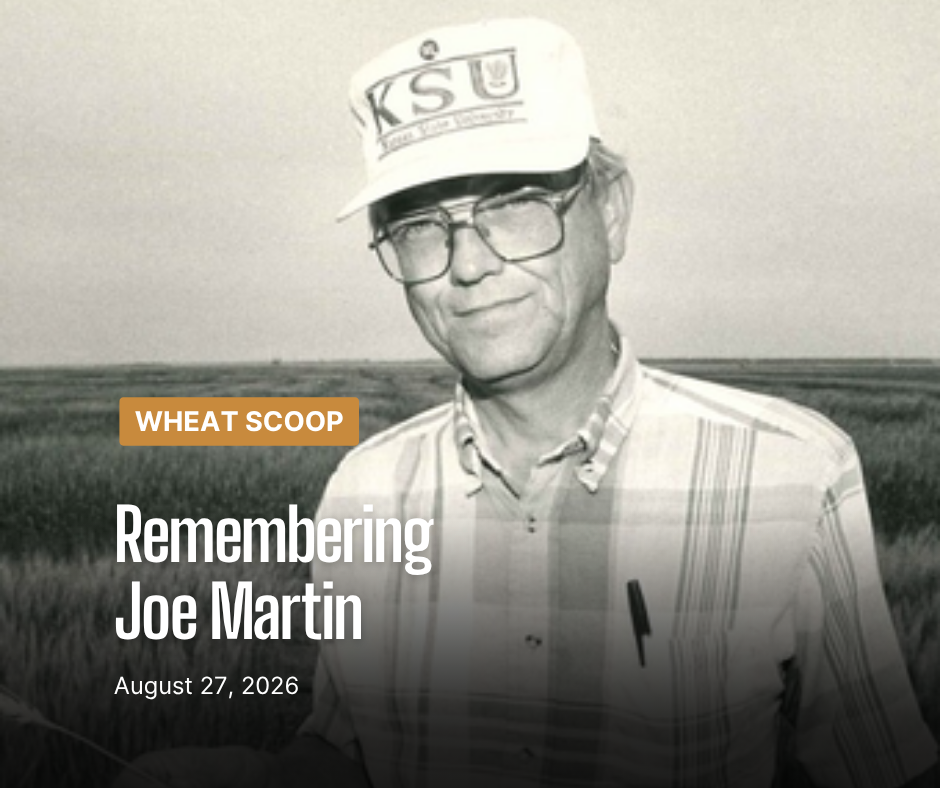
“Joe was a tremendous wheat breeder and made lasting contributions to Kansas wheat, but for me, and I know for many others, he was much more than that,” said Justin Gilpin, Kansas Wheat CEO. “He was a colleague, a mentor, a friend, and someone who cared deeply about wheat, the people in the industry, and the future of Kansas agriculture.”
Hays program
Martin’s career became part of a wheat breeding tradition at Hays stretching back decades.
Early research at the Hays station focused primarily on production practices and evaluating available wheat varieties. By the 1940s, researchers began crossing wheat varieties and selecting offspring specifically adapted to western Kansas conditions. That work eventually produced Kiowa and Bison, the first wheat varieties selected, increased and released from the Hays station.
The program continued under a succession of wheat breeders, including Ronald W. Livers, who focused on developing pure-line varieties adapted to western Kansas. Livers’ work produced varieties including Eagle, Sage, Kirwin and Larned.
When Livers died in 1979, Martin moved from the plant pathology project to lead the wheat breeding program.
Born Dec. 28, 1947, in Baxter Springs, Kansas, Martin earned a bachelor’s degree in biology from Pittsburg State University in 1969 and a master’s degree in plant pathology from K-State in 1972. He completed a doctorate in botany and plant pathology at Michigan State University in 1974 before joining the Hays research center that same year.
Taking over the breeding program placed Martin in charge of continuing decades of wheat improvement while confronting new disease, pest and production challenges facing western Kansas farmers.
His first variety release demonstrated the direction that work would take.
Wheat breeding
Released to Kansas producers in 1982, Arkan was the first Kansas wheat variety to combine resistance to multiple pests and diseases, including leaf rust, stem rust, soilborne mosaic virus, powdery mildew, Cephalosporium leaf stripe and Hessian fly.
Arkan eventually replaced Newton as the most popular wheat variety in Kansas in 1987 and 1988.
Dodge and Norkan followed in 1985. They were the first varieties released from Hays that were truly semidwarf in stature and carried the same source of dwarfing genetics associated with the Green Revolution.
But one of the most consequential shifts during Martin’s career came as K-State looked beyond traditional hard red winter wheat.
In 1987, Kansas wheat breeding resources began a major push toward developing hard white wheat varieties for western Kansas. Previous research indicated the region could successfully produce white wheat and that the class could create additional market opportunities for Kansas producers.
For roughly the next 12 years, much of the Hays breeding program’s effort focused on that goal.
The program provided experimental hard white wheat KS84HW196 to the American White Wheat Producers Association in 1989 to help begin developing markets. A decade later, the Hays station released Trego, a high-yielding hard white wheat with performance in western Kansas that exceeded available hard red varieties.
Trego combined yield potential with winter hardiness, strong test weights, tolerance to preharvest sprouting and resistance or tolerance to several important wheat pests and diseases. Its performance helped demonstrate that hard white wheat could be a viable option for western Kansas producers.
Lakin followed in 2000, combining bread-making quality with characteristics suited for Asian noodles, further connecting breeding decisions in western Kansas fields with potential customers around the world.
Martin’s program also continued developing hard red winter wheat. Ike, released in 1993, became one of the most popular varieties in western Kansas, while Stanton brought Russian wheat aphid resistance to producers.
His later releases included Danby, which became the most planted hard white winter wheat variety in the southern Great Plains in 2004, and Clara CL, a hard white winter wheat with Clearfield herbicide resistance and Martin’s final variety release before retiring in 2012.
Martin’s work also contributed important wheat streak mosaic virus resistance. RonL became the first commercially released variety carrying resistance that would later be identified as Wsm2, providing genetics that would continue to influence wheat improvement today.
“I know many within the KWA seed network and Kansas wheat industry knew Joe personally or worked with him over the years,” said Bryson Haverkamp, Kansas Wheat Alliance CEO. “His contributions to Kansas wheat were significant, and his influence can still be seen in the varieties being grown and developed today.”
One of the clearest reminders of Martin’s influence came after his retirement, when a new hard white wheat variety was named Joe in his honor. Developed through the Hays wheat breeding program and released by wheat breeder Guorong Zhang, Joe was made available to producers in the fall of 2016 for production. The variety combined genetics from Jagger, Arlin, Trego and a Colorado experimental line. Joe (the wheat variety) offered strong yield potential and resistance to several diseases, including wheat streak mosaic virus through the wsm2 resistance gene.
A legacy measured beyond varieties
The value of Martin’s work could be seen in more than the names printed on seed tags.
Estimates of wheat yield improvement from variety development during the 20th century placed gains at approximately one-quarter to one-half bushel per acre each year. By the time Martin retired in 2012, the K-State wheat breeding program was estimated to generate $89 million annually in benefits to Kansas, representing more than $18 in return for every $1 invested in the research program.
More importantly, the genetics developed and selected through Martin’s program did not stop with his retirement. They became building blocks for the breeders who followed him and for varieties developed for the next generation of Kansas wheat producers.
“I appreciated Joe on a lot of levels,” said Allan Fritz, K-State head wheat breeder. “He was a pioneer, particularly on disease resistance and his work with white wheat. There was a lot I learned from him as a breeder. He was someone who cared deeply about the producers and wanted his material to benefit growers. He was a resource to me when I was getting started. Joe really helped me get my program going and he was willing to be a mentor and then just as a friend.”
For those who worked with Martin, however, his influence went well beyond his scientific accomplishments.
“I had the good fortune to work with Joe over many years and to witness his work and the impact it had on Kansas wheat,” Gilpin said. “I will always appreciate his knowledge, his willingness to share it, and the perspective he brought to so many conversations. He had a gift of saying a lot without saying much.”
Beyond the field
Martin and his wife, Lorna, married Nov. 4, 1966, and were lifelong partners for nearly 60 years. Together, they raised three sons, Todd, Denny and Jeffrey.
Martin was preceded in death by his parents, Verl and Marie Martin, and his youngest son, Jeffrey. He is survived by his wife, Lorna, sons Todd and Denny and their spouses, Donna and Becky, his brothers, Dean and Ray, 11 grandchildren and a great-granddaughter.
A celebration of life will be scheduled at a later date. Memorial gifts may be made to the Humane Society of the High Plains or to the Kansas State University Foundation for the Fort Hays Agricultural Research Center Fund.
Hays Memorial Chapel has posted an obituary page, with additional information expected as arrangements are finalized: https://www.haysmemorial.com/obituary/Joe-Martin



