Nutrition, management important for heifer development
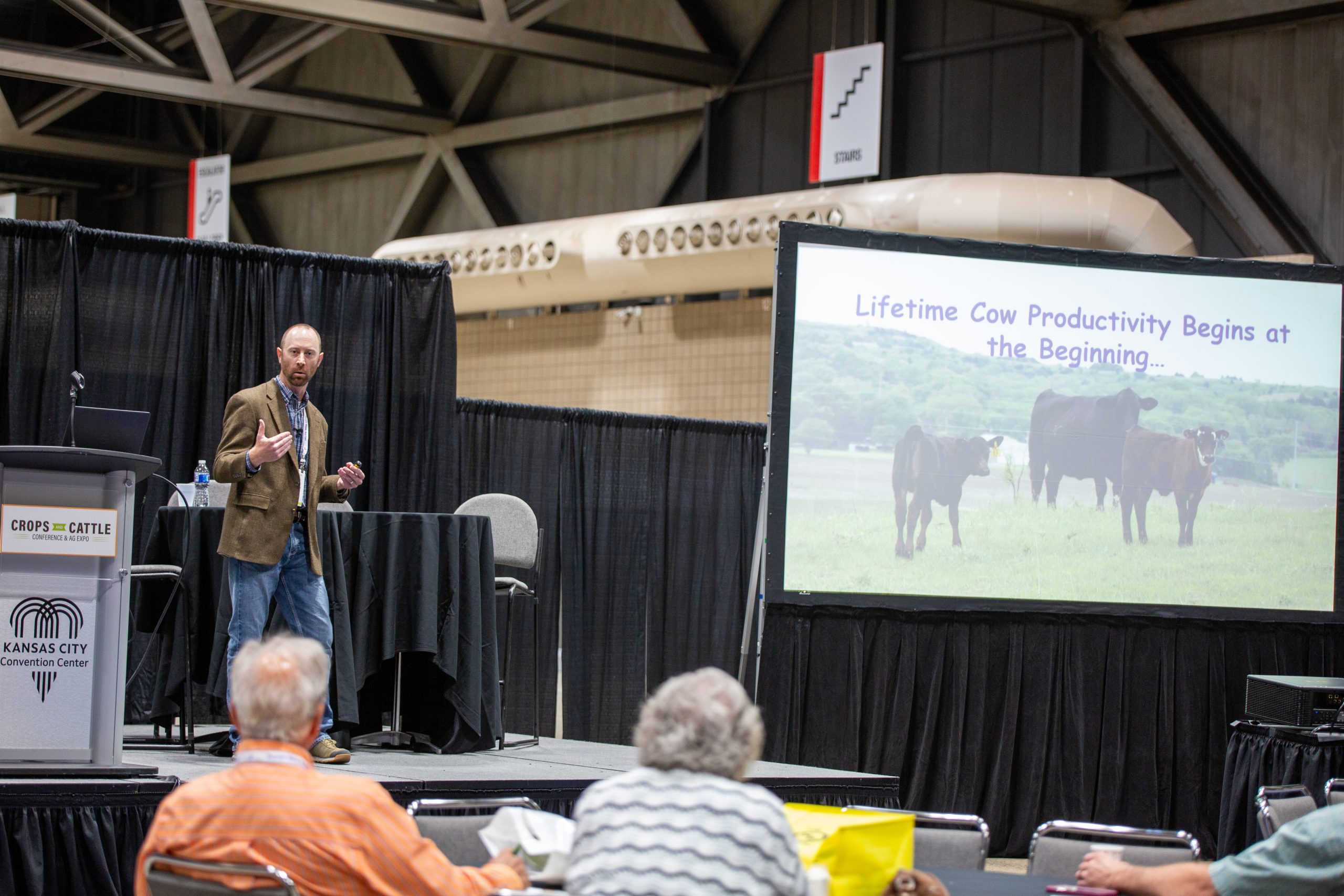
Those raising heifers to keep as replacements and overseeing young cows going into the later parts of the year should think about shifting their focus to improve nutrition and management.
Jason Warner, Kansas State University Extension cow-calf specialist, told attendees at the recent Crops and Cattle event in Kansas City, Missouri, that strategy could help improve lifetime productivity when heifer and cow prices are high.
“These things we can always improve upon, and get better at as an industry,” he said. “We can’t overemphasize the importance of that for what we do on a day-to-day basis with our operations.”
For him, there are several considerations to keep in mind from a big picture management standpoint. That includes taking note of how the operation’s cow herd has changed over the years and in context with heifer retention and herd growth.
Longevity is important moving forward, and regardless of where a producer is at when it comes to a female growth or retention standpoint, they need to decide if their herd is going to continue to expand in terms of numbers.
“I think just reiterating the importance of that as we think about developing these females and bringing them back into the herd, regardless of the manner that you do it, taking the time and the approach to consider it from an overall lifetime productivity and longevity standpoint, I think is certainly critical,” Warner said.
In today’s market, prices this spring were at $4,000 to $5,000 for some bred females. Open ones were around $2,500 to $3,000, depending on location.
“But certainly, I think we’re at a time period in our environment, in our operation, our industry, we’ve never really experienced before, and trying to develop these females and manage them such that we can try to maximize their lifetime productivity is certainly important,” he said.
According to Warner, when thinking about making decisions now for ranchers who wean in the fall and decide about replacements, some of those decisions are critical. It can start even before the cows are born—when breeding decisions are being made prior to conception.
“When those offspring are in gestation and utero, we know that there’s some pretty interesting data that we’ve developed over the course of time that’s come out of our university research herds that shows that health and nutrition during late gestation certainly has an impact on lifetime productivity of these females,” he said. “We think about protein supplementation, energy supplementation, and making sure that that we that we are not deficient in any of those nutrients as those females get closer to calving is really critical.”
But appropriately managing those females from the moment they hit the ground as babies until they get to a feeder age all the way through the system is key.
Best management practices with the right approach from nutrition standpoint to try to maximize lifetime productivity of those females can pay dividends, he said.
From a management standpoint, when making replacement heifer decisions and other management decisions, it’s important to stay on track with the goals of the herd and bottom line, especially working to get the heifers mature enough to breed and retain pregnancies.
“Sometimes I think it’s easy for us as managers of operations and as producers, we get sidetracked, or maybe get a little bit preoccupied with all the things that are going on around us that we cannot control,” he said. “The weather, the markets, policy, those types of things. It certainly influences our operations, but I think we always want to come back and focus on the things that we do control, the things that we do manage, and that we make decisions on.”
When thinking about bringing females back into the herd—whether they’re retained or purchased—control remains with the producers.
When thinking about a big picture ranch management or cow-calf management perspective, Warner argues the most important decision is when those females are going to get bred and when they’ll subsequently calve.
That sets the tone for everything that will that will follow from then on out, he said. “When we think about replacement heifer development, bringing these females in, and getting those females properly developed prior to breeding, we’re going to control how much weight we want to put on those females, and the manner in which we’re going to do it, or the rate in which we’re going to do that.”
That’s important from a reproduction and cost standpoint.
“But then, what we’re going to use to try to develop those females and get the weight and get the growth and the proper development on those females so that they’re actively cycling and that we have a good chance of getting those females pregnant at their first opportunity is really important too right?” he said.
Staying ahead
There are several key questions that impact the bottom line, he said.
His first question is how big do those females need to be at their first breeding for them to be successful? He said there’s been a fair amount of research on the subject.
“How many of you have heard or maybe read information about the target weight concept on females? How big do these females need to be in order for us to be able to successfully breed them?” he said.
Keep in mind if females are going to be developed to a little bit bigger initial weight at breeding relative to their expected mature weight, the same goes for those who will be lighter weight for their maturity at breeding.
“There’s really no hard and fast rules with those particular numbers,” he said. “Most of the research that really started with this concept that we need to develop females to about two-thirds of their mature body weight at first breeding really started from some of our USDA research herds.”
That was in the 1960s and 70s, and Warner said in the past 30 years, there’s been more research looking at how to develop females at a little lighter body weight relative to their mature weight at first breeding and still get them bred.
“With the idea being that with today’s genetics and growth rates in these females, are these heifers attaining puberty at younger ages, and can we successfully get that done in more of a lower input type of an environment?” he said. “Just keep in mind that there’s kind of some general guidelines there, but there’s really no hard and fast rules in terms of does a female need to be at 65, 67, 68 percent of a mature body weight at first breeding in order to have a successful initial pregnancy.”
Warner said understanding body condition, the basics with nutrition and management and some of the tools available to producers, they can make more informed management decisions about heifer selection.
“Things like pelvic measuring. I don’t want us to get away from that. I think there’s certainly value in that understanding where those females are, particularly about a month to 45 days prior to the start of the breeding season,” he said. “Reproductive tract scores, that’s a really good opportunity to engage with your veterinarian and understand where those females are and understand cyclicality status on those females.”
After these scores come in, and heifers need removed from the group because of their scores, this is an ideal time to make those choices. Genomic tests can also help evaluate and improve heifers over time—and add value.
“You’ve got to understand what traits that you’re going to look at. There’s certainly a record keeping component to that,” Warner said. “Those tests have improved over time. Historically they have been more focused for registered females, but we’re developing them for the commercial market as well too.”
Also consider forage quality when looking at weight gains and body condition scores, he said.
The young females need to have quality nutrients and enough calories to consume so they still meet their growth requirements while still remaining bred.
“I think we’ve overlooked that at times on these young cows,” Warner said. “These 2-, 3-, and 4-year-old cows, there’s times I think there where we’re a little bit more prone for mismanagement that we want to make sure that we focus in on what I think is certainly very valuable for us.”
Kylene Scott can be reached at 620-227-1804 or [email protected].