The 2018 farm bill expired at the end of the fiscal year again, after having been extended twice by Congress. This year, Sept. 30 came and went without much fanfare on the farm bill front. In part, that’s because many of the key provisions covering commodity programs, crop insurance and some conservation programs were included in the GOP budget reconciliation bill that Congress passed earlier in the year. And for the short term, the focus has shifted to some type of emergency aid package to boost farm income.
On Oct. 6, more than 200 national and state agricultural organizations appealed to President Donald Trump for economic assistance. A top White House official said an aid package would be announced “really, really soon.”
What’s left for the farm bill?
Even though the farm bill expired on Sept. 30, not all of the programs authorized by the multi-year law are affected. As the Congressional Research Service pointed out in a report last month, the “timing and consequences of the farm bill expiring vary by program” and the dates to watch for include both Sept. 30 and Dec. 31. Here’s the breakdown.
- For programs with mandatory funding that is provided by the farm bill and for provisions that expire at the end of fiscal year 2025, authority to operate may cease.
- For programs with a fiscal year authorization that are funded with discretionary appropriations, or for programs with mandatory spending authorized, but not appropriated by the farm bill—such as the Supplemental Nutrition Assistance Program—an appropriations act, or continuing resolution could allow operations to continue.
- For the farm commodity and dairy support programs that expire after the 2025 crop year, the consequences of expiration begin on Jan. 1, 2026, when inactive and outdated laws—commonly called “permanent law”—would be restored for dairy, the first commodity affected in the new crop year.
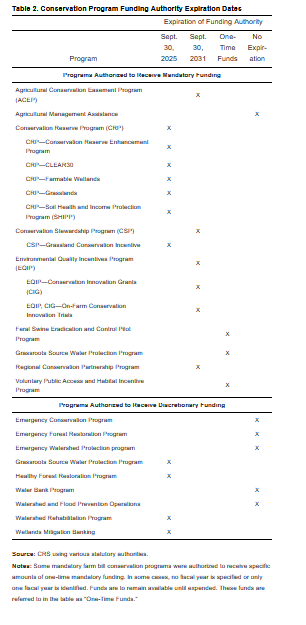
- Some programs had their expiration dates extended beyond the expiration of the farm bill by other legislation. P.L. 117-169, commonly known as the Inflation Reduction Act of 2022, extended some—but not all—conservation programs through fiscal year 2031.
- Some programs, such as crop insurance, are permanently authorized, do not expire, and would not be affected by farm bill expiration.
CRP impacted now
The popular Conservation Reserve Program has already been impacted. No new CRP offers or offers for re-enrollment may be processed or approved. Some, but not all provisions under the Environmental Quality Incentives Program, that are impacted now include:
- Livestock funding. Requires 50% of funding to be used for payments related to livestock practices.
- Payment limits. Limits total EQIP payments to $450,000 per person or legal entity for the duration of the 2018 farm bill.
- Organic payment limits. Limits total EQIP payments related to organic production to $140,000 per person or legal entity for the duration of the 2018 farm bill.
However, not all conservation programs will be impacted in the same way. The Inflation Reduction Act, extended some conservation programs and their funding authority through the act’s 10-year budget window, resulting in some farm bill conservation programs expiring at the end of FY2024 and others at the end of FY2031. Here’s the breakdown from the CRS report:
Once we get past the focus on some type of trade aid package and all of the controversies surrounding a government shutdown, you can expect more attention to be paid to finishing up the rest of the farm bill, sometimes referred to as a “skinny” farm bill or “Farm Bill 2.0”.
As we get closer to the next big expiration date at the end of the calendar year, the possibility of returning to permanent law—and the significantly higher government outlays that would be required—almost guarantees that Congress will do something.
Permanent law requires the U.S. Department of Agriculture to set support prices that would guarantee producers between 50% to 90% of the parity price depending on the commodity. Dairy would be the first to be impacted.
Under permanent law, the mandated purchase price for milk would be $49.43 per hundredweight based on August 2024 data. According to CRS, that’s more than two times (or 117% higher than) the current market price of milk ($22.80/cwt. for all milk).
Little wonder then that House Agriculture Committee Chairman Glenn “G.T.” Thompson continues his focus on moving a new farm bill. “We need to get Farm Bill 2.0 done to provide certainty on the remaining parts,” he told us recently.
Editor’s note: Sara Wyant is publisher of Agri-Pulse Communications, Inc., www.Agri-Pulse.com.