Farm transition planning: How to get it right

Farm transition planning is often the elephant in the room during holidays and family gatherings. The conundrum of how to effectively pass a legacy on to the next generation is one that every agricultural family faces and ignoring it only puts the farm in more danger.
Shannon Ferrell, professor of agricultural law at Oklahoma State University, spoke about this topic at the recent HPJ Live event held in Wichita, Kansas, Aug. 6 to 8. He said farm and ranch transition planning is unique from general estate planning because of all the real estate and possessions farmers must sort out and pass down are active business assets.
“If we pull out one of those assets and give it to somebody else, our Jenga tower falls,” he explained.
Ferrell said about 64% of American farmers and ranchers have no estate planning tools in place whatsoever, which means those operations are facing an uphill battle for the next generation to be able to take over and continue the family business.
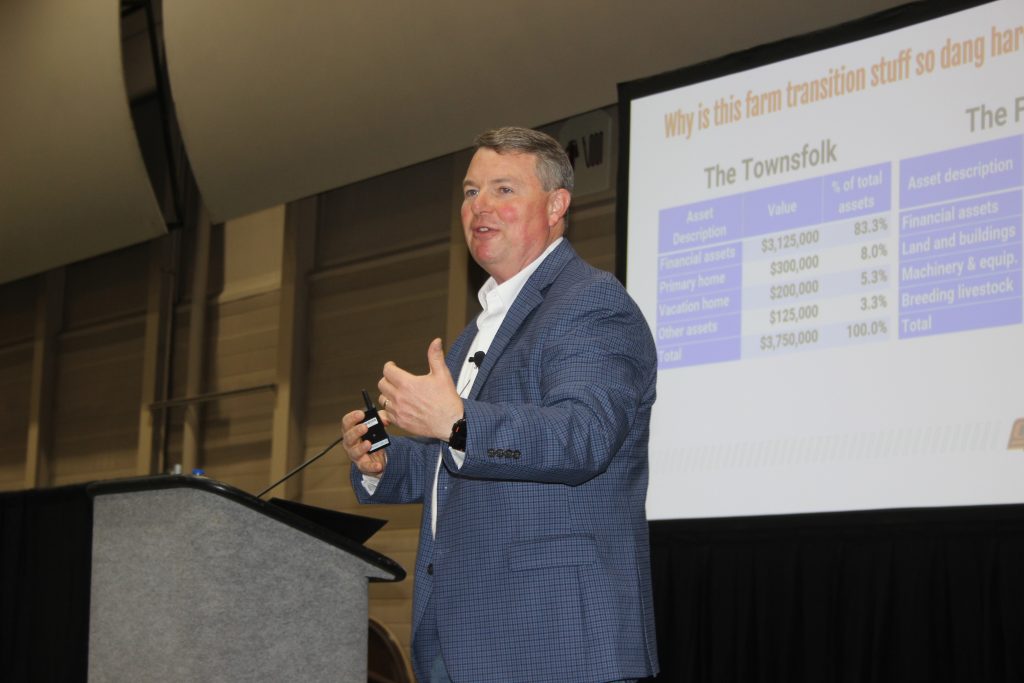
“Yet, if I were to ask 100 farmers what they want to happen to their farm or ranch after they die, they would all say they want to keep their farm together and keep their family farming it,” Ferrell said. “I think one of the biggest tragedies that we have in agriculture is that we spend a lifetime of work in the growth business and deny ourselves the greatest opportunity to see growth, and that is to see that next generation succeeding while we’re still here to witness it.”
Successful transition planning
Ferrell said there are five steps to a successful transition that every farmer or rancher should follow, include taking an inventory of everything on the farm; communicating with stakeholders; developing a business succession plan; creating a will to divide an estate and bestow gifts; and continuing to adjust plans and revise over time.
To help make the farm transition smooth, he recommends hiring an accountant, attorney, investment adviser, farm management consultant, and human resources adviser. Apart from those five steps, there are several documents Ferrell recommends everyone complete and notarize in the event of his or her death. These include a guardian nomination for minor children, beneficiary designations, durable power of attorney, an advanced directive of health care, long-term care plan, and a will.
A guardian nomination ensures that children under 18 will have an adult take custody of them if both their parents die. Ferrell noted the importance of discussing potential guardianship with the person you wish to raise your children and make sure they are willing to accept the responsibility. He said it is also wise to set aside financial resources to help the guardian care for the children so it is not a financial burden for them.
Beneficiary designations are an important detail for anyone’s estate planning, whether he or she is a farmer or not. Most investments like individual retirement accounts, certificates of deposit and life insurance require the asset holder to select one or more individuals to receive the assets after they die. Ferrell said a beneficiary designation does not have to go through the probate process, so those funds will not be tied up if the owner of the investment selects a beneficiary.
Keeping beneficiary information updated is also crucial. Major life events, like marriage, divorce, birth, or death, can change who you want to profit from your investments and if the information is outdated and the investment owner dies, whoever is named as the beneficiary will receive it, even if it is not the wish of the decedent.
Ferrell said many people select powers of attorney, but he recommended a durable power of attorney instead.
“If you become incapacitated, you cannot communicate, or if you’re unconscious, your power of attorney goes away unless it’s a durable power,” he explained. “A durable power of attorney remains effective while you’re incapacitated. You can also split up your durable power, into a health care power and a business power.”
He said another option is a springing durable power of attorney, which only activates if you are incapacitated, and when you regain capacity, it ceases.
Health directives, wills and trusts
Ferrell said everyone should have an advanced directive for health care, which will help family members make medical decisions if the time arises. An advanced directive for health care includes medical powers of attorney, living will and the option of a DNR.
Whoever is selected as a medical power of attorney will be in charge of making life and death decisions and often times those choices must be made in a short amount of time and with limited information. It is important to talk with your appointee prior to naming them and discuss your thoughts on how you would like your health to be handled if you are unable to communicate.
A living will outlines the level of care you want in certain medical situations. It helps family members make decisions if you are unable to give your opinion and simplifies care based on your wishes. If you provide this information, your family will not have to wonder what your wishes would be for your medical care. Ferrell used the following example.
“If you have a terminal condition with no chance of recovery, do you want life support to be withdrawn if you have a condition where you’ve had a loss of brain function and there is no prospect for its return?”
A DNR, also known as a Do Not Resuscitate order, is a medical directive that prevents doctors from performing CPR or other resuscitation methods in the event of cardiac or respiratory arrest. Ferrell said it is crucial to have this paperwork signed and notarized for it to be legally binding, and to always discuss these types of decisions with family. A long-term care plan is another element of estate planning that is often forgotten but can be beneficial in the long run.
“If you are a man aged 65 or older, your odds of needing long-term care or a nursing home, are approximately 60% and your length of stay will average about two years,” Ferrell said. “For ladies, if you’re 65 years or older, your odds of needing long-term care are 70%, and your average length of care is about three years. So, for most people the odds are they will need long-term care.”
Ferrell said basic assisted living costs are about $4,500 a month, and memory care can reach $25,000 a month. He recommends looking into long-term care insurance to protect the farm’s balance sheet and personal savings.
The final document of estate planning is probably the most important, a will. A will is designed to distribute property and assets after death, but it does not restrict property. A trust on the other hand can hold property for an allotted amount of time. Ferrell said even if there is a trust that is set up to handle your assets after you die, a will is still paramount.
“You still need to have a will, if for no other reason than to round up anything that you forgot to put in the trust,” he said. “But for lots of us, we don’t have any other estate planning tools at all, and we definitely need a will to be our last line of defense to make sure that stuff goes where we want it to, versus having it just divided up according to the default rules.”
How to assign roles and split up assets
Ferrell said selecting individuals for roles in an estate plan—such as guardians, nominations, trustees, and executors—is a strategic decision, and you should consider the three T’s—time, temperament, and talent—prior to making final decisions.
“Does this person have the time to do what you want them to do,” he asked. “Do they have the talent, skills, knowledge, ability, and temperament to deal with the other people in your family that they’re going to have to contend with while they’re doing this unpaid job?”
Ferrell said certain individuals may not be cut out for the difficult decisions that can come with roles such as medical power of attorney. This person needs to be able to think rationally under pressure and make decisions without the weight of emotions affecting his or her reasoning and choices.
Above all else, communication is the key to setting up an estate plan that serves you and your family and keeps everyone informed of the circumstances after your death. This can prevent drama and family conflict after you are gone.
“Nobody likes nasty surprises,” Ferrell quipped.
When deciding how to divide up land and assets between descendants, Ferrell said it is never a good idea to split everything down the middle between children that return to work on the farm and those that seek other careers. Ferrell said this strategy is used on 64% of family farms and has never worked in his 22 years of helping farmers with succession plans. The problem is, it forces the farm’s successor to buy their sibling(s) out and creates extreme debt, putting the farm at risk.
“Land is a very illiquid, difficult to divide asset,” he said. “Ask yourself are you giving your kid a blessing or a curse when you’re splitting this stuff down the middle?”
Instead, Ferrell suggests talking with heirs before making decisions on who will receive assets in the will and consider where each person’s interests lie, which will affect what they do with the property or other possessions passed down.
“Communication is how you go about aligning interests and getting everyone on the same page,” Ferrell said. “If we can’t do that, treat people a little differently based on their interest, even if that doesn’t mean treating them identically. If I make the farm buy half of itself out every generation that starts to pull equity out of our farm, and we spend our entire lives trying to turn debt into equity. That’s what the split down the middle strategy does.”
Farm transition planning is a complicated, tedious, and sometimes emotional topic, and there is no one correct way to handle it because every family and operation is unique. However, handling it before it is too late is the best decision any multi-generational farm can make.
“At the end of the day, farm transitions are way more than estate planning,” Ferrell said. “It’s really your way of figuring out how you can move these assets to the next generation and do so in a way that gives them the best chance of success.”
Lacey Vilhauer can be reached at 620-227-1871 or [email protected].
(Photo by Tom Fisk via Pexels.)