Drought and flood risk tool available worldwide
Visualization platform co-developed by AgriLife Research now available to users across the globe
A web-based tool that lets farmers, researchers and policymakers assess drought and flood risk in agricultural regions has expanded from a Texas and U.S. resource into a platform available to users anywhere in the world.
The Water, Impact and Sustainability Estimator, or WISE, draws on decades of hydrologic modeling work at the Texas A&M AgriLife Blackland Research and Extension Center at Temple. That’s where scientists developed the Soil and Water Assessment Tool Plus, or SWAT+. It is now one of the most widely used watershed models in the world for simulating water quality and quantity, land-use impacts and climate effects.
Built on data from SWAT+, WISE has given Texas producers, water managers and researchers high-resolution insight into water availability for years. Its global expansion means those tools are now reaching an international audience for the first time.
The international rollout was announced in a joint presentation by Texas A&M AgriLife Research, Texas A&M University and South Korea’s Rural Development Administration, RDA, at the 17th Conference of the Parties to the United Nations Convention to Combat Desertification, held in Ulaanbaatar, Mongolia. Texas A&M and RDA developed WISE and showcased it as part of a broader look at investments in technologies for responding to drought and flooding in farm countries.
A data-informed global watershed tool
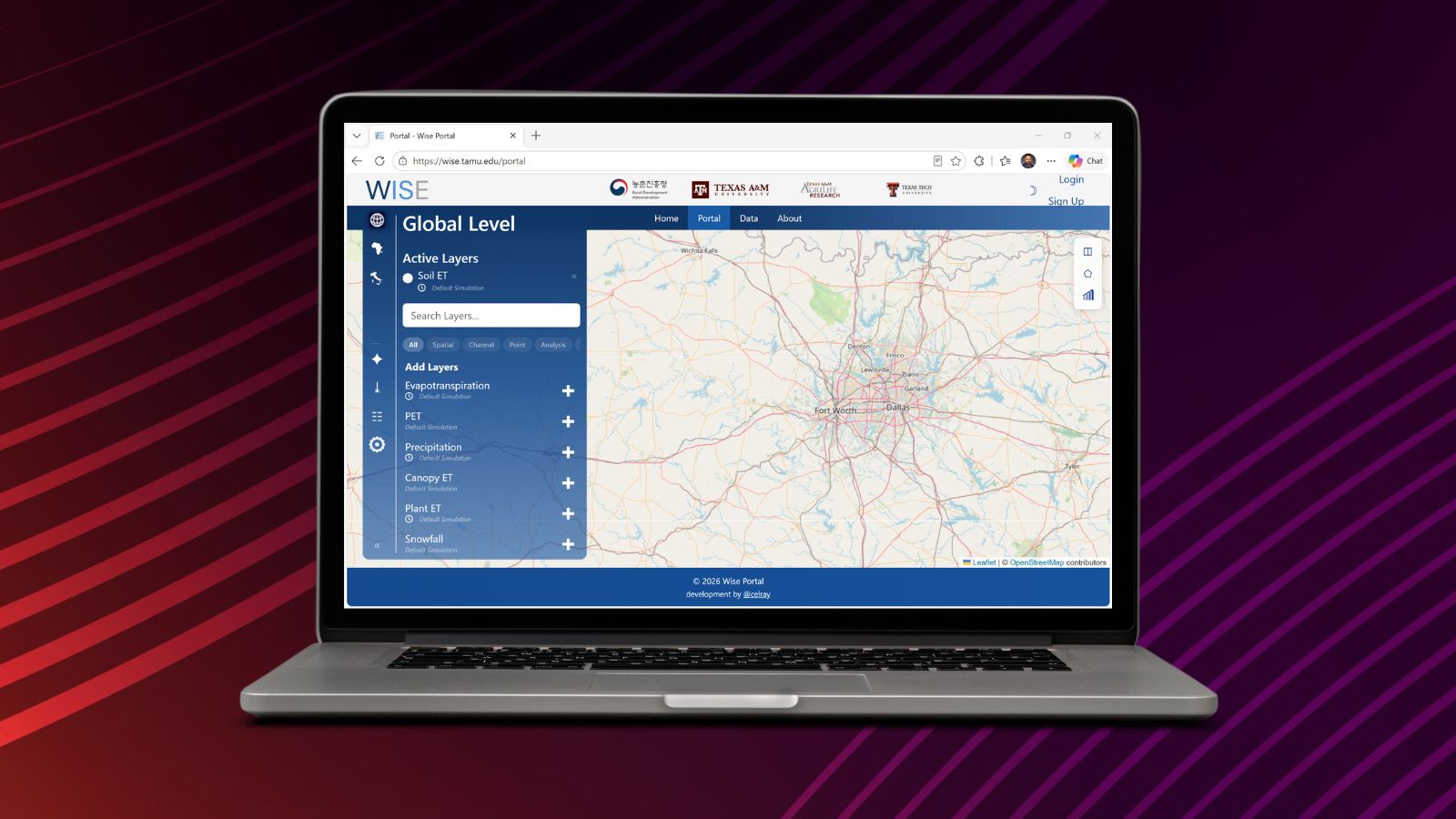
WISE now offers more than 41 hydrological variables at 1-kilometer resolution, with data coverage spanning 2001 to 2024 across 218 countries. Users can explore interactive maps, generate time series and zonal statistics, and request written country reports — all free through a web browser, without specialized software or modeling expertise.
At the U.N. convention in Mongolia, Jaehak Jeong, Ph.D., AgriLife Research hydrologic modeling scientist and professor in the Texas A&M Department of Biological and Agricultural Engineering, demonstrated the platform’s key functions and applications. Sang-min Jeon, Ph.D., of South Korea’s National Institute of Agricultural Sciences, walked delegations through WISE’s development and current capabilities. Experts from the University of Nebraska-Lincoln, the Asian Institute of Technology in Thailand and Hankyong National University also joined the discussion, focusing on how countries might put WISE to work in policy and field-level decisions.
WISE has also been added to the U.N. Convention’s online drought toolbox, a step meant to help make the platform’s data useful for country-level drought management, climate impact forecasting and vulnerability assessments worldwide.
“WISE was built on the same modeling foundation that has guided water resource decisions in Texas and across the U.S. for years, and now we’re able to extend that same capability to researchers and policymakers around the globe,” Jeong said. “Our team will keep refining the platform’s data and analysis tools, so it becomes more powerful for every country that relies on it.”
AgriLife Research, Texas A&M University, Texas Tech University and the RDA collaborated on the WISE platform, which is accessible at https://wise.tamu.edu.
PHOTO: The Water, Impact and Sustainability Estimator, or WISE, is now available to users worldwide (Gabe Saldana/Texas A&M AgriLife)