Today I am going to focus on exactly how big and who is investing in the future of alternative proteins. If you cannot see how they plan to control and feed us a total mixed ration, according to their guidelines, you are not paying attention.

First off, the global sounding board that is the network for organizing greater effort toward alternative protein is the Good Food Institute. The institute tells people that total investments in animal-free protein are more than $20 billion. In addition, those trying to increase more investments are saying:
The alternative protein industry raised $881 million in investments in 2025 and $359 million in H1 2026, bringing total investments since 2017 to over $19.5 billion. In 2025, plant-based companies raised $450 million, fermentation companies raised $357 million, and cultivated meat and seafood companies raised $74 million.
Just as a reminder, I got onto this path because I simply asked the Brave search engine a question, “How does the energy requirement for cell cultured protein compare to beef.”
Science Direct in September of 2025 had the actual question:
The Life Cycle Assessment was the first study to analyze scenarios of cultivated meat production powered by an average conventional energy mix versus a renewable energy mix.
The study showed that in cultivated meat production, the majority of emissions are scope 1 and 2 carbon dioxide emissions due to energy use at the production facility. Compared to plugging into an average electricity grid today, cultivated meat manufacturers can reduce their carbon footprint by about 70 percent through single actions such as using and sourcing renewable energy at their facilities.
This is in contrast to conventional meat production, where the majority of emissions are scope 3 and more distributed amongst land use change and various greenhouse gasses such as carbon dioxide, methane, and nitrous oxide, making the carbon footprint of conventional meat more difficult to reduce through single actions.
Beef Energy Use: Conventional beef production requires significantly more energy for raising animals, including feed production, livestock maintenance, and processing. Life cycle analyses suggest cultivated meat could use 7–45% less energy than conventional beef, though this varies by study.
Efficiency Comparison: Cultivated meat is estimated to be nearly three times more efficient at converting feed into protein than chicken, the most efficient conventional livestock.
However, if powered by a typical global energy mix, cultivated meat’s carbon footprint may surpass that of chicken or pork, whereas renewable energy can lower its greenhouse gas emissions by up to 92%.
They are comparing apples to oranges, in my opinion. When talking about alternative proteins, they assumed that wind/solar would be used. Zero consideration for the emissions and energy requirements to construct the wind/solar, but when it comes to animal proteins, they assume the normal efficient means of power from fossil fuels will be used.
Where can you find a high concentration of wind/solar in conjunction with a building infrastructure other than at the location of a hyperscale artificial data center? Who is really pushing AI data centers?
The answer is Donald Trump and other politicians. Let’s look at some of the leaders that have invested in alternative protein supplies:
Cargill has acknowledged a $75 million investment in Puris (the largest North American producer of pea protein) and additional undisclosed investments in companies such as Aleph Farms, Wildtype, Upside Foods and Enough.
Tyson Foods has invested over $100 million through its venture capital arm, Tyson Ventures, since 2016. This capital has been deployed across various alternative protein startups and technologies, including Beyond Meat, Memphis Meats (now Upside Foods) and Future Meat Technologies.
JBS has invested a total of $100 million in alternative proteins, specifically within the cultivated meat sector. Additionally, JBS has made separate significant acquisitions in the plant-based sector, including the $409 million purchase of Dutch brand Vivera and the acquisition of The Vegetarian Butcher from Unilever.
Aleph Farms, Future Meat Technologies, Remilk, Redefined Meat and MeaTech are Israeli-owned companies that specialize in alternative protein production that may soon be using cell-cultured proteins and a 3-D printer to create your next ribeye.
Editor’s note: The views expressed here are the author’s own and do not represent the view of High Plains Journal. Trent Loos is a sixth generation United States farmer, host of the daily radio show, Loos Tales, and founder of Faces of Agriculture, a non-profit organization putting the human element back into the production of agriculture. Get more information at www.LoosTales.com or email Trent at [email protected].
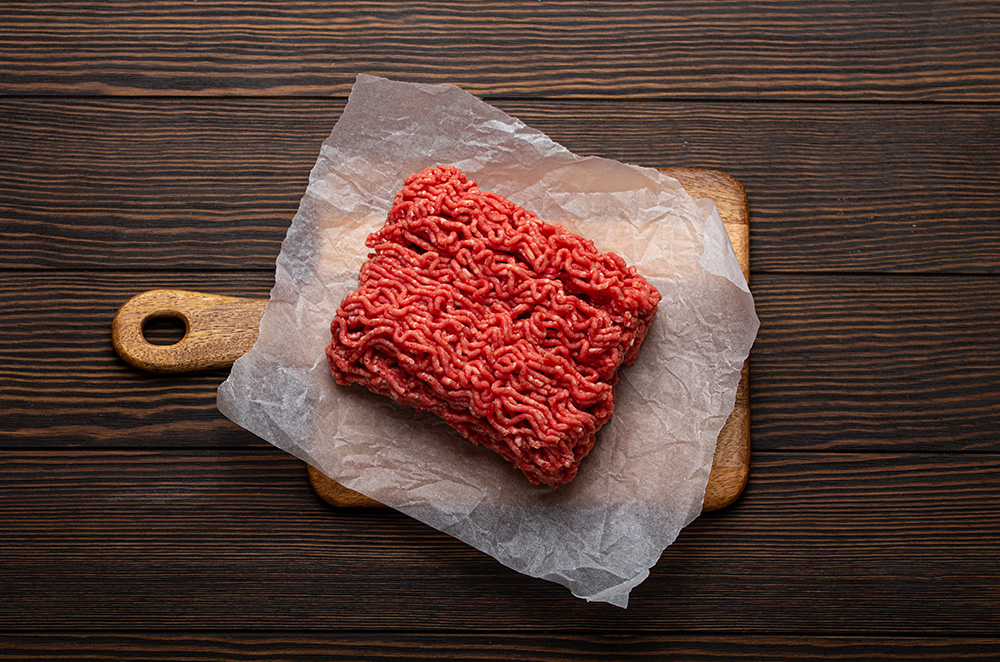
PHOTO: Ground beef on cutting board. (Adobe Stock-#427262684 │ somegirl)