
U.S. hog inventory down 2%
As of Sept. 1, there were 74.3 million hogs and pigs on U.S. farms, down 2% from September 2025 but up 2% from June 1, according to the Quarterly Hogs and Pigs report published in September by the U.S. Department of Agriculture’s National Agricultural Statistics Service.
Other key findings from the report included:
- Of the 74.3 million hogs and pigs, 68.4 million were market hogs, and 5.87 million were kept for breeding.
- From June through August 2026, 34.5 million pigs were weaned on U.S. farms, down 2% from the same period a year earlier.
- From June through August 2026, U.S. hog and pig producers weaned an average of 11.96 pigs per litter.
- U.S. hog producers intend to have 2.85 million sows farrow from September through November 2026 and 2.80 million sows farrow from December 2026 through February 2027.
- Iowa hog producers accounted for the largest inventory among the states, at 24.7 million head. Minnesota had the second-largest inventory at 9.3 million head. North Carolina was third with 7.6 million head.
National Pork Producers Council economist Holly Cook Anderson said nearly all of the numbers were within 1% of the average pre-report expectation, falling within the “expected” range.
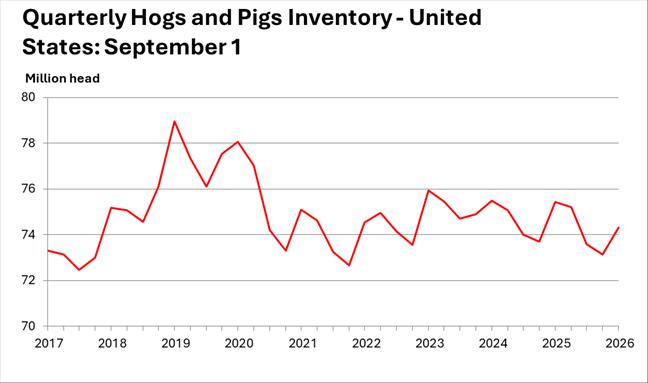
On Sept. 1, 2019, the hog and pig inventory reached an all-time high of 78.963 million head, said Lee Schulz, chief economist with Ever.Ag, who also spoke on a recent Hogs and Pigs webinar presented by the Pork Checkoff. The U.S. hog and pig inventory on Sept. 1, 2026, was 4.662 million head smaller at 74.302 million head.
The U.S. market hog inventory on Sept. 1, 2019, peaked at a record 72.503 million head. On Sept. 1, 2026, the U.S. market hog inventory was 4.076 million head smaller at 68.427 million head. The breeding herd was 585,900 head smaller over those seven years, he said.
“Future growth will depend on the decisions of individual producers, productivity, and disease pressures over the coming year,” Cook Anderson said.
Breeding inventory
The U.S. breeding inventory on Sept. 1, at 5.875 million head, was down 1% from a year earlier and 0.1% from June 1, 2026.
“This is the smallest Sept. 1 breeding herd since 2013,” Schulz said. “The smaller breeding herd will restrain supply growth for spring and summer 2027.”
The average number of pigs saved per litter was 11.96 for the June through August 2026 period, compared with 11.82 a year earlier. Litter rates have been higher than or equal to year-earlier levels for the last 21 quarters, Schulz said. The litter rate of 11.96 is an all-time national record for any quarter.
With the smallest Sept. 1 breeding herd since 2013, any increase in the pig crop or overall slaughter availability will likely be attributed to improved productivity, Cook Anderson said. The number of pigs saved per litter continues to break records in 2026 and was up another 1.2% for June through August compared with the same period in 2025. Pork production growth can also come from heavier carcass weights, she added.
Cost concerns
Pork producers are monitoring input costs, most notably diesel and corn.
After declining in 2024 and 2025, production costs have begun moving higher for hogs marketed after the first quarter of 2026, according to information from Iowa State University.
Rising costs and falling hog prices point to tighter hog margins than were expected earlier this year, Schulz said. Projected annual average 2026 farrow-to-finish profits have dipped from $21 per head forecast in February to $3 per head projected in September.
“Early projections for 2027 using lean hog, corn, and soybean meal futures prices to represent the market’s expectations suggest potential losses averaging $22 per head as input costs remain elevated and softer hog prices are implied,” Schulz said.
Higher nonfeed costs, including fuel and utilities, continue to account for a larger percentage of total costs, while feed expenses are also higher than a year ago, Cook Anderson said.
“Futures and USDA forecasts suggest higher corn prices will be a contributor to higher breakeven price levels for pork producers in the months ahead,” she said.
Exports
The latest U.S. Meat Export Federation report indicated a lag in pork exports but showed some strength in several Pacific Rim countries.
“Despite some headwinds on variety meat exports to Mexico from May to July, export performance has been resilient and is up 2% so far in 2026 in several key markets,” Cook Anderson said.
Year-to-date performance across all pork and pork products was as follows:
- Mexico, down 2%
- China/Hong Kong, up 11%
- Japan, up 15%
- South Korea, down 8%
- Canada, up 7%
Focus points
Pork producers have several factors to monitor, and Cook Anderson highlighted two for the coming quarters.
“Several sources, including Kansas State University’s Wholesale Pork Demand Index, point to a pullback in wholesale pork demand so far in 2026 and particularly in recent months,” she said.
“Maintaining strong consumer demand is critical to supporting derived demand for hogs and the prices received by pork producers,” she said. “Factors can impact pork demand include consumer incomes and financial sentiment, both of which will be important to monitor as we move into 2027.”
Schulz said hog prices were down approximately 4% year to date in 2026, while farrow-to-finish production costs rose about 3%. Nonfeed and fixed costs increased about 7%, and managers will need to monitor costs. Current projections indicate approximately $2.50 per head in average profit in 2026 and a $21 to $22 per head loss in 2027, based on available futures markets.
He said the numbers he used are based on early futures market prices that provide a possible context for returns in 2027. The projections also are based on current inventories.
“To provide some final context on these profitability levels, that $2.50 per head forecast for 2026, is roughly near the long-term average for the industry,” Schulz said. “If you look at the last 25 years it’d be the 16th highest profit in the last 25 years. In the past 53 years it would be the 31st high profit in that period.”
He also said projected losses of $20 to $25 per head or worse rarely occur when looking at historical data.
The Quarterly Hogs and Pigs report and all other NASS reports are available online at www.nass.usda.gov.
Dave Bergmeier can be reached at 620-227-1822 or [email protected].



