Sri Lanka, Nepal trade team visits Kansas soybean farm
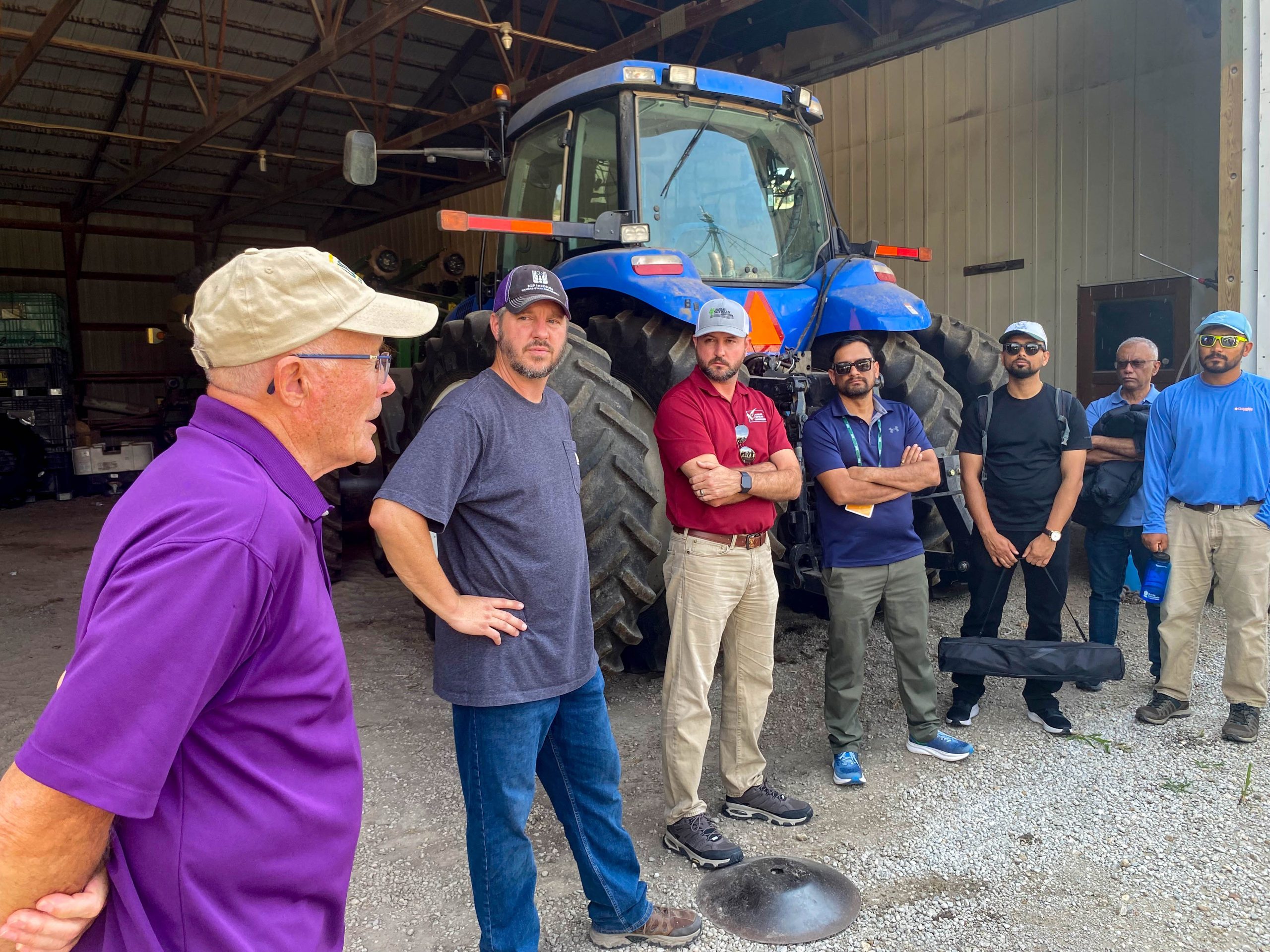
Bob Haselwood recently opened his farm to visitors from Sri Lanka and Nepal.
The team was visiting in conjunction with Soy Connext, the U.S. Soybean Export Council’s annual global event that connects buyers, sellers, growers and other industry partners.
Haselwood has been a member of the Kansas Soybean Commission for 21 years and has hosted many trade teams. He said the farm’s location between Manhattan and Kansas City makes it an ideal stop.
“I couldn’t tell you how many teams we’ve hosted over the years,” he said. “Whether they’ve come through USSEC or IGP, we’ve had plenty of that here.”
Haselwood believes this is the first group that he’s had from Sri. Lanka and Nepal.
“We’ve had people from Japan and China and parts of Europe and out of the Americas,” he said. “We’ve hit about every region, but that area (of) South Asia, and I don’t think we’ve had anybody from there.”
Overall, the response was positive.
“It’s always good to talk about the things that we do, and I mean we hope that we’re doing things sustainably,” Haselwood said. “We did talk about that, and then they asked about production costs and what type of yields we get and things like that.”
For him, visits like this are important.
“I think a lot of the people want to see what we’re doing in the U.S., so they kind of get an idea what’s going on with our products,” Haselwood said. “We’re in soy products, and why we’ve had better quality than, say, another supplier.”
It works the same when another Kansas farmer or United States farmer visits another country.
“The buyers always like to show what they’re doing too, so it’s a I guess it works in reverse too,” he said.
Haselwood has attended Soy Connext for several years because of his involvement with international promotion of U.S. soy. According to Kansas Soybean, in 2026 about 400 international buyers from 67 countries were in attendance at the soy event. This is a strong indicator of U.S. soy’s value in global markets.
USSEC plans the trade teams before and after Soy Connext in an effort to get every international visitor on a farm and in front of a farmer before they leave. Most visitors are container importers meaning they allow preserved shipments of food-grade U.S. soy. Containers give these countries the flexibility to ship to small ports or landlocked countries like Nepal, Haselwood said.
Officials at Kansas Soybean said attendees were employed in roles like CEO, managing director, or financial controller, and the vast majority were from poultry feeding operations, though others included feed manufacturers and one crush plant. A couple of journalists—one each form Nepal and Sri Lanka—were taking the stories of U.S. farming back with them.
Sri Lanka is the top U.S. soybean meal market in South Asia, feeding their large poultry population. Soy from the U.S. holds about an 87% market share of soybean meal imports to Sri Lanka, even with disadvantages to other countries like India because of taxes and import duties. Nepal is landlocked and often imports raw ingredients for feed. Demand for meat and eggs is expected to double in the next decade with 91% of their whole soybean imports coming from the U.S.
Haselwood is encouraged by the U.S. Department of Agriculture crop production numbers that came out recently, showing an increase in acres for soybeans. He said when looking at the U.S. crop, traditionally about half of it was exported, sometimes nearly 60% was shipped out. Crush expansion has pushed that number further.
“The last I heard, the U.S. has a capacity to crush 60% of the crop, so that would only leave 40% for export,” he said. “You listen to different economists and whatever, and some suggest there could be things that some of the crushers can do to add capacity to the plants, without major things, and we could move it up—the amount that we were able to crush.”
The added crush capacity will leave more soybean meal and oil to “do something with,” he said.
“Of course, right now with the new renewable volume obligations for renewable fuels, that’s put a go signal for everyone to produce more biodiesel and renewable diesel,” he said. “So that is going to take up some of that. “There’ll be more meal to export or be consumed domestically.”
“Some of these countries that we don’t think about exporting soybeans or meal or oil to, some of those countries—the younger generation comes on, they’re trying to eat more protein, and animal protein is what they’re looking at, and that’s why they’re going to need more meal,” Haselwood said.
The farm
Haselwood’s nephew, Ryan Johnson, has taken over the majority of the acres on the farm and after farming with him for the last eight years. This helps Haselwood to continue to do the work on the checkoff boards, but the soybean crop in 2026 is looking good.
“Well, we were very fortunate. We had ample rain through June and July, and I think Ryan told me the other day that we had 6 inches, or a little over 6 inches of rain in July, and almost two of those came in the last two days of July,” he said. “We’re only a couple of weeks from a big rain, and then actually last week I think we got four-tenths.”
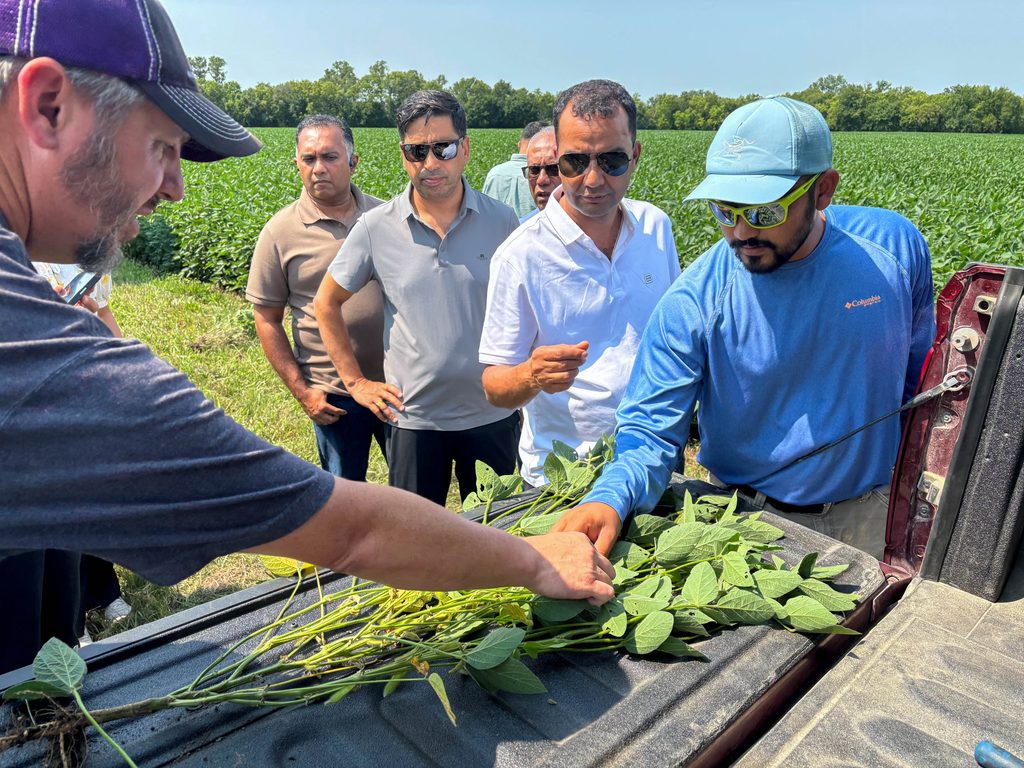
But some of the beans during the tour had smaller pods, he said, and that’s not something Haselwood likes to see.
“There’s a lot of little bitty pods. They’re just past bloom and if it stays hot like this, some of them are going to just drop. They’ll abort those and just fall off,” he said. “Last year we had. I think Ryan said we averaged 65 or 66 bushels per acre off everything he had, and we’re not expecting that kind of yield.”
Johnson is aiming for 50 bushels per acre, but Haselwood said, “ask me again in two weeks.”
Harvest isn’t moved up like wheat or corn crops, but instead the soybeans work off the length of night and reach maturity on their own time.
“If it stays hot, they might decide to quit. Fill what they can, drop some of the pods, and then go ahead and mature,” he said.
Board member
Haselwood got his start in the organization as a Kansas Soybean Commission member, after being asked to apply to fill an open seat in the eighth district. A few years later he got appointed to the United Soybean Board and served 10 years, with one being a chair of the USB. He’s also serving on the Clean Fuels America Alliance.
“Which is basically the same board that promotes biodiesel, renewable diesel, and sustainable aviation fuel,” he said. “I’ve been serving on their governing board—it’ll be two years in November.”
For him, serving on the boards is rewarding.
“When you see that soybean growth in just not only acres but yield in soybeans and the fact that we’re using so many more soybeans, whether it’s through feed or alternative uses or fuel, it makes you think that we’re doing something right,” he said.
He looks at it like—if they weren’t doing something right, people wouldn’t want to plant more soybeans.
“And because they can make a profit, if everything’s right, they’re more profitable than some of the other crops, and so I feel like that’s why when serving on these checkoff boards, that we’ve invested the money wisely, because I don’t think people would be so enthused about planting it.”
Kylene Scott can be reached at 620-227-1804 or [email protected].