Why wait until spring? Strawberries can be planted this fall
K-State horticulture expert says university research continues to uncover best practices, varieties
Kansas gardeners may have more flexibility than they realize when it comes to planting strawberries, according to research at Kansas State University.
While many gardeners traditionally plant strawberries from mid-March to early April, when soil can be worked, preliminary research by at K-State’s Olathe Horticulture Research-Extension Center indicates that June-bearing strawberries also can be successfully planted in late summer and early fall.
The research is currently being conducted by Ravneet Sandhu, a research assistant professor at the Olathe location.
“Fall provides an often-overlooked window for establishing June-bearing strawberries in Kansas,” K-State horticulture expert Matt McKernan said. “(The university’s) initial findings show that plants can be established from late August through late September without negatively affecting yield or fruit quality.”
Researchers have studied annual plasticulture strawberry production at the Olathe center since 2024. In this system, strawberries are grown in raised beds covered with plastic mulch, typically with drip irrigation beneath the mulch. Plants are established each year and removed after a single fruiting season, generally from May through June.
McKernan says the timing of fall planting is important, however. Strawberries planted too late may not become sufficiently established or accumulate enough growing degree days — a measure of heat accumulation used to track plant development — to produce an adequate spring crop.
K-State researchers also tested whether floating row covers could provide an advantage during fall establishment. The study used the June-bearing cultivar “Ruby June,” planted in late August, mid-September and late September in 2024 and 2025.
According to McKernan, some rows received lightweight row covers for two weeks after planting, while others remained uncovered. Researchers then used a heavier row cover on all plants during winter to provide protection from cold temperatures.
“The row covers did increase cumulative growing degree days during fall establishment in both years,” McKernan said. “However, that increase did not translate into a significant difference in overall yield or fruit quality the following spring.”
The findings suggest Kansas growers do not necessarily need to limit June-bearing strawberry planting to spring, if adequate winter protection can be provided to the plants.
“Planting from late August through late September appears to be a viable option for annual June-bearing strawberry production,” McKernan said. “That gives growers another opportunity to establish plants under conditions that can be favorable for root and plant growth.”
McKernan added that researchers continue to learn about which strawberry cultivars perform best under Kansas growing conditions.
Preliminary results indicate the cultivar Chandler may be a strong choice, with consistently competitive yields across two seasons of research. Camino Real, Keystone and Fronteras also showed strong yield potential during their first year of data collection in 2025-26.
McKernan said more testing is needed before K-State researchers feel comfortable making more firm recommendations. Kansas’ growing conditions can vary considerably from one production season to the next, making continued evaluation important.
“As with all research, there is always more to learn,” McKernan said. “We’re continuing to evaluate varieties and production practices to better understand what works consistently for Kansas growers.”
McKernan and his colleagues in K-State’s Department of Horticulture and Natural Resources produce a weekly Horticulture Newsletter with tips for maintaining home landscapes and gardens. The newsletter is available to view online or can be delivered by email each week.
Interested persons can subscribe to the weekly newsletter, or submit their garden and yard-related questions, by sending email to [email protected]. More information also is available at your local K-State Extension office.
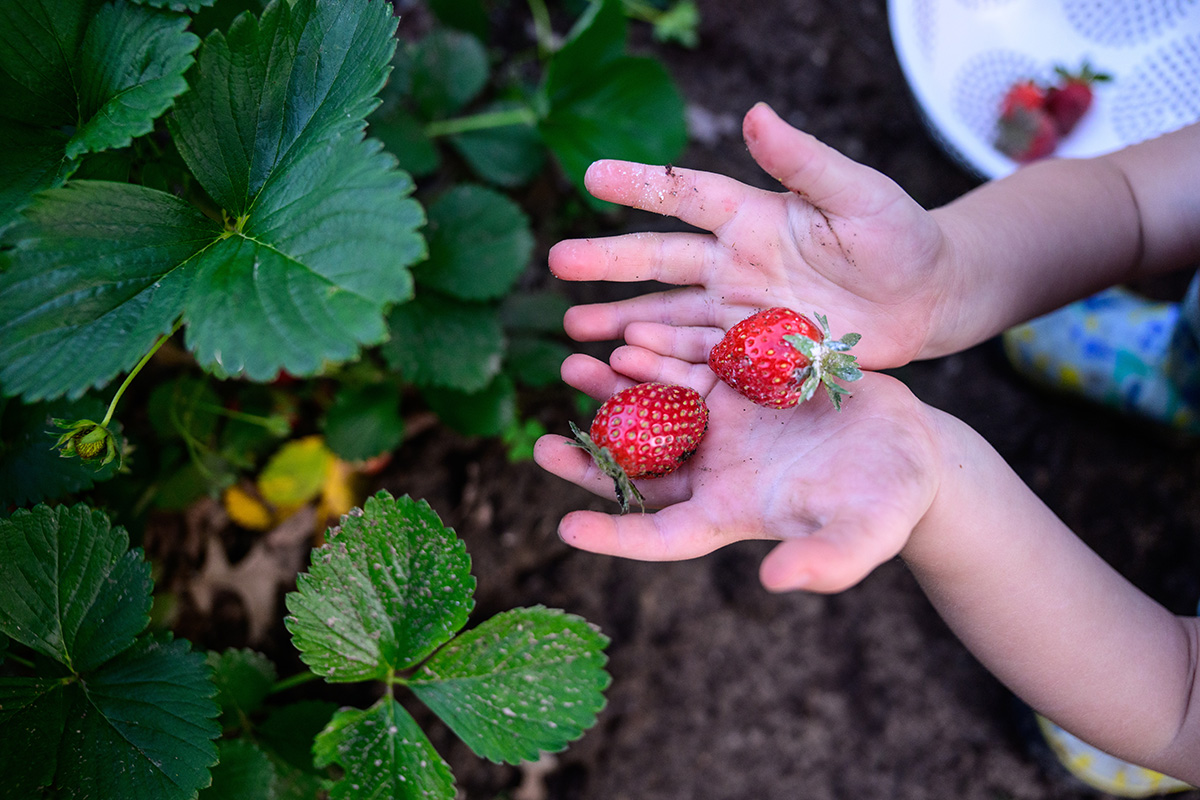
PHOTO: Tiny hands holding strawberries in strawberry patch with green leaves. (Adobe Stock-#1198172203 │ Schaefer Photography)