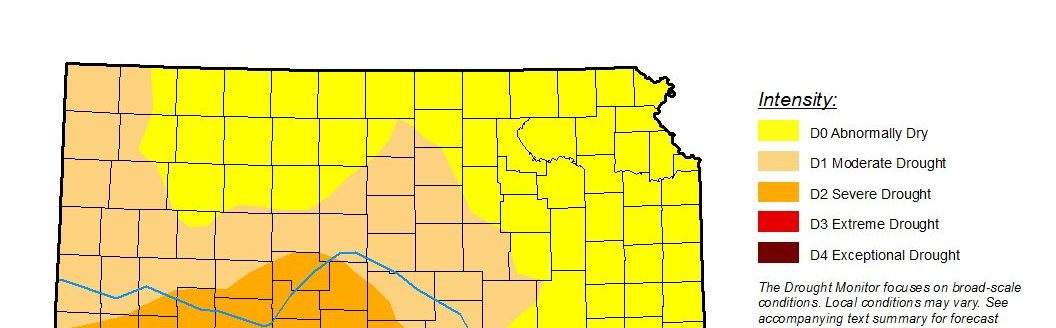
Above average temps this fall, paired with drought conditions and already hot exhaust systems on combines and other machinery can become the perfect storm for a field or combine fire.
Heat can be a common ignition source during harvest, and there are steps equipment operators can take before and during harvest to help reduce risk, as well as how to respond during those first critical moments after a fire starts. Knowing where to move equipment so it’s out of the fire’s path and when to leave are good things to know, as is how to communicate effectively with fire departments and emergency personnel.
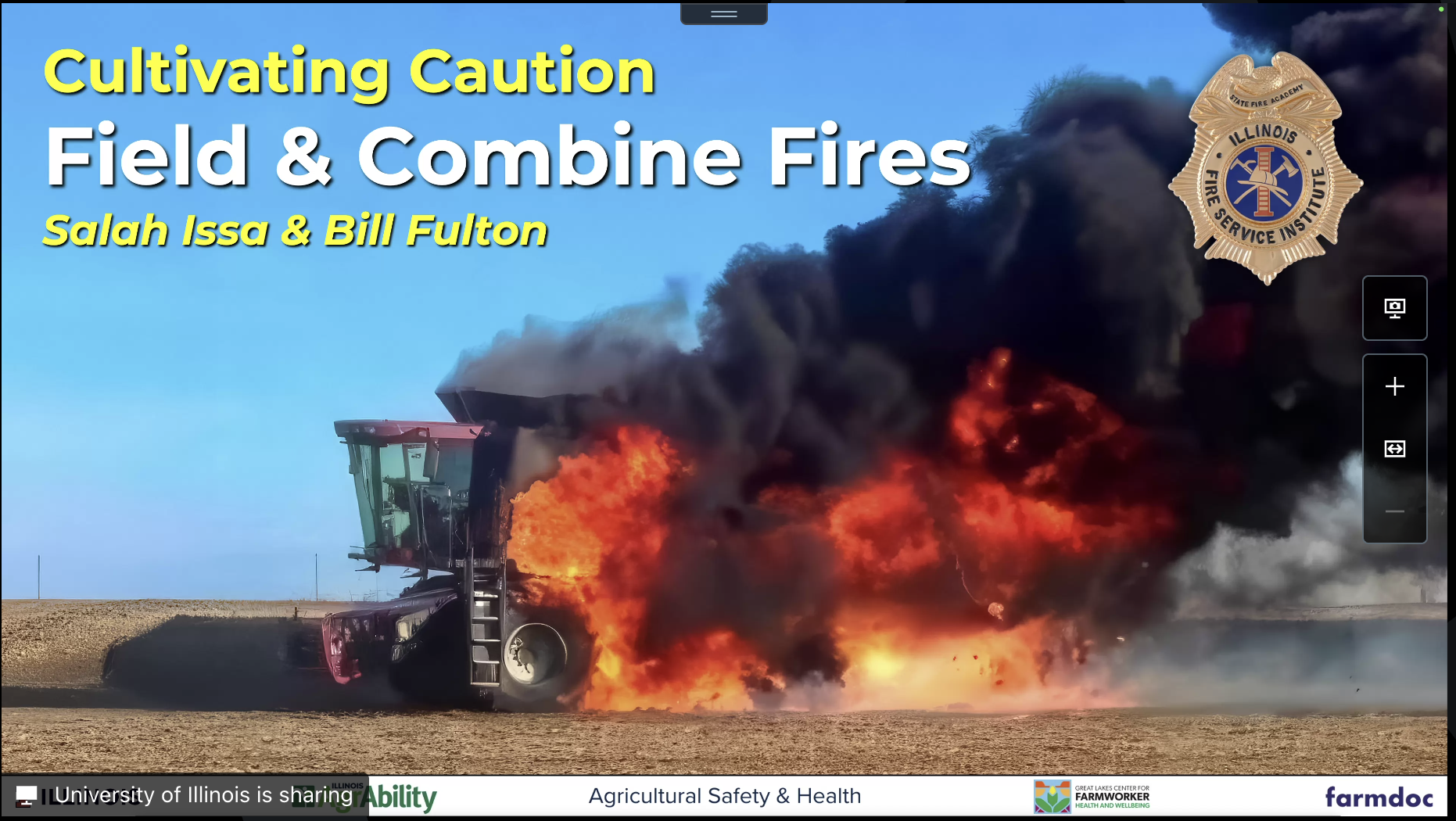
Bill Fulton, senior field instructor with the Illinois Fire Service Institute and assistant fire chief in Salem, Illinois, and Salah Issa, associate professor and Extension specialist with the Ag Safety and Health Program in the Ag and Biotech Engineering Department at the University of Illinois Urbana-Champaign, hosted a recent online event where they discussed what to be aware when a combine and field fire occurs.
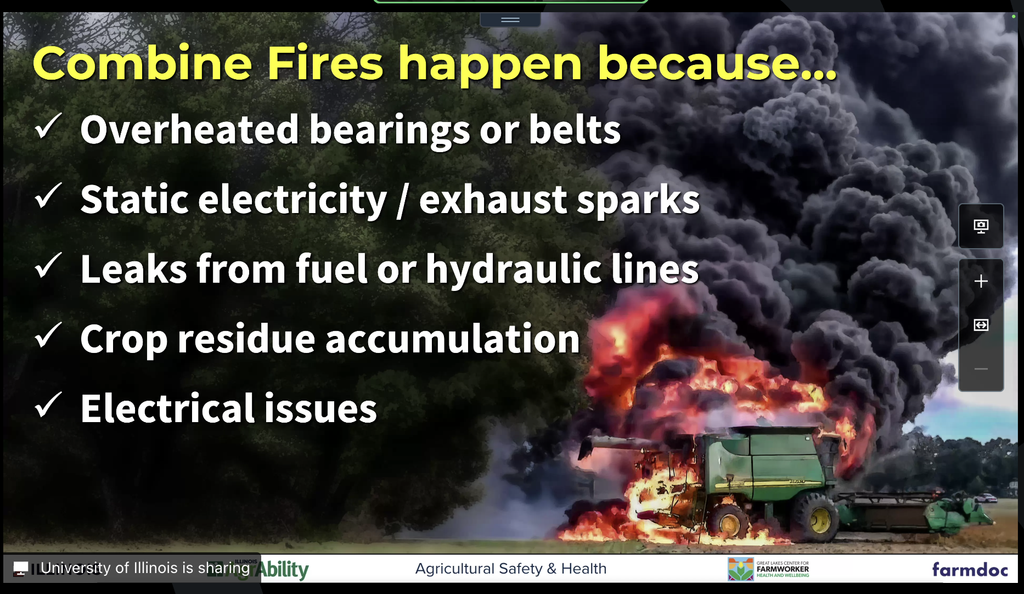
Fulton said typically, when you look at a combine, it’s an overheated bearing or belt that causes a problem.
“Something jams up and it causes excessive friction and heat can cause a fire,” he said. “Static electricity has been an issue to the point that I’ve heard some of the implement dealers are actually asking the producer to drag a chain, just like you used to see on the old gas delivery trucks, to keep the static electricity down on the combines.”
Static electricity has been tied to several fires in recent history. Others have been caused by fuel or hydraulic lines leaking onto some of the more heated areas of the combine.
“We see a lot of crop residue accumulation, especially in weather conditions like we’ve had here just lately, where it’s been extremely hot and dry, and then we get a windy day, which gives it plenty of oxygen,” he said. “And again, the heated areas of the combine, your hydraulic pump, can have excessive heat.”
Fulton said most modern combines have a lot of electrical wiring throughout the machine.
“If you can get a short, again that gets into some of that crop residue and can cause issues,” he said.
He believes there will be more combine fires when there is a long stretch without rain, especially during harvest.
“It may be hot and dry, or at least dry and windy,” Fulton said. “We’re going to see the possibility of more combine fires.” Fulton said.
Farmers are adding to the risk by not taking time to do maintenance or blowing debris out or the machine, he said.
Preparation
Fulton posed the question of how to prepare for a combine fire, and his first recommendation was to have fire extinguishers on hand. He recommends two 10-pound dry can extinguishers.
“That would be the ABC type extinguishers on the combine. Maybe one on the external part of the combine. Usually, they’ll come with one mounted somewhere around a ladder,” he said. “I am not opposed to seeing one in the cab because there are times that the fire is actually down around that left-hand side of the combine, and when you’re getting out, you kind of have to jump away from it, and you can’t get to that extinguisher.”
He also said to make sure you have a cell phone available and call 911 as soon as possible. It may take responders a while to locate you.
“But the quicker we get the call, the quicker we’re going to be able to respond,” he said.
A shovel on the combine can be helpful tool, allowing the operator to put soil on the fire down low on the combine, or if the field starts on fire, he can use the shovel to extinguish the fire before it can get away.
Fulton said it’s important to know the field’s location and give the dispatcher an exact location of the entrances, so firefighters don’t have to search for a field entrance that may not be noticeable when they get there.
Fulton said the combine operator should call 911 before trying to fight the fire.
Other unknowns
Many firefighters are not well versed or accustomed to working around farm equipment and may need guidance, he said. Knowing what the machines are made of is important, too.
Many modern combines have more polycarbonate sheeting on them, so it burns quicker than the metal-covered combines of the past, he said. “So, it’s important that we get notified as quickly as possible so we can get out there because once it gets into that (sheeting), gets into the tires, gets into the fuel system, we’re probably not going to be able to save the combine.”
If the combine is on fire, Fulton said, more than likely the field will be on fire too. Fire departments will usually send one brush truck or a grass firefighting apparatus to respond.
“I know that’s our standard operating procedure for a combine fire, is an engine followed by a brush truck, so that we can contain that fire,” he said. “When you’re on the phone with the dispatcher, if you feel like it’s going to get into the field, make sure that they understand that, and so that we have as much knowledge as possible before we even leave the fire station.”
“So it could be that brush truck is actually what we fight that combine fire with, because it should be four-wheel drive and have the capabilities to get a good start on putting that combine (fire) out,” he said.
Maintenance
Issa said it’s important to maintain equipment and operate machines as intended.
“As in all things, maintenance is key. It’s important to grease and oil your bearings, your chains, and other parts of your combine to the manufacturer’s recommendation,” he said.
An infrared thermometer can detect hot spots on farm equipment, and Issa said they’re relatively inexpensive. Fulton agreed.
“It’s a really good thing to check. Go over the combine and just find where the hot spots are,” he said. “It’s good preventive maintenance.”
Issa said keeping the machines clean and free of debris is important.
“Clean combines, as you can imagine, have a lot less issues—not just fires,” he said. “But other mechanical, other things than just dirty combines. It’s really important to go in there and really clean all the spots in your engine compartment.”
Fulton said well-maintained and greased combines are going to run more efficiently.
Many times he’s shown up to a combine fire, he said, and it’s been caused by something mechanical that includes bearings, leaks or other issues.
“But again, a clean combine is going to have a lot less problems,” he said. “You don’t have that material there that that gives it the fuel.”
Considerations
With combine fires and possible field fires, Fulton suggested thinking about keeping a water trailer or truck that can haul water available during harvest season. Make sure it’s full, if possible.
If there are possible water sources around certain fields, it’s important to know where those are located and relay that information to responders.
“That way you’ve got a water source readily available to you, so that, if need be, you can actually get started on putting out that field fire with that water,” he said.
He recommended keeping the water truck or trailer on the burned side and not on top of crop ground or pastureland.
“You don’t want that engine running over that fuel, like a truck or pickup truck, because catalytic converters can actually set that material on fire,” he said.
Fire responders don’t want their equipment sitting in the line of fire either.
“We don’t want to take a chance on our equipment igniting more of the field. It’s just not safe for us,” he said. “We’re going to always try to work from the burn side.”
Fulton said following the instructions of an incident commander is the best way to stop the fire from progressing.
“The incident commander, I will tell you, he’s in charge. I’m sure he’s going to have a plan. Let him do his job,” he said. “They have the experience. They may be seeing something that you don’t see, and the other thing, they’re going to have some safety things in mind for everybody concerned. That sometimes in the heat of the fight, some people don’t see. Again, work together.”
Also get to know your local fire department. Not all farm locations have a 911 address.
“It’s important for the fire department to understand your farm, know where your locations are,” Fulton said. “It’s sometimes difficult to describe where the fire is, but if you can give us road locations and that kind of thing, then we can pin it down that way.”
Fulton said to make sure the fire department is aware of any hazards. For example, if there is an old well in the area, that can be a hazard to firefighters.
“I mean, all we want to know is what we can do to best serve you if you happen to have an incident and we get called,” he said.
Kylene Scott can be reached at 620-227-1804 or [email protected].