
Technology brings tool to kill difficult weeds

It’s like those zombie movies, but for farmers in the Great Plains, the scenario might be even scarier. In this case, the zombies reproduce quickly and swarm unless you get a complete kill the first time.
“With Palmer amaranth, one plant, outside of competition, can put on more than a million seeds,” explains Jeff Wessels, research agronomist at Frenchman Valley Coop, Imperial, Nebraska. “Even when it’s competing with a crop, it can still put on hundreds of thousands of seeds.”
For Wessels, fighting and killing zombie weeds like Palmer and kochia has involved a career of trial-and-error research into chemistry, adjuvants and application timing. He says he’s found a tool he says is increasing the efficacy of every trip across the field. It comes to agriculture from the health care industry, and it’s called Satchur 8.
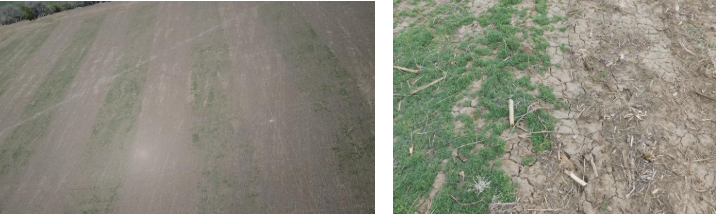
“Satchur 8 helps spread out the chemistry and gets it into the weed leaf better,” says Wessels. “We have a lot of Palmer amaranth and kochia, so we have a lot of broadleaf weeds in our wheat stubble. We need a solid control with a fall burndown to stay ahead of this weed pressure and Satchur 8 in the tank is bringing us a much better kill.”
Wessels said Satchur 8’s unique bonding properties help make the most of the fall application by holding the chemistry near the top of the soil, which he said helps prevent leaching and makes the chemistry more effective and longer-lasting.
“We can go out there and spray and we get a much better jump on the weeds the next year,” he says. “We don’t spray until the soil temps get down to 50 degrees—roughly around the first of November—so that the soil microbial activity slows down so those herbicides will last well into the next year. Satchur 8 has a very large benefit for the few dollars an acre it costs because we never have to go back to that field again and try to do a cleanup job.”
According to Planet Earth Agronomy, the technology behind the Satchur 8 formulation was originally developed as an aid in cancer treatment, with the goal of keeping active ingredients in place. The company says the technology was used to help hold chemotherapy agents at the site of a malignancy. Fiene said the same property is intended to keep herbicides, fungicides and insecticides in place over time.
“The power of Satchur 8 is in its trillions of little microfibers that stick to the leaf surface like Velcro when applied and hold the herbicide it’s mixed with on the leaf surface,” said Larry Fiene, founder and CEO of Planet Earth Agronomy, Mount Horeb, Wisconsin, the company that formulated and rigorously tested the technology for use in agriculture. “It won’t wash off and won’t dry up and blow off the surface. Residual weed control is lasting longer because the active ingredient is being retained in the soil upper profile longer.”
Research Wessels has conducted for Frenchman Valley Coop over the past several years also indicates benefits from fall application of Carbon Cycle, a biological product containing a consortium of microbes that is applied during the fall spray pass.
“Carbon Cycle has several benefits as a residue management tool,” Wessels said. “We want nice seed to soil contact, and nice even planting. Another benefit is getting those nutrients to release from the residue and into the soil.” Wessels has studied the effects of Carbon Cycle across several years and has found multiple benefits to its use on several crops.
“Several years ago, I put Carbon Cycle out where manure had been applied under irrigation,” he said. “When I sampled the soil again to see about the manure residue breakdown, I found we got a 27% higher phosphorus release from the Carbon Cycle, and almost a 40% higher potassium release.” Wessels said he has seen enough over the years to recommend Carbon Cycle every season.
“When you can apply less fertilizer, get better planting conditions and get nutrients released out of the soil, it’s clearly a win,” he said.
For more information, contact a Frenchman Valley Coop representative or visit fvcoop.com.
To contact us: hpj.com/contact/



