When you hear the phrase “4-H,” you might picture livestock such as cows, pigs and goats filling the barns at the Minnesota State Fair. But head into the 4-H Building, and you’ll find that animals can be part of 4-H in a very different way.
Just ask Lauren P.
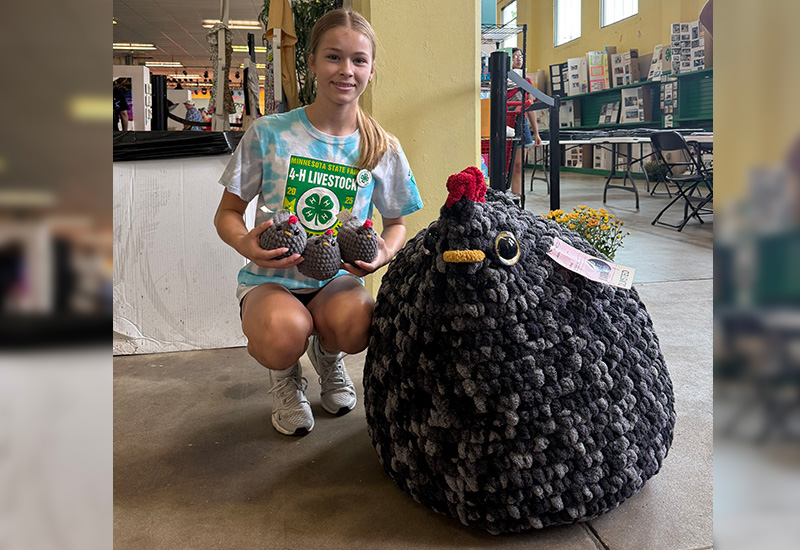
Lauren brought four chickens to the state fair this year. Three were hand-held size, little babies. The fourth, however, came in at over 15 pounds.
How is this possible? She crocheted them!
Made with blanket yarn, Lauren’s four chickens were the result of hours of work, patience and plenty of yarn.
Each of her baby chicks took around two hours, completed over the course of two days. Her larger chicken was a bigger undertaking. She worked on it for two hours every other day over the course of two months.
That’s over 66 hours of work in all!
Lauren drew inspiration for the project from her own chicken, Thunder, back home on her family’s farm.
How to make a giant chicken
Creating a chicken that large came with some challenges of its own. Lauren used a 15-millimeter crochet needle, which she described as being “10 times the size” of a normal needle. The size of the yarn made the process of crocheting even more difficult.
“When you’re crocheting, you’re supposed to put the yarn between your fingers, which I couldn’t do, because the yarn is so big,” she said.
The biggest challenge came when it was time to close up the enormous chicken.
“It took so much strength to close,” Lauren said.
She ultimately used 11 bags of polyfil to stuff the chicken.
Despite the challenges, Lauren knew the project would be worth the effort if it helped her stand out. She was surprised by how many crochet projects were exhibited at the fair this year. Still, she said the judges were blown away by how big her creation was. She also took away a new skill from making her oversized chicken.
“When you’re crocheting, you have to have a certain amount of tension when you’re pulling, so the stuffing doesn’t come through,” she said. “So I learned that tension matters a lot when you’re doing larger plushies.”
Lauren first learned how to crochet from her mom, who taught her how to make blankets when she was younger. Eventually, Lauren turned to YouTube for more videos and tutorials. From there, she began making plushies and tackling more complex patterns.
This isn’t the first crochet project Lauren has brought to the state fair. Last year, she brought a wagon filled with plushies inspired by the fair itself, including a pig, a cow and a corn dog.
Don’t underestimate it
Since joining 4-H, Lauren has also exhibited live animals, including ducks, goats, chickens and rabbits. For Lauren and her fellow 4-H’ers, exhibiting at the state fair is about more than simply putting a project on display. It’s an opportunity to showcase the time, effort and dedication that went into making it.
And for Lauren, the people are the one of the best parts of the experience.
“Everybody’s so nice and the experience is just so fun. It helps me learn new things for the future, and just life skills in general,” she said.
If there’s one thing Lauren wishes more people understood about 4-H, it’s that the program is much more than what they see in the livestock barns.
“I feel like people underestimate it. It’s so fun and it’s definitely a great learning experience,” she said.
As Lauren looks ahead, she’s excited to move into higher age groups, face more competition and come up with new projects.
As for her four crocheted chickens, they may not be staying in her collection for long. She plans to sell them and is even considering starting an Etsy shop to sell her 4-H projects alongside her other crochet creations.
For Lauren, 4-H might include chickens, but they don’t always have to be the kind with real feathers.
PHOTO: Lauren from Olmsted County with her crocheted chicken state fair project (University of Minnesota Extension)