Cattle tags save time, labor for producers
A solar powered tag on your livestock might make sense in some places, allowing producers to keep an eye on them from afar.
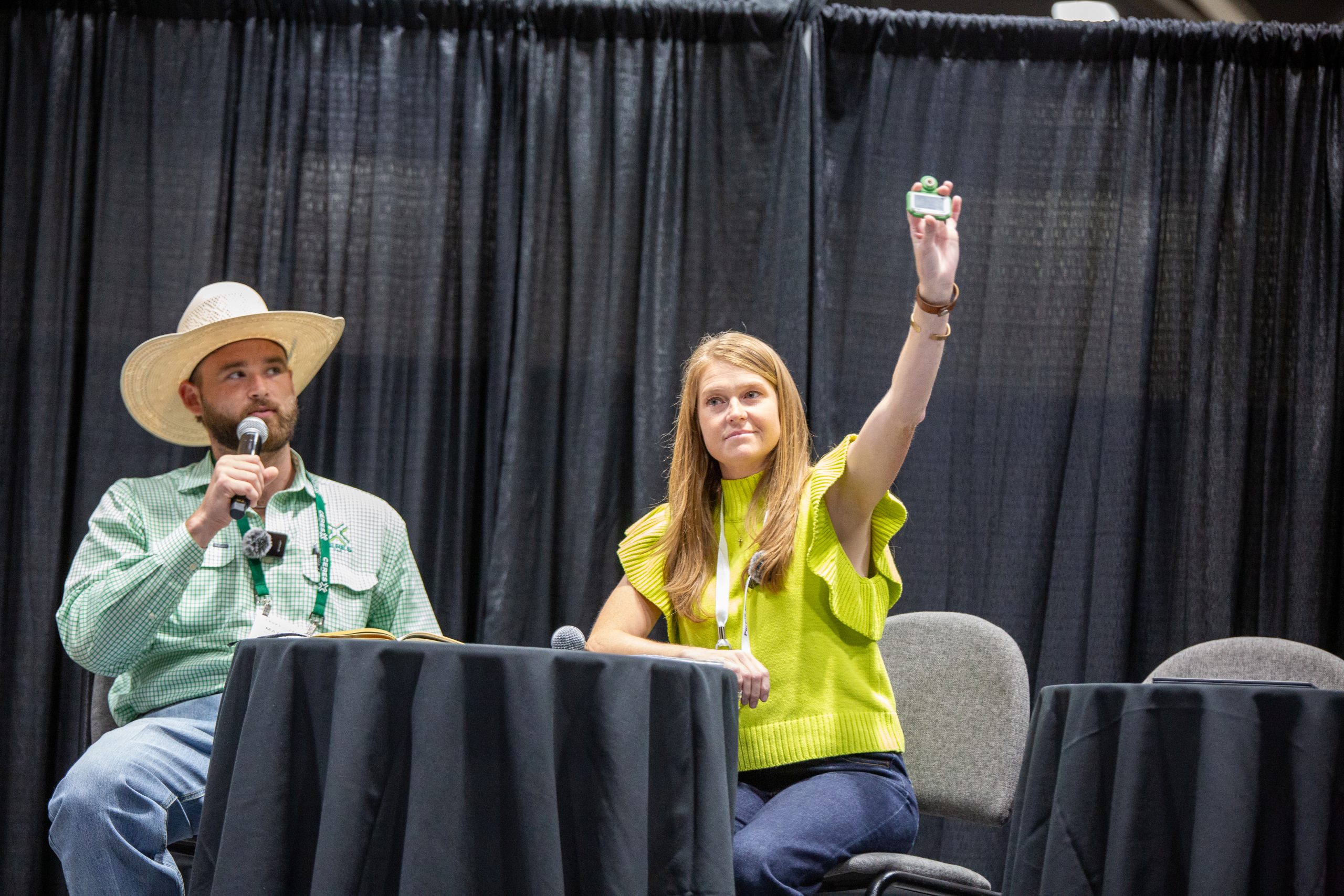
Matthew Randerson, sales lead for Ceres Tag, and Brandi Buzzard, rancher/public speaker/consultant, High Bar Cattle Company/Buzzard’s Beat, shared their insight about Ceres tags at Crops and Cattle this past summer in Kansas City, Missouri.
Ceres Tag is an animal health intelligence platform that allows producers to automate and monitor their animals with direct-to-satellite solar-powered tags.
Randerson said his company has tags on 41 different species across about 50 countries with a United States headquarters in Kansas City. Brisbane, Australia, is where the full headquarters is located.
“It’s super important also that I mention we’re an open platform, so collaboration is a keystone corner of our business,” he said. “We work with different research universities, software partners, and distributors to build a community that allows you to have people that you can go to to gain insight about how the technology works and how you can apply it.”
The tags are “deployed” on animals and once they’re deployed, they automatically start collecting data 24 hours a day. The data is sent to a satellite, which means there’s no need for infrastructure to collect the data.
“No Wi-Fi, cell service, or phone service,” he said. “And through the satellites, it is then encrypted and sent to our servers, and we then make that data available to you through any one of our ranch management software platforms.”
Then producers gain insight on how animals are performing to make better decisions, which can ultimately help them be more profitable.
For Buzzard, living in remote and rural areas of the country, hearing the term “direct to satellite” can sound like another buzz phrase.
“I don’t have great cell phone service, and you don’t need great cell phone service for these devices to send the data to your platform or send it to your laptop or your mobile app or whatever, which is really important,” she said. “Because when I get an alert that maybe a cow is out of the grazing area that we’ve set, I don’t want to have to wait until I have good cell service to get that alert.”
These alerts have been helpful in her operation.
Randerson said there’s several technologies on the market now, and what makes Ceres Tag stand out for him is the advanced algorithms that allow data collection, including pasture feed intake.
An open data platform allows a producer to collect data for different purpose or a different operation, he said. A rancher running yearlings will want different metrics on animal performance versus someone who has a cow-calf herd or a seed stock producer.
Multiple options can allow the producer to access data for ranch management software, Randerson said. Direct to satellite for scalability is important in remote places around the country and the world, including the northern part of the U.S. where producers may not have permanent infrastructure on land that they might not even own.
The new Ceres Gen 6 devices are the newest flagship product on the market, according to Randerson, and the company recently introduced a suite of reproductive algorithms that include estrus and calving alerts.
“Those are all based on individual animal performance, not herd performance, which is important because not all cows act the same, as all of you know,” he said. “Even within a herd, you’ll have outliers in terms of just their normal behavior, and so monitoring and making decisions based off individual animal behavior is how we’re able to give accurate information to you as a producer.”
The tags are “redeployable,” meaning they can be removed from one animal and placed in another. The tag will start learning the movements and intricacies of the new animal.
“You can assign it to a new cow,” Buzzard said. “All of my tags are assigned to certain cows, and some of them have nicknames in our system, and some of them just have their tag number.”
Buzzard said once the tag is assigned to the new cow, after seven days, they’ll have data specific to her.
“You’re making the investment for this tag, and it’s not just tied to one cow. You can reassign it, and to my knowledge, there’s no limit on the number of times you can assign it to a new cow,” she said. “You’re going to be able to reuse that tag over and over. And so that, to me, is a really key point and a really valuable component of the Ceres Tag system.”
Randerson said producers can spread out the cost of investment across a herd.
“Technologies need to be safe to fail, meaning that you don’t have to commit a large financial overhead to be able to understand how the technology works for you,” he said. “We’ll have producers who put them on their bulls, understand bull activity, and then if they have a group of first calf heifers, you can throw it on the first calf heifers and have it there for the calving—it’s the same tags, so you’re really spreading out that initial investment across multiple animals.”
The real “meat and potatoes” of the tag allows producers to see certain details based on the data the users receive. Randerson said they get a standard data packet every six hours or four packets a day.
“That data includes location as well as minutes spent grazing, resting, ruminating, drinking, and walking,” he said. “Along with that data packet, you’ll get a daily pasture feed intake metric.”
The tag has an accelerometer on it, and that helps to be able to distinguish and classify the five behaviors mentioned previously.
“For pasture feed intake, it’s not only the behavior of the animal grazing, but it’s also where they’re grazing at,” he said. “We use RAP data, or the rangeland analysis platform, to know the forage portfolio in the area that animal’s grazing. And since we know there’s differential energy availability between warm and cool season grass types, we’re able to collect that data, put it with the time spent in raising, and that goes into a series of algorithms, which gives you a 93% accurate passive feed intake metric for cattle.”
There’s also push alerts that come as events happen.
“Those include high activity, which is an animal that is seven to nine standard deviations above their normal resting behavior,” he said. “That can be anything from predation to wildfires to theft.”
The new reproductive algorithms are also push alerts, Randerson said—estrus alerts, calving alerts.
“It’s not a virtual fence, but it is a geo fence,” he said. “So, what that means is that if you have existing infrastructure, you can map your pastures and be alerted when animals go outside of that boundary. So instead of getting a call from the neighbor after you haven’t seen cows for two days, you get that alert as needed, and you can go and handle that.”
Buzzard said on her operation she uses the data differently than other classes of cattle, but as a seedstock producer, she’s more interested in what the grazing data looks like.
“I remember just recently I did like a rundown of how much time cows were grazing versus how much they were walking, and a surprise to no one if your cow is walking more hours a day than grazing, it’s going to have a lower pasture feed intake,” she said. “So, we looked at that compared to the size of the calves that we were weaning off.”
She had a particular cow she didn’t like, and as an experiment put a tag in her and tracked her data. She was hoping her calves would be small, and it was a more valid reason to get rid of her.
“And I was wrong. We have to keep her because she’s weaning off big calves and is putting her grass into her calves,” she said. “It’s a wonderful testament, like this cow that I hate. But it shows you that we’re able to instead of say, OK, the cows are out there eating and she looks like she’s good condition, for us able to actually have like a legitimate idea of how much she’s consuming.”
Buzzard has several types of grass in her pastures and had examples of how she was able to track cattle in certain areas of the pastures and whether they were in the areas with native grass versus fescue.
“It’s really cool to see such a dynamic technology; it provides different kinds of intake data rather than just your cow is eating corn and it’s the same everyday corn, corn, corn,” she said. “I think, as a self-proclaimed grass geek, I find that very cool, knowing that there’s different levels of nutrition based on the seasonality of the grasses, and we can see what they’re eating. So that’s what we, as seed stock producers, we’ve been able to use it for.”
For more information about Ceres tags visit cerestag.com.
Kylene Scott can be reached at 620-227-1804 or [email protected].