Fertilizer costs add pressure to farmers’ 2027 production budgets
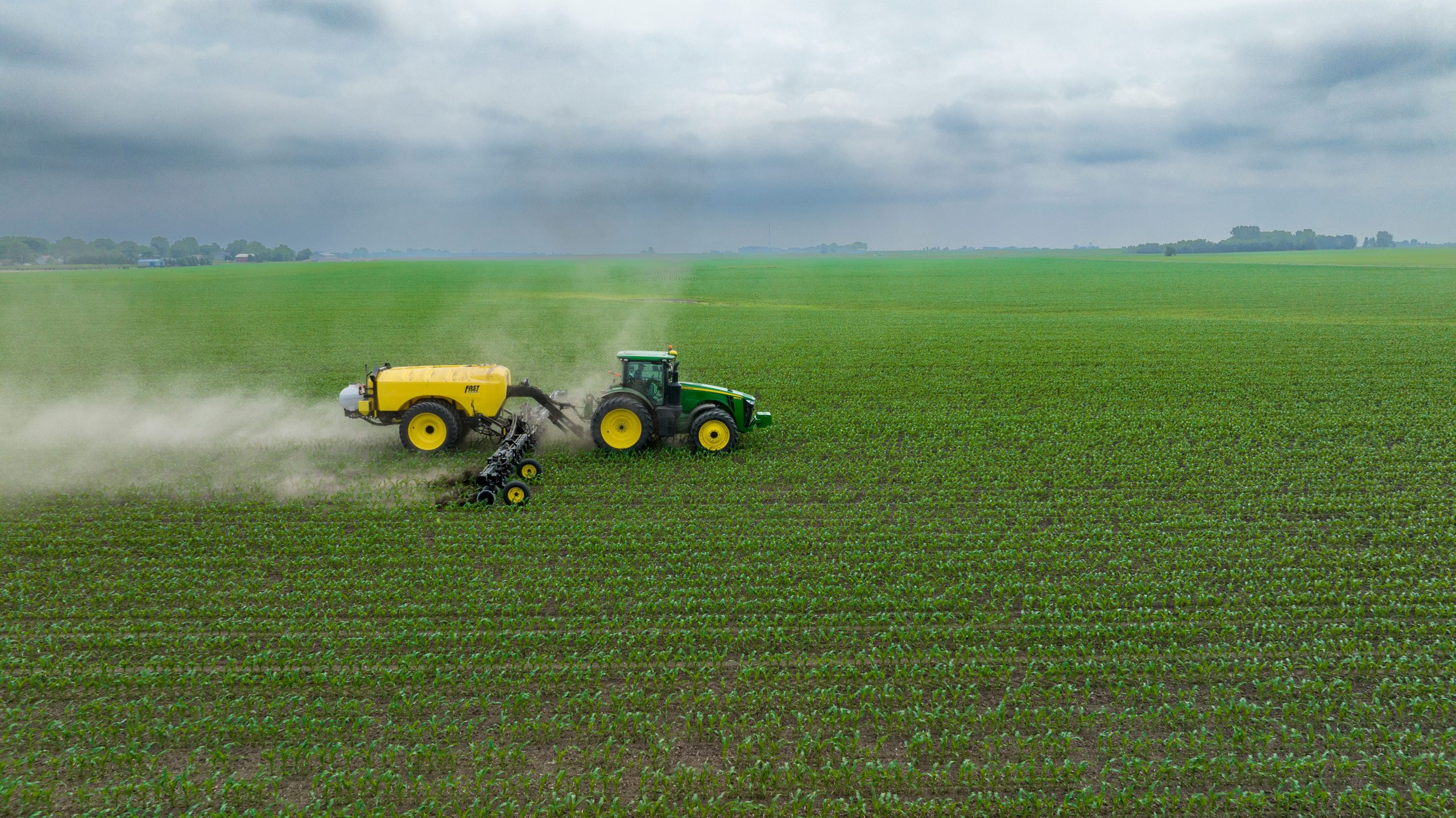
Farmers are reviewing fertilizer purchases and nutrient management strategies as rising input costs add pressure to tight production margins ahead of the 2027 growing season.
With fertilizer prices rising significantly in 2026, producers are evaluating where they can reduce expenses without sacrificing yield potential or creating longer-term soil fertility concerns.
According to DTN Retail Fertilizer Trends, fertilizer prices continued to climb in November, with all eight products showing year-over-year increases compared with November 2025.
Anhydrous ammonia recorded the largest increase, rising 17% to an average of $1,003 per ton. Urea prices increased 11% to $662 per ton, while monoammonium phosphate climbed 7% to $991 per ton.
Starter fertilizer 10-34-0 increased 6% to $704 per ton, followed by UAN32, which rose 4% to $484 per ton. Diammonium phosphate and potash each increased 3%, averaging $950 and $504 per ton, respectively. UAN28 also was up 3% to $428 per ton.
Faith Parum, deputy chief economist for the American Farm Bureau Federation, said fertilizer market volatility is expected to continue into 2027, while Brian Arnall, precision nutrient management Extension specialist at Oklahoma State University, said producers already are adjusting their nutrient management decisions in response to higher prices.
“We’ve had tight margins for several years in a row, and that was without this big spike of fertilizer and fuel prices in 2026,” Parum said.
The combination of relatively low commodity prices and rising production expenses has left farmers with limited opportunities to improve profitability. Parum said fertilizer can account for 30% to 40% of a crop producer’s operating expenses, depending on the operation’s budget. Fuel also represents a significant expense.
The pressure extends beyond traditional row crop operations to specialty crop producers and ranchers applying nutrients to grazing land.
Fertilizer markets remain volatile
Several factors have contributed to higher fertilizer prices, including geopolitical conflicts, energy costs and international supply chain disruptions.
Parum said nitrogen-based fertilizers experienced particularly sharp increases following the conflict in Iran, while other fertilizer products saw price increases later as supply chain problems affected availability.
“The Middle East is a large producer of petroleum products, and petroleum byproducts are used in a lot of things, from plastic fibers in our clothing all the way to fertilizers,” Parum said. “It’s very similar to what we saw in 2022 when Russia invaded Ukraine, and that continues to drive fertilizer volatility today.”
International purchasing and export decisions add another layer of uncertainty. Parum pointed to India’s large-scale fertilizer purchasing practices and China’s decisions to restrict exports during periods of market volatility as factors capable of moving prices.
Even if geopolitical conflicts end, Parum said damaged infrastructure and disrupted supply chains will take time to recover. She expects fertilizer prices to remain elevated throughout 2027, although increases may not be as significant as those experienced in 2026.
Her advice to producers is to watch for favorable purchasing opportunities and consider pre-buying fertilizer when their suppliers and local supply chains make it possible.
“If farmers and ranchers have the ability to pre-buy and their supply chain is set up that way, I think that could help mitigate some of this risk,” Parum said.
Producers reconsider fertilizer applications
Higher prices are already changing how producers approach nutrient management, particularly phosphorus and potassium applications.
Arnall said producers are pulling back on phosphorus and potassium applications, especially on fields with average yield potential. Rather than applying nutrients at replacement rates, many are moving toward sufficiency-based recommendations.
“I have talked to several people who are not applying phosphorus and potassium unless sufficiency is below 90%,” Arnall said.
He recommends producers avoid yield-replacement applications of phosphorus for now, particularly on dryland acres, and instead follow soil-test-based sufficiency recommendations.
Potassium presents a somewhat different situation. Arnall said producers should consider using sufficiency recommendations for most crops, while considering replacement applications on higher-yielding ground and high-production forage acres.
Arnall also emphasized the difference between replacement fertility and crop fertility needs. He said one mistake producers can make when reducing fertilizer expenses is assuming replacement rates directly increase crop yields.
“Replacement fertility is about the soil, not the crop,” he said.
Replacement applications are intended to maintain soil nutrient levels over time. They do not necessarily provide an immediate yield response in the crop receiving the fertilizer.
Soil testing guides decisions
Both Parum and Arnall emphasized soil testing as an important tool for determining where fertilizer expenses can be reduced. Parum said producers should work with Extension specialists, agronomists and other trusted advisers to identify nutrient applications that can be adjusted without creating yield losses.
Soil testing can help determine what nutrients are needed and where applications may be unnecessary. Variable-rate technology also allows producers to make more targeted applications based on differences within individual fields.
Arnall said even a relatively inexpensive soil test can make a substantial difference in a producer’s fertilizer budget. He suggested producers do not necessarily have to view soil-test results as precise numerical targets. Instead, they can use high, medium and low categories to guide decisions.
Fields with high nutrient levels may not need additional fertilizer, while low-testing fields warrant applications. Medium-testing fields may require additional consideration based on field history and other factors.
“A test that can cost as little as $15 per field can have a big impact on the number of zeros in your fertilizer bill,” Arnall said.
For corn and sorghum producers, he also recommended considering deeper soil samples to evaluate nitrogen and sulfur levels. While nitrogen is not traditionally included in every soil-testing program, he said residual nitrogen is particularly important to consider this season.
If residual nitrogen levels are high, producers may be able to reduce application rates. Arnall also recommended banding phosphorus, when possible, to improve nutrient placement.
Protecting yield potential
While reducing fertilizer expenses is important, both experts cautioned against making decisions based solely on the goal of cutting input costs. Parum said producers need to understand their break-even prices, expected yields and overall production budgets before making purchasing and application decisions.
Those budgets should be reviewed throughout the growing season as commodity prices, input costs and production expectations change. She said producers should evaluate the economic return from each additional fertilizer application by considering whether the expected yield increase will justify the expense.
“If you’re spending ‘X’ amount and you’re not getting any more yield on it, then maybe it’s not the best sound financial decision,” Parum said.
Arnall similarly emphasized the importance of making nutrient decisions based on individual field conditions rather than following practices simply because they have been used in the past.
Producers should be cautious about applying the same fertilizer strategy across every field, as soil fertility, yield potential and nutrient requirements can vary considerably. Arnall said producers should focus on sound agronomy and thoughtful planning rather than searching for a single product or application strategy that will solve the problem.
“There is no silver bullet product,” he said. “This season needs solid agronomy and thoughtful planning.”
Lacey Vilhauer can be reached at 620-227-1871 or [email protected].