We’ve all been there. You want to eat healthier, but cooking dinner after finishing a long, hard day of work sounds impossible. Signing up for a meal kit service suddenly seems like a good solution.

If that sounds familiar, you’re not alone. Meal kits — whether they’re simply heat-and-eat, packaged with already portioned ingredients, or somewhere in between — are big business. According to recently published research, the global meal kit delivery services market was valued at $20.54 billion in 2022 and was expected to grow at a compound annual rate of 15.3 percent from 2023 to 2030.
If you’re trying to decide whether to sign up for one of the meal kit services, Lida Araghi, assistant professor and nutrition extension specialist for the University of Arkansas Division of Agriculture, offers some guidance.
“Consumers should begin by identifying what problem they want the service to solve,” Araghi said.
“Meal kits may be helpful for people who lack time for meal planning and grocery shopping, want to cook more often, need new recipe ideas, or frequently rely on takeout,” she said. “However, someone who already plans meals, shops efficiently and uses leftovers may find less value in a subscription.”
Five questions to ask
Araghi said consumers should ask these five questions before deciding on meal kits.
1. Am I trying to save planning time, shopping time, cooking time, or all three?
A key selling point of meal kits is the time they can save you. Araghi said if planning and shopping are the main barriers, a traditional ingredient-based meal kit may help. However, if cooking is the main barrier, a fully prepared meal-delivery service may be more appropriate.
2. What is the true cost per serving after shipping, fees, add-ons, and required pantry ingredients?
Advertised prices for meal kits may seem like a good deal, but Araghi said hidden and add-on costs can add up quickly.
3. Do the meals fit my nutritional needs and portion expectations?
Just because a meal is advertised as a healthy option doesn’t mean it will fit your specific needs, Araghi said. Always check the labels and read the fine print.
4. Will I realistically prepare and eat the meals before the ingredients spoil?
While meal kits can simplify the planning and shopping process, consumers still need to be realistic about the time needed to prepare the food. Araghi said that if you struggle to find time to cook meals now, it is important to consider how you will make the most of a meal kit.
5. Does the convenience justify the additional cost?
It all comes down to weighing the convenience of meal kits — including the time they might save and the simplicity of specialized kits for different dietary goals — vs. your budget, Araghi said.
Can meal kits help me achieve dietary goals?
In addition to convenience, meal kits can offer menus to help consumers achieve dietary goals.
“Many services offer vegetarian, high-protein, calorie-conscious, carbohydrate-conscious, or other specialized choices,” Araghi said. “However, these terms are often marketing categories and may not be standardized. Consumers should review the Nutrition Facts label, ingredients list, portion size, and several weeks of menus rather than relying only on the plan’s name.”
Araghi also said that those with food allergies, celiac disease, diabetes, kidney disease, hypertension, or other medical dietary needs should also examine allergen and cross-contact information carefully and consult a registered dietitian nutritionist or healthcare provider when appropriate.
Meal kits may also support weight-management or other nutrition goals when the portions and nutrient content match the individual’s needs.
“However, a meal labeled ‘high protein,’ ‘low carb,’ or ‘low sugar’ is not an automatically balanced meal,” Araghi said.
For a balanced diet, “consumers should also consider calories, sodium, saturated fat, fiber, vegetables, and whole grains,” she said.
Do kits contain ultra processed foods?
Meal kits are not automatically nutritious, Araghi said.
For years, nutrition experts have cautioned consumers against ultra processed foods, which tend to be calorie-dense, high in unhealthy fats and starches and poor sources of needed nutrients.
Araghi said the amount of processed foods varies considerably among meal kits.
“Some meal kits may include fresh produce and other minimally processed ingredients along with prepared sauces, seasoning blends, refined grains or processed meats,” she said.
“Fully prepared, ready-to-heat meals may contain more processed components, but that is not true of every product,” Araghi said.
“Processed” is not an all-or-nothing category, Araghi said. Consumers should examine the actual ingredients list and Nutrition Facts label rather than assuming that every meal kit is more-or less-processed than a meal prepared at home.
Are meal kits cheaper than groceries?
“Generally, meal kits are unlikely to cost less than carefully planned grocery meals, especially for larger households or consumers who purchase ingredients in bulk and use leftovers,” she said. “The comparison changes if the meal kit replaces restaurant meals, takeout, or groceries that would otherwise go unused.”
Consumers should calculate the full cost per serving, including delivery charges, fees, add-ons, and pantry ingredients. Introductory discounts should not be used when estimating the long-term cost, Araghi said.
What does the research show?
Research suggests that “meal kits may increase meal variety, provide more opportunities to prepare vegetables, reduce meal-planning burden, and help some consumers cook at home more often,” Araghi said. “Pre-portioned ingredients may also reduce household food waste.”
She said that “meal kits can make home meal preparation more convenient, but consumers should not assume they are automatically healthier or less expensive.
“The best choice depends on the person’s budget, schedule, health needs, cooking habits and the specific meal kits selected,” she said.
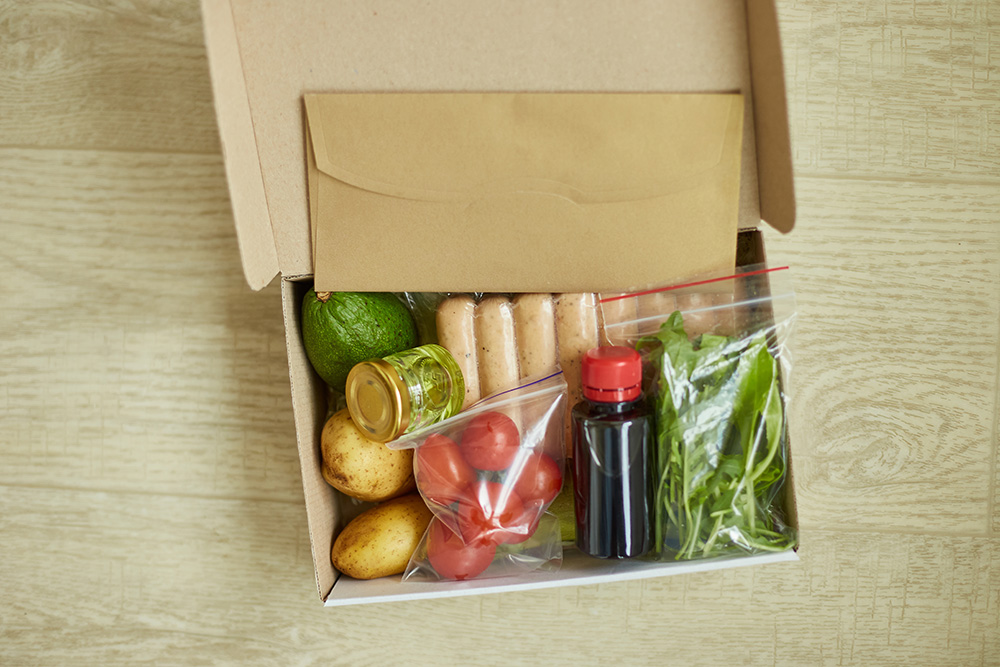
PHOTO: Food box meal kit of fresh ingredients and recipe blank order from a meal kit company. (Adobe Stock-#430544469 │ bondarillia)