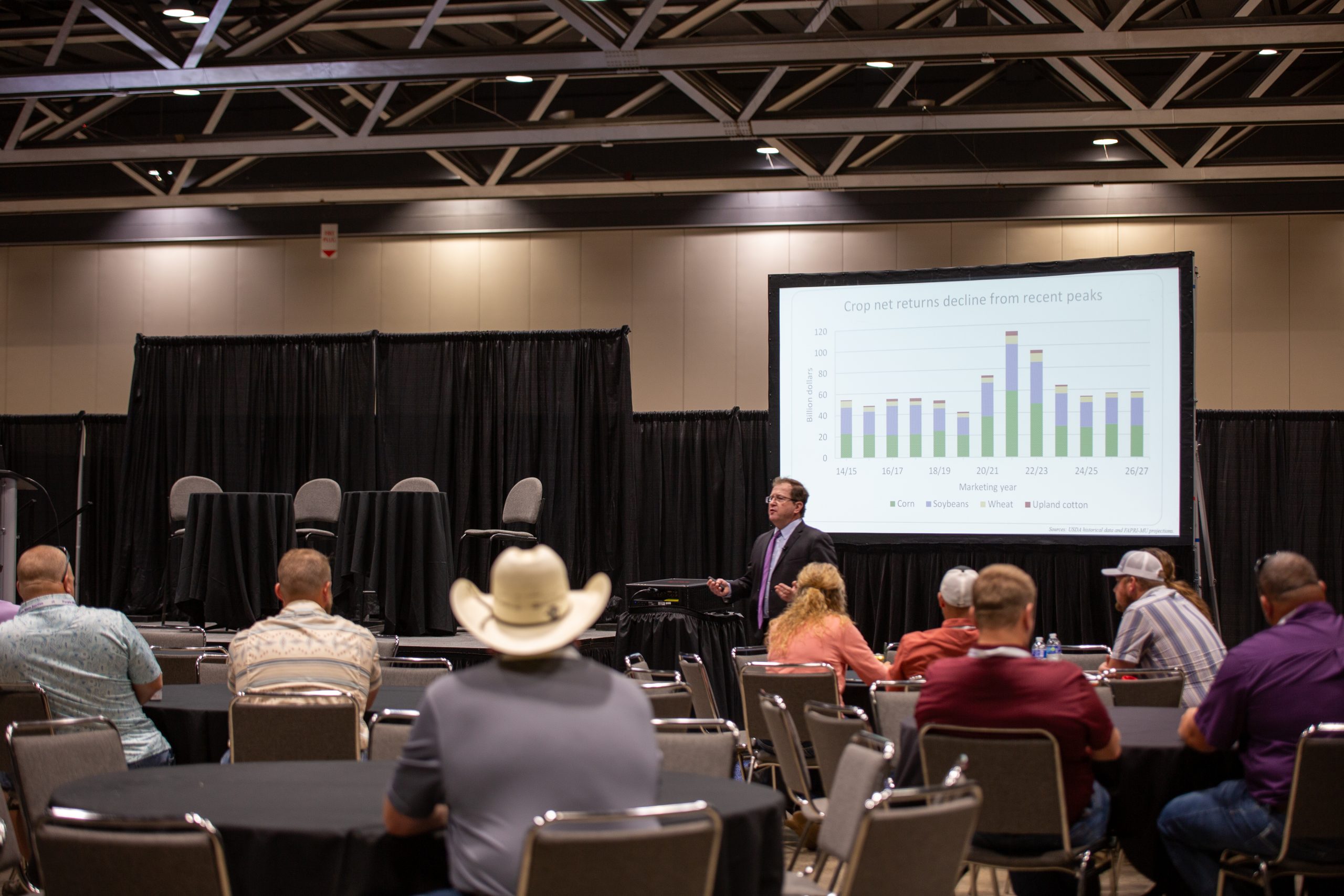
Numbers do not lie, but in the current economic environment they tell a different story in agriculture, according to a keynote speaker at High Plains Journal’s Crops and Cattle Conference and Ag Expo Aug. 6 in Kansas City, Missouri.
In 2026, net farm income is projected at $153.4 billion.
“You have a situation where the livestock sector is bringing in a lot more receipts than the crop sector,” Meyer said. “That’s not all that common when you get that large of a wedge and that kind of dichotomy between the two sectors.”
Ranchers also are feeling the pain of higher operating costs. Meyer noted that while cowherd numbers remain about 28 million head, the cattle industry has remained resilient because of consumer demand for beef. Ranchers and feedlot operators also have been sending heavier animals for the packing industry to process.
He noted that when egg prices soared several years ago, consumption was not dramatically reduced. That trend is also being shown in beef.
“Consumers are becoming less responsive to price and more responsive to preferences, and so you can get these price swings like in eggs, and you can get that kind of price movement in cattle because demand isn’t changing all that much,” he said.
Pasture and rangeland conditions have not improved enough to spur ranchers in the Dakotas, Nebraska, Kansas, parts of Oklahoma and neighboring states to ramp up cow-calf production. Until those conditions significantly improve, ranchers are going to be cautious, he said.
Pictured at top, Seth Meyer, of the University of Missouri’s Food and Agricultural Policy Research Institute and a former U.S. Department of Agriculture chief economist, said the crop side of the farm economy is hurting, but the livestock side, particularly cattle, has shined. Pictured at top is Seth Meyer, director, FAPRI-MU and associate professor, University of Missouri. (Journal photo by Kylene Scott.)
Crops
Government and ad hoc assistance programs have helped buoy the crop side, Meyer said. USDA reports that in 2026, direct government farm payments are forecast at $44.3 billion, a $13.8 billion increase from 2025. While the aid also assists ranchers, payments are largely projected to go to commodity programs.
Payments from the Market Facilitation Program, Coronavirus Food Assistance Program and Farmer Bridge Assistance Program have put money in the hands of producers, Meyer said. The One Big Beautiful Bill Act, signed in July 2025, sets the stage for less money for ad hoc assistance. In exchange, producers will see changes in reference prices and more flexibility with Agriculture Risk Coverage and Price Loss Coverage programs.
Meyer said the past two years have had a similar feel to 2014-2019, except input costs, most notably fertilizer, have stayed consistently high. Diesel costs remain high because of the Iran war. Crop producers felt the sting of elevated input costs in 2025, and it persists, he said.
Grain producers in other countries are also feeling the pain.
“Brazilian farmers are getting squeezed too,” Meyer said.
Crop producers are benefiting from biofuel and renewable energy development, he said. Most ethanol produced in the United States is destined for the export market.
China is a less reliable market, but Meyer said its actions are more tied to economics because the country’s population has peaked. The U.S. ag sector needs more diversity in its export markets, he said.
Corn has shown resilience, and export commitments indicate 3.3 billion bushels are headed to global markets.
“Now we are exporting 3 billion bushels, which we’ve never done before,” Meyer said. “We’re going to blow through that by another 10%. So, we’re sending it out the door. The price is doing the work.”
Soybean crush and biodiesel markets have helped maintain demand for the crop in recent years as China has been buying soybeans from Brazil, he said.
As of Aug. 6, Meyer said there had been some upward movement in grain prices because of numerous uncertainties.
“It’s going to take more than one of them in order to send prices higher,” he said.
The wheat sector has been hit by a poor crop in the High Plains, but a major price spike has not materialized because farmers around the world can grow the crop, Meyer said. One driver of recent higher prices has been an escalation in fighting in the Black Sea region.
Sorghum could be the beneficiary of better trade relations between the U.S. and China, he said. China likes the grain because it is not genetically modified.
Dave Bergmeier can be reached at 620-227-1822 or [email protected].
Related coverage and resources
- Related on HPJ: Farm economy follows several paths
- Related on HPJ: Mizzou’s FAPRI notes separate path for grain and beef producers
- Outside resource: University of Missouri FAPRI — 2026 U.S. Agricultural Market Outlook