Google considers Ford County for data center
Google is looking at Ford County in southwest Kansas as a potential landing spot for a data center.
Officials said during a July 21 community forum sponsored by Victory Electric Cooperative Association that the project is in the discussion stage. Google has been doing preliminary work and has communicated with Victory Electric, Ford County and other entities that would be essential if the project comes to fruition.
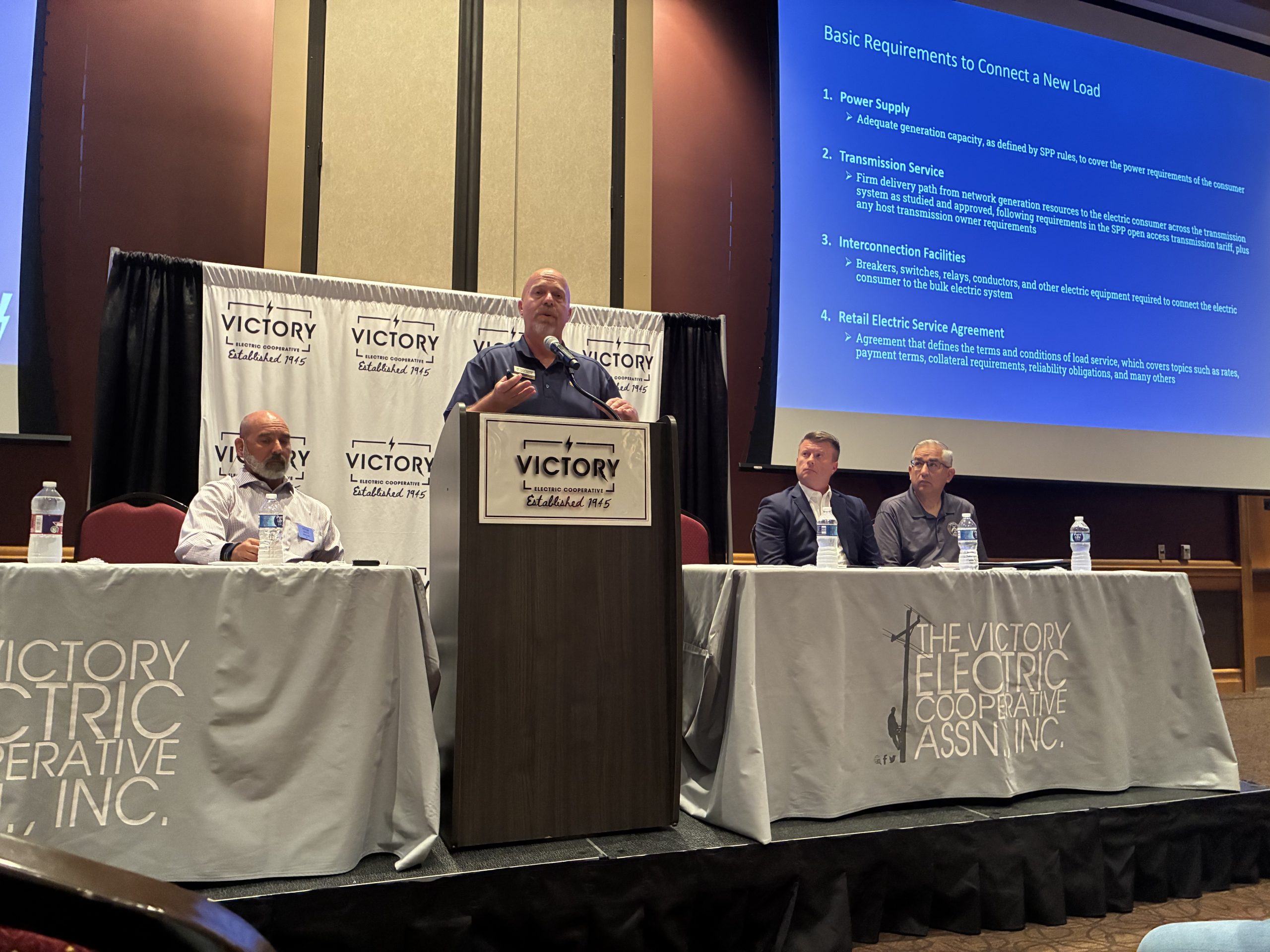
Shane Laws (pictured in the top photo at left), CEO of Victory Electric Cooperative Association, said the data center would likely include two 800,000-square-foot buildings. The company has secured 640 acres for the data center and an additional 640 acres for a backup generator and other infrastructure.
The forum, sponsored by Victory Electric Cooperative Association, included presentations from other entities that have also been looking at the potential of a data center. Other presenters included (pictured at the podium) Corey Linville, senior vice president and chief operations officer of power supply and generation with Hays-based Sunflower Electric Power Corporation; (pictured second from right) Vice Mayor Michael Burns and (at right) Dodge City Manager Nick Hernandez; and Ford County Commissioner Gary Thomas, who was not pictured, but at was at Laws’ right.
Linville said Google would like to decide later this year on the viability of a Ford County project. Officials noted that the company would still need to go through a permitting and zoning process. As of July 21, Google had not filed a request with Ford County, Laws said. Since then, Ford County has announced on Facebook that the county’s zoning board will have a public hearing at 7 p.m. Aug. 24 on proposed data center and battery storage regulations. That meeting is planned at the Ford County Expo Center.
The data center would take about 2 1/2 years to build, Laws said. Once in operation, it could create 300 permanent jobs, with entry-level pay expected to be $80,000 a year. Presenters anticipated a career-to-work program with Dodge City Public Schools and Dodge City Community College to help fill jobs. The workforce would also include high-paying professional jobs.
Victory has been talking to Google for about six months, Laws said, and it immediately included Sunflower Electric, which provides wholesale power to the cooperative. Ford County was included because it would oversee the permitting and zoning process. Dodge City was integral because of its capacity to supply water and wastewater.
Ford County Commissioner Gary Thomas said the county has been clear about its expectations on air-cooled technology, noise abatement, protection of groundwater and other natural resources, site design, landscaping and setbacks. He added that a project of such size requires significant expertise, and he was thankful for the advice, counsel and research provided by Samantha Sweley with Kerbs Law Office, which provides legal counsel to the county commission. Sweley also answered one of the questions during the Q&A.
Expanding the county’s economic base and finding ways to reduce local property taxes are messages Thomas and other elected officials constantly receive. He also wants to make sure any project is sustainable for many years.
“One way I try to humanize it is we drink the same water, use the same schools and we don’t want to have a change in quality of life,” Thomas said. “If everything fits in the box, we want to have ways for all of us to benefit. That is universal across the administrations and commissions.”
Water
Google wants to use city water and wastewater services to meet state regulations, Hernandez said. The city has made it clear that only an air-cooled technology would be accepted. He said the data center, as proposed, would still need to use about 55,000 gallons per day to support its operation.
In comparison, Cargill uses about 442,959 gallons per day and Hilmar Cheese uses about 713,820 gallons per day. The Boot Hill Casino and Conference Center, which was the site for the forum, uses about 31,200 gallons per day.
Hernandez said the city has a process to recycle nearly all of that water at least one time and distribution costs must be paid by the applicant.
Earlier tour
A delegation from Victory Electric, Ford County and Dodge City observed a Google data center on 187 acres in Mesa, Arizona. That is about an eighth of the size of the one proposed in Ford County. The delegation also included proponents and opponents of data centers, giving them an opportunity to see the facility and ask questions. The Mesa plant, one of 12 in that region, was air-cooled.
Laws and Thomas both said even with the large fans, the noise level was 55 decibels and two people could have a conversation right beside the fans.
Development
Laws said data centers can provide economic development opportunities for communities. The discussions come at a time when electric utilities face rising costs. Victory has not had a rate increase in 10 years as a result of good stewardship by the board and staff and because of other economic development projects, such as Hilmar Cheese.
Economic development can allow for improvements for energy delivery, supporting Victory’s infrastructure and reducing rates. The potential of the Google project could be a win-win for future infrastructure improvements and rate stability.
Power
Sunflower Electric is also a member of the Southwest Power Pool, a regional transmission organization based in Little Rock, Arkansas, that covers 17 states in the central part of the country, including all of Kansas. Sunflower Electric requires its seven Kansas cooperatives to buy power from it, and SPP is in charge of the wholesale market.
Electric providers have an obligation to serve requests, but not at any cost, Linville said. Victory and Sunflower have said that 100% of the connection must be paid by the applicants and a detailed agreement covers it.
Sunflower Electric also faces rising equipment costs, aging generation infrastructure, supply chain constraints and growing energy demand. Much of its generation infrastructure was built in the 1950s and 1960s.
“We need to look at innovation and efficiency and also large energy consumer contracts can help,” Linville said.
SPP draws on traditional power sources, including coal, natural gas, nuclear, wind and solar, Linville said.
Laws said because of wind energy already in place, Ford County has high-voltage lines and infrastructure is in place that could provide power to a data center.
The forum also provided a question-and-answer format after the formal presentation, and attendees asked thoughtful questions for nearly 90 minutes. Questions ranged from tax policy, long-term water supplies and commitments on jobs and local sourcing to how construction-phase and permanent jobs would affect housing, police, fire and emergency services.
Q&A
One questioner asked why data centers have been perceived negatively in other communities in Kansas.
Burns said objectivity is important and that public policy requires the establishment of facts and destruction of myths so that policymakers can make objective decisions for their communities.
“I think social media has ruined objectivity,” he said.
He noted that in social media posts he had read that this proposal would mean power bills would triple for consumers and businesses and destroy the remainder of the Ogallala Aquifer. Those assertions, he said, were clearly wrong.
County Commissioner Shawn Tasset said negative perceptions are often created by sources that are not from Kansas. Tasset said those posts have come from friends and foes of the United States that have a vested interest in their countries’ own data center strategies.
Hernandez said manufacturers depend on data and must compete on a global stage.
Several attendees noted they were opposed to providing any tax-reduction incentive, saying they would prefer the money be earmarked for property tax reductions and utility rate reductions that can particularly help residents and younger families.
Tasset and fellow commissioner Chris Boys said they did not want to see a property tax abatement requested.
“I want them on the tax roll at 100%,” Tasset said. “If we can cut mill levies everyone wins.”
Boys said many youth today are leaning toward technical careers and opportunities to help them and allow them to stay here are an important consideration.
Burns also noted economic development that expands Dodge City’s economic base beyond agriculture and meat processing helps the community at large.
Burns and Laws both said the Google project has to meet a high bar based on facts and community input to become a reality.
Laws said it was important for the community to have dialogue, discuss the facts and be fully transparent so decision-makers can make a good decision. He said another forum might be planned if needed because it is important to keep the public informed.
The forum was at the Boot Hill Casino and Resort Conference Center in Dodge City. The forum was recorded and is available at victoryelectric.net.
Dave Bergmeier can be reached at 620-227-1822 or [email protected].
Related coverage and resources
- Related on HPJ: Community Matters Live webinar to explore data center development
- Related on HPJ: Will AI data centers feed US?
- Outside resource: Google Cloud — Global infrastructure and data centers