Drought challenges livestock producers
Many livestock producers understand drought also can stress hay and forage feedstuffs.
Warren Rusche, an assistant professor and Extension specialist in feedlot management at South Dakota State University, said such stressors mean nitrate levels need to be closely monitored. In South Dakota, most areas have faced drought conditions this year.
Farmers and ranchers need quality forage, Rusche said, and drought conditions have them looking to salvage spring-planted crops. If they intend to use the crops for beef cattle, there are parameters to consider.
Producers who know they may not get the corn yields they need may choose to chop instead of picking the crop, which can mean more cow feed, he said.

“If they know it’s just not going to be the kind of yields they were either expecting or needing from a profitability standpoint, there’s going to be corn to harvest in a lot of cases,” Rusche said, noting beef specialist Don Boggs once said when that occurs that is why South Dakota has a fit for the livestock industry.
“The ability to take some of that as either wet corn or earlage is certainly valuable for those of us that are you know feeding any class of cattle is useful,” Rusche said.
Nitrate
When exploring a Plan B, nitrate concerns do not go away, but producers generally can manage the risk through how they put together their silage pile, depending on harvest timing.
“When I was a kid, everyone had his own silage chopper and you could pick your time to harvest. Now we have most of that work done by custom crews and sometimes you are at the mercy of when you can get them to come in and that sometimes means making compromises on timing,” Rusche said. “That’s one of the questions I’m trying to help people work through.
“It becomes a critical control point on wet feed because of the potential for organic matter loss if we don’t do a good job of getting it harvested at the right time, packed sufficiently and covered well,” he said.
The questions involve how to minimize shrink loss and maximize value, and that also applies to dry hay.
Nitrate toxicity is an important health challenge worth revisiting as a cautionary note, he said. In livestock, nitrate toxicity interferes with oxygen transport, which can become a problem for beef cattle. Because of the way a cow’s body handles toxins, the animal will preserve itself at the expense of the fetus.
“If we’re feeding too much of it (high nitrate forage), we can end up shutting off oxygen to the uterus and the fetus,” he said. “We can end up with a death in live cattle within three to four hours.”
South Dakota State University’s “Forage Nitrate Toxicity in Ruminant Livestock” bulletin at extension.sdstate.edu is a good resource. Rusche likes to use the nitrogen nitrate test. A level of less than 1,000 parts per million is considered safe.
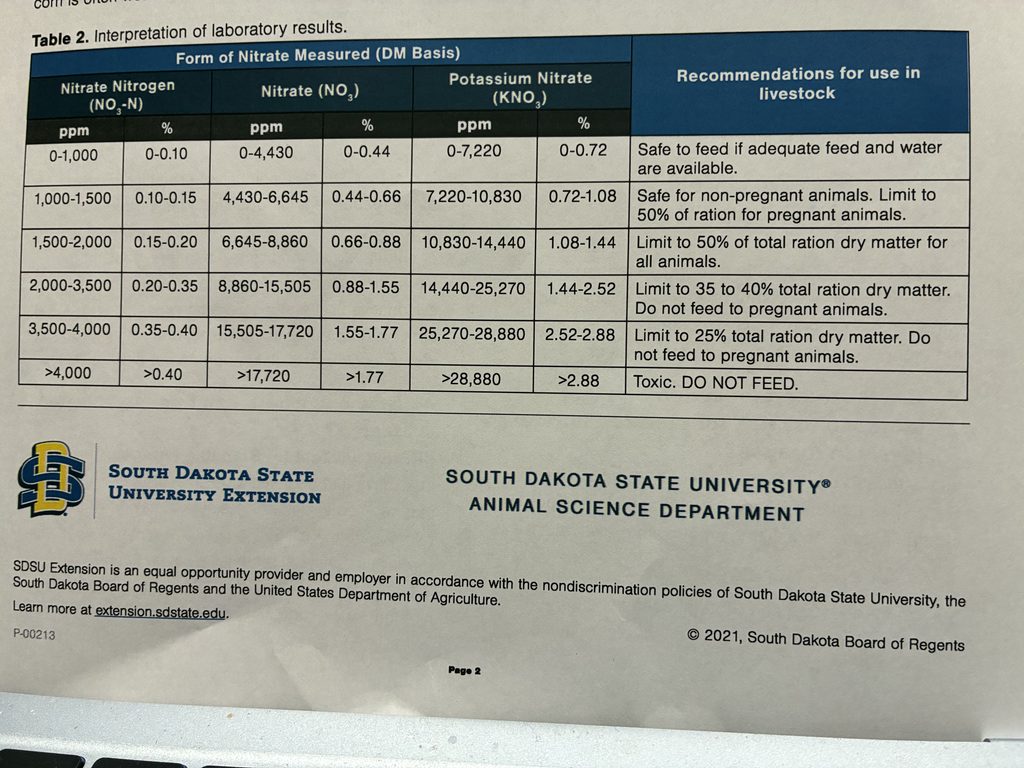
Generally, 1,000 to 1,500 ppm is not a problem if the producer is feeding the forage to growing cattle, non-open replacement heifers or finishing cattle, Rusche said.
“As we start getting into bred cattle, now I want to limit that to 50% or less of the diet. When we go above 1,500, now I want to limit that 50% to everything. Once we start going up a couple thousands, then we’re going to pull it out of the bred cow diet and do some more limitations.”
If the test levels climb to around 3,500 to 4,000 ppm, he wants to limit that feed to less than a quarter of the dry matter, he said, and a producer should not feed it to any animal that is bred.
“If we’re over 4,000 parts per million, now we’re starting to really get in the danger zone where I just don’t want to feed it,” Rusche said.
Livestock that are grazing may have more leeway when it comes to potential nitrate toxicity concerns, but ranchers need to stay on top of the issue as Extension researchers continue to evaluate data.
“Cattle can detoxify a certain amount of nitrates,” he said. “Grazing animals tend to take feed in smaller amounts throughout the day. We don’t have that big slug of nitrates going in the rumen. They’re able to handle that better. The other part is nitrates tends to concentrate in the bottom portion of the stalk, so if we’re grazing, that’s the time I don’t want to make cattle take things down to the dirt.”
That means focusing on the top half of the stalk. In the harvest field, that means moving the cutting head higher.
“Let’s say I’ve got a field of let’s say sorghum-sudan or some forage sorghum that we know is a little on the high side as we’ve done some preliminary testing,” Rusche said. “If we raise the cutter head up a little bit and leave more than that lower portion of the stalk, I’m leaving the nitrates in the field where they aren’t going to do us any harm. There’s some things that we can do to try to minimize some risk as we think about how to best utilize and salvage some of these crops.”
Stretching resources
Hay has been in short supply in many parts of South Dakota, and crops that are being salvaged and repurposed should be tested, he said.
“I’ve worked with some producers that took some samples early and were kind of scary high,” Rusche said. “If they let them get just a little more mature, the next test came back good. Sometimes we just have a have to have a little bit of patience.”
In South Dakota, farmers are also concerned about buffalo bur, an annual weed that can be highly toxic. It can be harvested with other crops and is a particular concern in hay. Producers need to know whether it can be diluted.
If producers are outsourcing feedstuffs, particularly if the feed comes from an unfamiliar source, they should ask the seller to provide tests for nitrate and moisture, Rusche said.
Dave Bergmeier can be reached at 620-227-1822 or [email protected].