Arizona sees first NWS case, NM adds to theirs
On Oct. 28, officials with the Arizona Department of Agriculture (in cooperation with the U.S. Department of Agriculture) announced Arizona’s first case of New World screwworm.
Officials in New Mexico have announced additional New World screwworm cases. As of Oct. 27, two cases of NWS were found in Doña Ana County: One in a sheep on the New Mexico State University campus in Las Cruces, and one in a cow at an off-campus location.
Other cases announced: Oct. 23 in a calf in Hidalgo County, and an Oct. 21 news release from NMDA, confirmed a case of New World screwworm in a beef cow in Otero County.
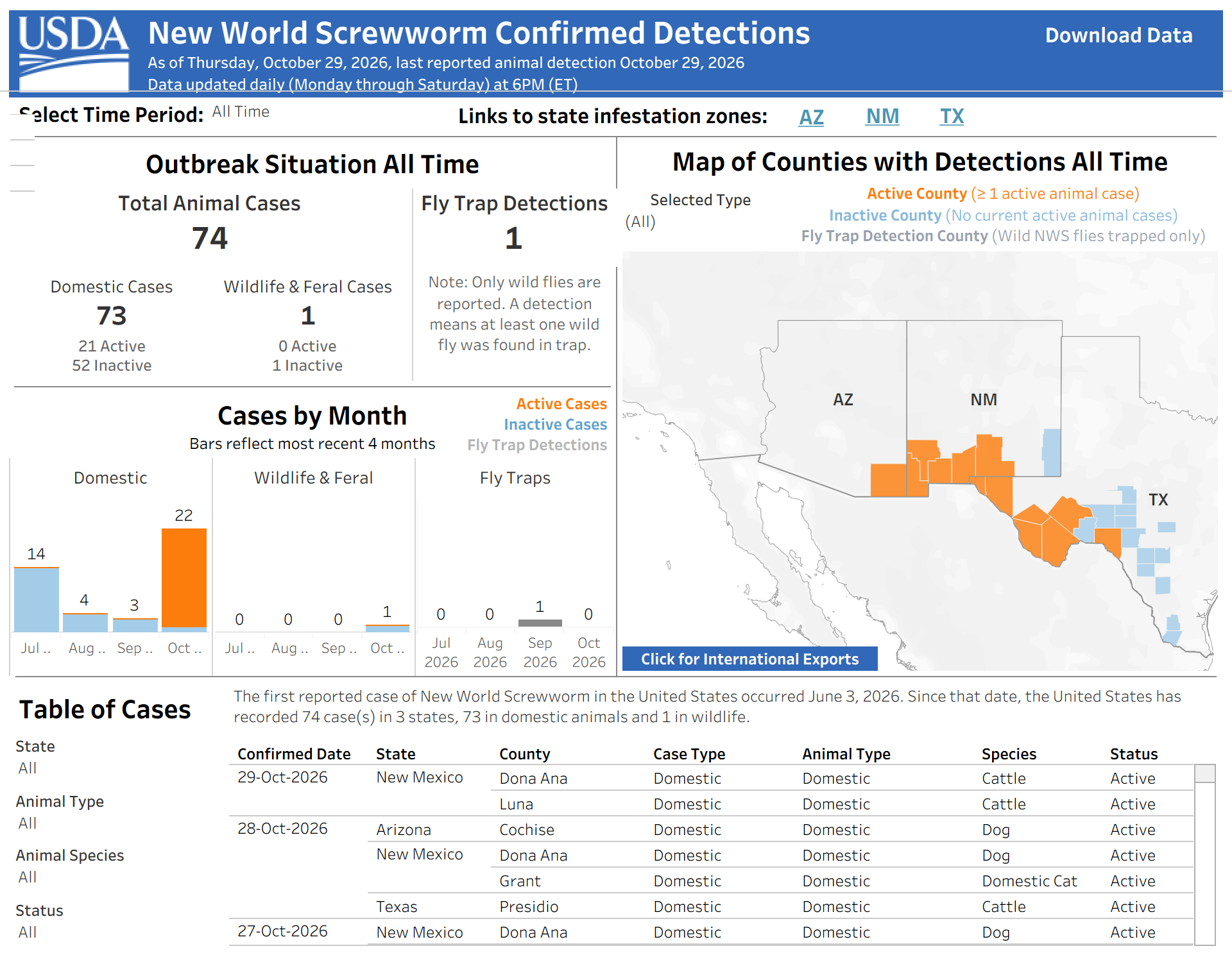
As of Oct. 29, the USDA has 74 confirmed cases of NWS in the United States, with 21 of those still remaining active.
Arizona
The confirmed case in Arizona was found in a canine in Cochise County when a local veterinarian examined the animal on the evening of Oct. 26 and identified a wound on the canine’s back heavily infested with maggots consistent with NWS characteristics, according to a AZDA news release. Scientific testing, in coordination with federal partners, verified the species.
“We have been preparing for this possibility for a long while and are acting swiftly,” said State Veterinarian Dr. Ryan Wolker in a news release. “Because of the extensive outreach, coordination, and surveillance already in place, Arizona producers, veterinarians, and pet owners know what to look for and how to report suspected cases. That preparation is allowing us to move quickly to protect animal health in the state.”
The affected animal is under veterinary care and AZDA is working with the attending veterinarian and the owner to gather additional information. This information will guide any necessary epidemiologic investigation and local response actions. Consistent with federal NWS protocols, AZDA is coordinating closely with USDA, neighboring states, and Mexican counterparts to ensure this case is integrated into regional NWS response efforts.
Federal response actions from USDA will include establishing an Infested Zone, increasing animal surveillance, and conducting outreach to local partners. AZDA has also advocated for the release of sterile flies in the area to help suppress the fly population and prevent the pest from becoming established. Plans for a Sterile Fly Dispersal Facility in Douglas, Arizona, are continuing to move forward.
During the past year, AZDA has proactively communicated with livestock owners, pet owners, Tribal partners, industry stakeholders, and animal health professionals about NWS detections in Texas, New Mexico and Sonora to educate on the importance of vigilant wound inspection and prompt reporting. AZDA, in collaboration with the University of Arizona’s Arizona Livestock Incident Response Team, has conducted more than 60 tabletop exercises, industry workshops, train-the-trainer sessions, and other NWS educational events. These communication efforts have been accompanied by enhanced surveillance activities and rapid response planning designed to ensure that any suspected case in the state is quickly identified, investigated, and addressed.
AZDA officials have encouraged livestock owners, livestock auctions, processing facilities, pet owners, animal shelters, hunters, and other allied stakeholders to be extremely vigilant and observant with animals in their care or custody.
In Arizona, if any unusual wounds are noticed that appear to be infested with maggots consistent with NWS, please report those immediately to [email protected] or by calling 602-542-4293 during business hours 8 a.m. to 5 p.m., Monday through Friday. Similarly, if hunters or other outdoor recreationalists encounter wildlife that appear to be infested, please contact the Arizona Game and Fish Department at 623-236-7201. Please ensure that GPS coordinates of the approximate location of the wildlife are captured.
New Mexico
After confirmation of additional NWS cases in late October, according to a news release from the New Mexico Department of Agriculture, state and federal officials are expanding surveillance and fly-trapping efforts around affected locations to identify additional cases and determine whether the pest has spread beyond the affected animals. Fly traps have been placed on the NMSU campus as part of these efforts.
“Early detection is critical to containing New World screwworm and protecting animal health,” said State Veterinarian Dr. Samantha Holeck with the New Mexico Livestock Board in a news release. “We encourage the campus community to know the warning signs and report suspicious wounds or infestations promptly.”
New World screwworm flies lay eggs in wounds or openings in living tissue. After hatching, the larvae feed on living tissue and can cause serious injury or death if left untreated. Infestations can affect livestock, wildlife, pets, and, in rare cases, people.
Signs to watch for include:
• Wounds that fail to heal or become progressively worse
• Maggots in wounds or other body openings.
• Foul-smelling discharge from wounds.
• Unusual irritation, discomfort or signs of pain around an injury.
Animal health officials established an infested zone extending at least 12.4 miles around an affected location to support surveillance and help prevent the pest from spreading. Because cases have been confirmed in Doña Ana County, residents should consult the current infested-zone map at ScrewwormNM.org to determine whether their property falls within a designated zone.
Infested zones do not restrict residents’ everyday activities. However, specific requirements apply to animals originating within these zones. Before animals can be moved within or out of an infested zone, they generally must be inspected within five days of movement, meet identification requirements and receive treatment when required. Additional documentation or approval may also be necessary. Animal owners should review current requirements and contact the New Mexico Livestock Board before moving animals from an affected zone.
Anyone who observes these signs in an animal should avoid handling or moving the animal and immediately contact the New Mexico Livestock Board. Anyone who suspects an infestation in a person should seek prompt medical attention.
“Protecting animal health requires awareness and action from all of us,” said New Mexico Secretary of Agriculture Jeff Witte. “With cases now confirmed in Doña Ana County, we encourage the NMSU community and surrounding residents to stay vigilant, recognize the warning signs and report concerns quickly.”
For ongoing updates on surveillance and infested zones, visit ScrewwormNM.org. New cases will be announced when confirmed in areas of the state not previously identified as infested.
Kylene Scott can be reached at 620-227-1804 or [email protected].