
Arkansas Poultry Chain distributes nearly 33,000 chicks to youth in Arkansas, Oklahoma
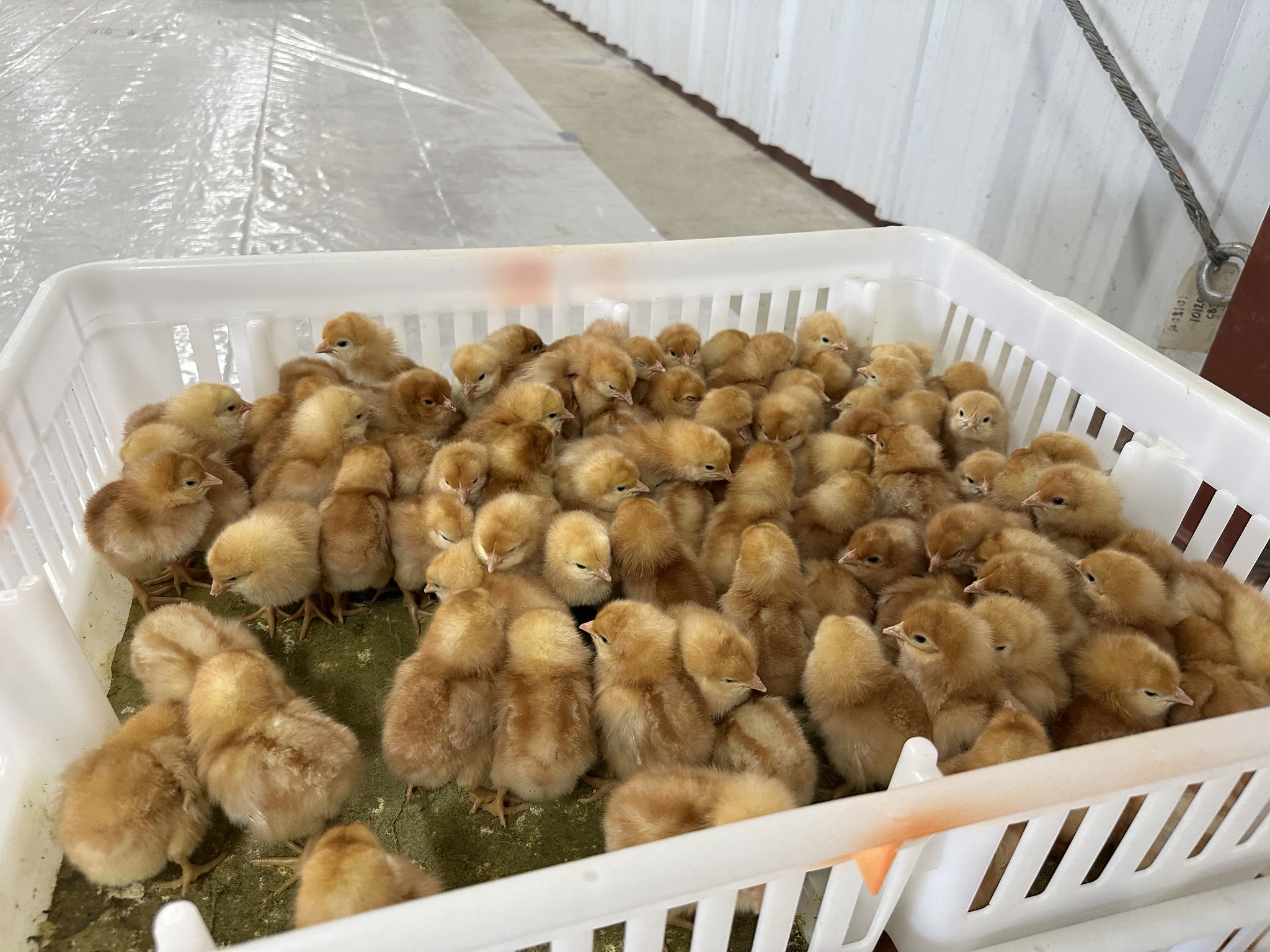
In the early morning hours on April 8, Cooperative Extension Service staff and volunteers began the work of unloading a truckload of nearly 33,000 Hy-Line Brown chickens to be distributed to more than 1,900 youth as part of the Arkansas Poultry Chain program.
At the Lonoke County Fairgrounds, the chorus of day-old peeping chicks was sorted into orders for Arkansas 4-H and National FFA Organization members in 69 Arkansas counties and seven Oklahoma counties. The full order included 32,700 pullets, or young female chickens, and 225 cockerels, or young male chickens.
Each participant received a flock of chicks to be raised for the next 20 weeks in preparation for poultry contests at county, district and state fairs in the fall. The youth from Oklahoma that participate in the program often compete at the annual Arkansas-Oklahoma State Fair in Fort Smith.
The Arkansas Poultry Chain program is organized by the Cooperative Extension Service, part of the University of Arkansas Division of Agriculture. Andrew Bolton, extension poultry science instructor for the Division of Agriculture, said the program’s goal is to expose youth to agriculture, regardless of where they live.
“Agriculturalists are important, and so are people who are informed consumers about where their food comes from, even if they’re not involved in an ag career,” Bolton said. “We see a lot of youth engaged in 4-H and FFA who don’t live on a farm — they live in cities, they live in neighborhoods, and they don’t have access to funds or land to have those traditionally large livestock projects, like cattle, goats or pigs.
“With poultry, I call it a gateway project,” he said. “It’s easy to get into, it’s low cost, and it doesn’t require a lot of space. And it’s one where people can see a quick turnaround. If you buy a calf, you’re looking at a year and a half before it can be butchered. But these egg layers, they’re going to start producing around the time the county fairs are over. You’re seeing that investment come back to you.”
Poultry care pays off
For Braylen Martin, 11, a member of White County 4-H who has participated in Poultry Chain for the past five years, the program is helpful preparation for his intended future career.
“My dad owns six commercial broiler houses that hold 23,000 birds each, and I plan to take it over after he retires,” Martin said. “Even though his houses are for broilers instead of layers, like the Poultry Chain birds are, it still is very good practice. They’re still chickens, and there are many similarities you have to deal with.”
Martin’s younger brother Willie Dan, 8, said he wants to be a veterinarian when he grows up.
“My favorite part of doing Poultry Chain is the day when I get baby chicks, because they’re so cute and I like finding the first egg when they start laying,” Willie Dan said. “It’s so fun watching the chicks grow up from a little tiny baby, all the way up to big grown chickens.”
In 2025, Willie Dan’s pen of Poultry Chain birds won Grand Champion at the White County Fair and fourth overall Poultry Chain Pen at the Arkansas State Fair.
“You can’t always win,” Willie Dan noted. “Sometimes you work so hard and do everything right, but you still don’t win.”
Jan Yingling, White County extension 4-H and agriculture agent, said White County often has the largest Poultry Chain order in the state. The county hosts a yearly auction of the youths’ Poultry Chain flocks, which raised more than $13,000 in 2025.
“Our Poultry Chain brings out the whole community from our extension staff, 4-H families, loyal supporters, our elected officials and our White County Fair Board,” Yingling said. “Every penny goes back to the participants each year. It is so fun to watch the youth learn what ribbon they received and then parade their poultry around the sale ring at the auction.”
A project for all skill levels
Bolton said that of Arkansas Poultry Chain participants, a large group are youth and families who are new to animal projects. Many other participants have existing poultry flocks and use the Poultry Chain as an opportunity to show birds and replenish their flocks. A third group consists of participants whose families are “deep into livestock” and for whom the Poultry Chain program is a natural addition, Bolton said.
“I have seen more and more counties incorporating poultry as a major project in their counties and county fairs,” Bolton said. “We’re teaching more poultry showmanship, and that impacts these kids because they have to do research and know about their animal and be comfortable speaking in front of a judge and answering questions. It’s building their public speaking confidence.”
Jessalyn O’Dell, 10, is a member of White County 4-H who has participated in the Poultry Chain program for the last four years. O’Dell said she particularly enjoys showing her chickens at the county fair.
“I’ve always loved it,” O’Dell said. “It’s not scary. You just have to walk up there, show your chickens and go back. When you hold them, it’s your last time holding them throughout the year, so it’s a special thing to do.”
O’Dell and her older sister, along with their three brothers, all participate in the Arkansas Poultry Chain. Their mother, Caitlin O’Dell, said learning to care for the birds alongside her children has been a gratifying experience as a parent.
“I did not know a thing about raising chickens until my own children started doing Poultry Chain, so I had to learn everything,” Caitlin O’Dell said. “Now they have such confidence in it, and that’s something I admire and am proud of for them. Even my six-year-old knows how to give them their first drink of water.”
Fun for the whole family
As extension’s poultry science educator, Bolton conducts workshops on chick care across the state during the spring as families prepare for the start of the Poultry Chain project. He shares information about brooding chicks — keeping them in a warm environment to help regulate their temperature during the first five weeks of life — proper housing for the birds, the importance of providing water, what and how to feed them and how to minimize food waste.
“It’s a forgiving project,” Bolton said. “They’re going to grow. You give them food, but you don’t have to formulate from different feeds and supplements, like you do for larger livestock. The Arkansas Poultry Chain starts with a very level playing field, because all the birds come from the same genetics and they’re all the same age. It’s about how you invest in the birds and how you take care of them. People have a lot of fun with it.”
Yingling said participating in the project offers many benefits to youth and their families.
“A young person learns so many lessons when they have the responsibility for an animal’s well-being on their shoulders,” Yingling said. “Accountability, selflessness, work ethic and sportsmanship are just a few of the life skills that are gained from this project.
“Learning to care for poultry alongside your children will be one of the best experiences you have as a family,” she said. “Get outside, get your hands dirty together and reap the benefits of providing part of your family’s food supply yourselves.”
Visit the Arkansas Youth Poultry Programs page on the Cooperative Extension Service website to learn more or contact your local county agent for information on the program.
PHOTO: READY FOR PICK-UP — Orders of day-old Hy-Line Brown chickens await pick-up by extension county agents to be distributed to more than 1,900 youth in Arkansas and Oklahoma to raise for poultry contests during fair season. (UADA photo.)


