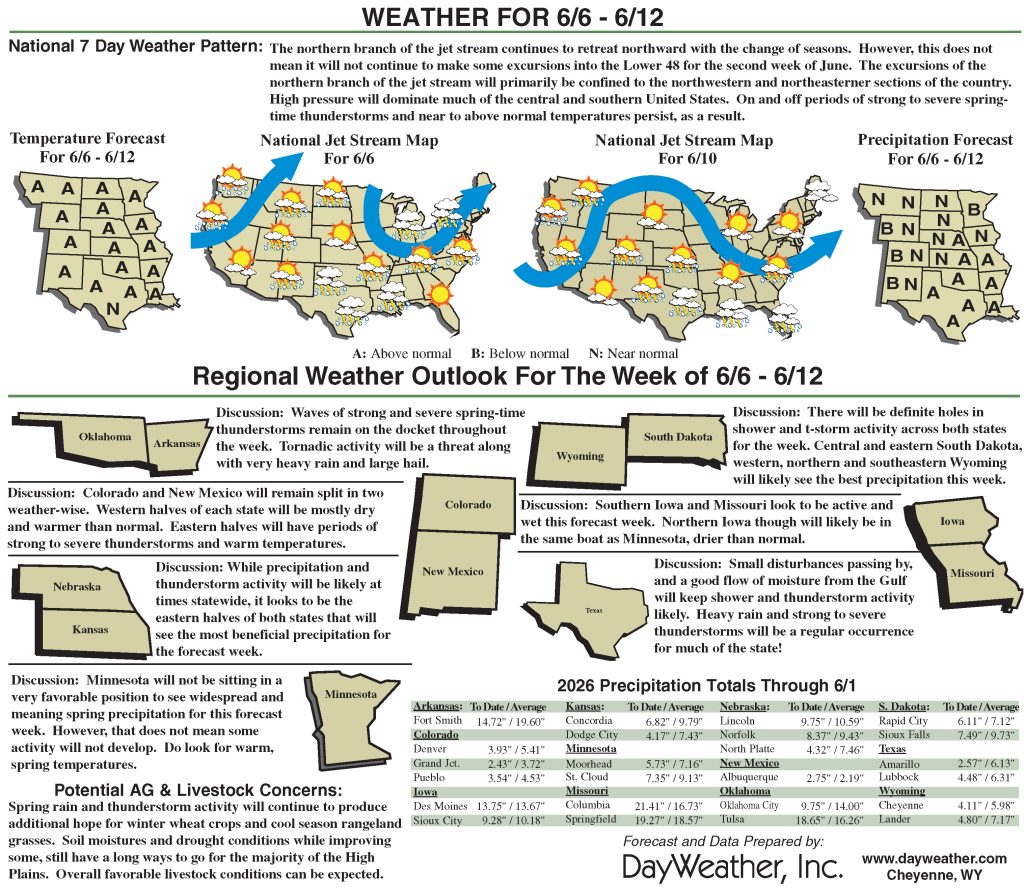
Active pattern brought moisture to High Plains
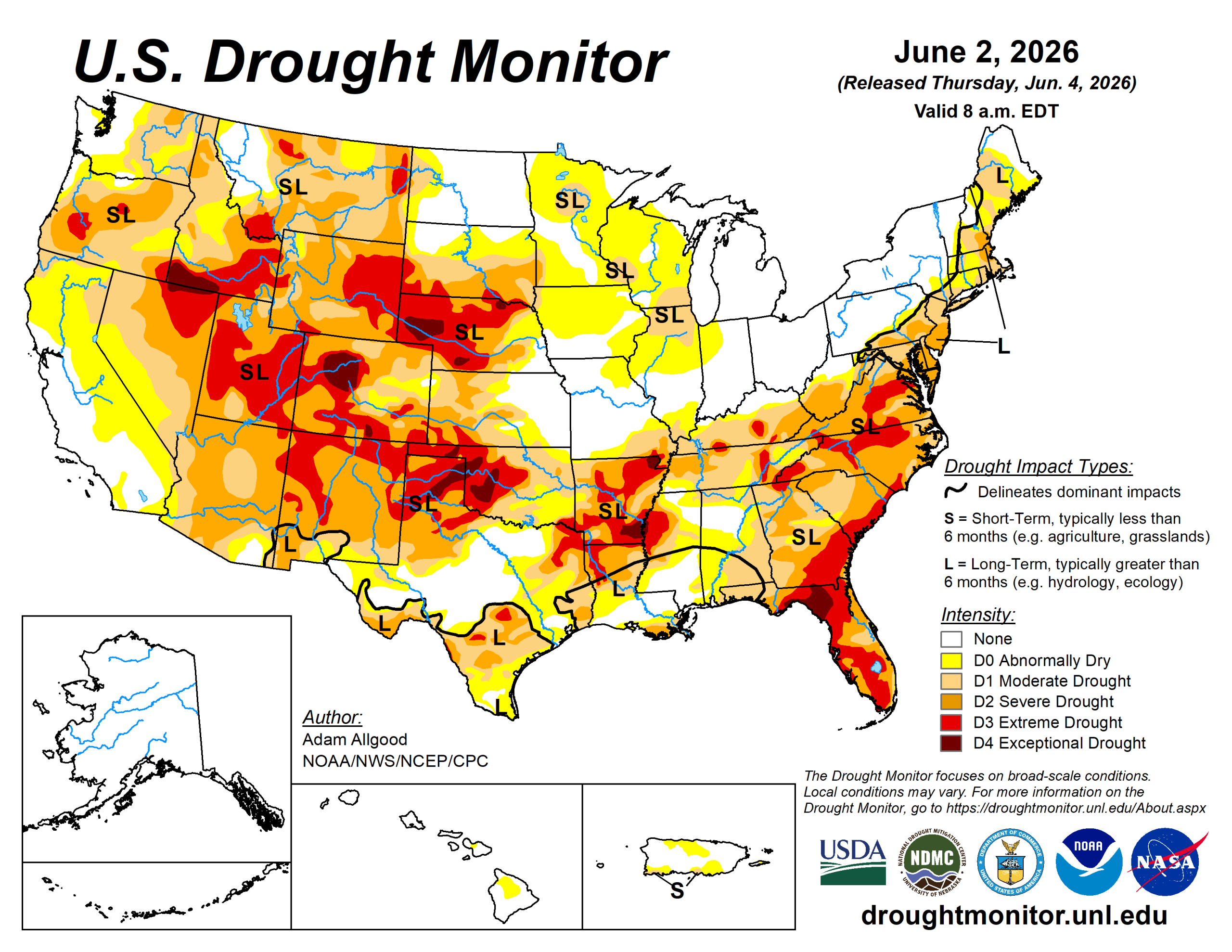
A mid-level height anomaly pattern during the week exhibited an omega-block type pattern, with mean troughing over Alaska and both the West and East, with the western trough cutting off over California, and strong ridging between the troughs across the central contiguous United States.
This pattern promoted below-normal temperatures across the Southwest for much of the period, with colder air pushing eastward towards the end of the week followed by warming temperatures. Across the East, cooler air overspread New England and the mid-Atlantic, keeping evapotranspiration rates a bit lower than normal.
In contrast, much above-normal temperatures were observed throughout the week across the northern Plains and upper-Midwest, though colder weather and storminess overspread the northern Rockies and adjacent High Plains at the end of the week.
An active pattern was noted across the Plains, South, and Southeast as a mean frontal boundary provided a focus for stormy weather. These rains, in conjunction with a wetter pattern overall during May, prompted widespread additional drought relief for the South and Southeast regions, as well as portions of the High Plains.
In contrast, hot, dry weather across the Northern Plains and Upper Midwest caused expansion of drought and abnormal dryness, with widespread degradation occurring in western portions of the Midwest region. Toward the end of the week, a storm system brought heavy precipitation to western and central Montana, bringing some drought relief following a period of hot, windy weather.
South
Soaking rains overspread most of Texas during the week, promoting additional drought reductions, primarily across southern Texas and the Big Bend country.
Rainfall also overspread eastern Oklahoma, but conditions worsened across the western half of the state which fared drier during the week. Along the lower Mississippi Valley, heavy rains, exceeding 6 inches in some locations, fell across northern Arkansas, promoting drought reduction.
Although conditions have improved overall across the southern region, widespread D3 to D4 continues across northern Texas and western Oklahoma, and long term drought impacts to groundwater remain a concern heading into the summer months across the whole region.
Midwest
While light showers fell across portions of Minnesota and Iowa, mostly dry conditions prevailed for another week across the rest of the Midwest region.
This dryness, combined with hot temperatures, continued to stress lawns and spring crops and reduce streamflows and topsoil moisture, prompting widespread deterioration on this week’s Drought Monitor despite longer term indices remaining more favorable. D0 expanded broadly across the middle and upper Mississippi Valley and the western Great Lakes region, with nearly all of Wisconsin now in D0.
Pockets of moderate drought were introduced to northern Illinois, southeastern Wisconsin, and along the Mississippi River just north of Iowa. Absent a shift towards a wetter pattern, this region is vulnerable to further rapid deterioration due to high evapotranspirative demand this time of year.
High Plains
Stormy weather brought soaking rains across much of the High Plains, with the highest coverage and accumulations over Kansas and Nebraska.
While beneficial, this precipitation competed during the week with much above-normal temperatures, which maintained high evapotranspirative demands. Accordingly, areas that missed out on significant rainfall, including portions of the Dakotas and far northern Nebraska, experienced some degradation, while reductions were noted across much of Kansas and eastern Nebraska.
Further west, beneficial precipitation brought some relief to portions of the Colorado Plains and a few spots in Wyoming, while drier conditions resulted in deterioration in southwestern Colorado.
West
A late season storm system brought heavy rainfall to southern Oregon and northern California, sparking a few modest improvements but overall doing little to change the current drought depiction.
Some degradations were noted across portions of California, Oregon and the Great Basin, where impacts from a lack of snowmelt recharge—especially low streamflowsare beginning to be felt. Temperatures during the week were near to above-average across the Northwest, but below average across California, helping to keep evapotranspiration demands lower than average.
Looking ahead
At the start of the next seven days, drier conditions are favored across much of the East, with daily temperatures quickly warming to above-normal.
A storm system now over the Plains will progress slowly eastward, bringing a potential for much needed rainfall across the upper Midwest and Great Lakes region.
The current quantitative precipitation forecast from the Weather Prediction Center show amounts potentially exceeding 1.5 inches across much of Iowa and far southwestern Wisconsin, but lighter amounts elsewhere.
Later on, a weak troughing over Alaska is favored to maintain below-average temperatures and above-average precipitation for another week. Downstream, positive height anomalies are forecast for most of the contiguous U.S., leading to coast-to-coast enhanced chances for above-normal temperatures. The highest probabilities for above-normal temperatures extend across both the West and the Northeast. Enhanced low-level southerly flow in this pattern favors a wide-open Gulf, with moist air penetrating far to the north across the central U.S.
Any interactions with shortwave troughs or other synoptic features could trigger periods of organized convection. Therefore, a broad signal slightly favoring above-normal precipitation extends from the Gulf Coast through much of the continental U.S. east of the Rockies.
Adam Allgood is with NOAA/NWS/NCEP/CP.