
Gene-edited chickens may offer resistance to avian influenza

Research into gene-editing technology could offer a new tool for reducing the impact of highly pathogenic avian influenza in poultry flocks, according to Kiho Lee, professor of animal science at the University of Missouri, who has a focus on genetically improving poultry.
“Our research focuses on developing a platform that supports the application of gene-editing systems to enhance the genetic value of chickens,” Lee said. “These technologies may enable the introduction of beneficial traits, including improved disease resistance. More broadly, genetic approaches offer new opportunities to address key challenges in poultry production, animal health and overall productivity.”
Lee and his research team is studying whether CRISPR gene-editing technology can be used to increase chickens’ resistance to avian influenza.
Avian influenza is one of the poultry industry’s most significant disease threats, which has resulted in the death or euthanasia of more than 200 million birds from 2022 to 2026, according to the U.S. Department of Agriculture’s Animal and Plant Health Inspection Service.
Avian influenza outbreaks can cause substantial economic losses through bird mortality, depopulation efforts, increased production costs, trade disruptions, and impacts on egg and poultry meat supplies.
Lee said more resistant birds could potentially reduce disease severity and transmission, lowering the need for large-scale depopulation during outbreaks.
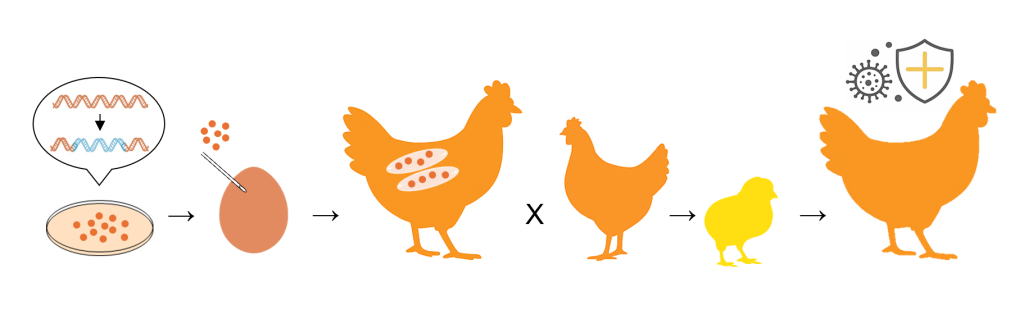
How could CRISPR gene-editing help?
CRISPR, which stands for Clustered Regularly Interspaced Short Palindromic Repeats, was originally discovered as part of a bacterial defense system against viruses. In laboratory applications, the technology uses two primary components to make precise modifications to DNA.
“CRISPR gene editing enables scientists to make precise, targeted modifications to specific genes, whereas traditional chicken breeding relies on phenotypic and genomic selection to gradually enhance overall genetic merit,” Lee said.
The technology has been available for slightly more than a decade, with its application in livestock production emerging about 10 years ago.
According to Lee, avian influenza infects chickens by binding to cellular receptors in the respiratory and digestive tracts. Once inside the cell, the virus uses the host’s cellular machinery to replicate and produce new viral particles that can spread throughout the bird and cause disease.
Scientists have identified several genes involved in avian influenza susceptibility and replication. Lee said members of the ANP32 gene family are among the most important because they support viral replication within the host.
“Several studies have demonstrated that genetic approaches, including the use of CRISPR technology, can reduce avian influenza virus replication and enhance resistance to infection in chickens under experimental conditions,” Lee said.
Research stage
Although the potential for CRISPR gene-editing in the poultry industry shows great merit, Lee emphasized that the research remains in its early stages and has not yet been proven for commercial poultry production.
“We don’t actively work with avian influenza at the moment, so the comment is based on what’s known in the field,” he explained.
Lee said the research indicates CRISPR gene-editing could potentially be applied in both broiler and layer chickens, which would benefit the entire poultry industry. However, Lee said current evidence suggests gene-edited chickens would likely exhibit increased resistance rather than complete immunity to avian influenza.
“The primary objective is to reduce the virus’s ability to infect, replicate and spread, thereby limiting disease severity and transmission,” Lee said. “However, achieving full protection against all avian influenza strains remains a significant challenge.”
He notes avian influenza viruses may evolve over time, potentially requiring continued monitoring and additional research.
Consumer acceptance?
With consumers becoming increasingly concerned about food production, GMO products and food safety, the natural question is if gene-edited poultry will be a turn-off for buyers.
“Because the distinctions between gene editing and traditional genetically modified organisms are not widely understood by the public, it is difficult to predict how consumers will respond to products from gene-edited animals,” Lee said.
In addition, he added that regulatory approval, public acceptance and successful integration into existing breeding programs are critical steps for the commercialization of this technology.
“Researchers need to demonstrate long-term safety and effectiveness, evaluate potential impacts on animal health and productivity, and assess performance against a wide range of avian influenza strains,” Lee said.
He added that regulatory approval and integration into existing breeding programs will be critical factors in determining whether gene-edited poultry becomes commercially available.
“Although research has produced encouraging results, commercial adoption will depend on additional scientific validation, regulatory approvals, integration into breeding programs, and market acceptance,” he said. “As a result, widespread commercial availability is likely to be several years away.”
Lacey Vilhauer can be reached at 620-227-1871 or [email protected].
Photo caption: Kiho Lee and his team at the University of Missouri. (Courtesy photo.)



