Free tests target ‘Red Crown Rot,’ a threat to Midwest soybeans
Several soybean groups have launched a free testing initiative that hopes to help identify red crown rot, a deceptive soybean disease that can cut field yields by up to 70%.
The University of Missouri’s Extension program, in partnership with the United Soybean Board and Missouri Soybean Merchandising Council, is offering free diagnostic testing for 100 submitted samples on a first come, first serve basis. According to MU Extension, farmers can submit up to two free samples of five to 10 symptomatic plants. Instructions of how to ship samples can be found on MU Extension’s website.
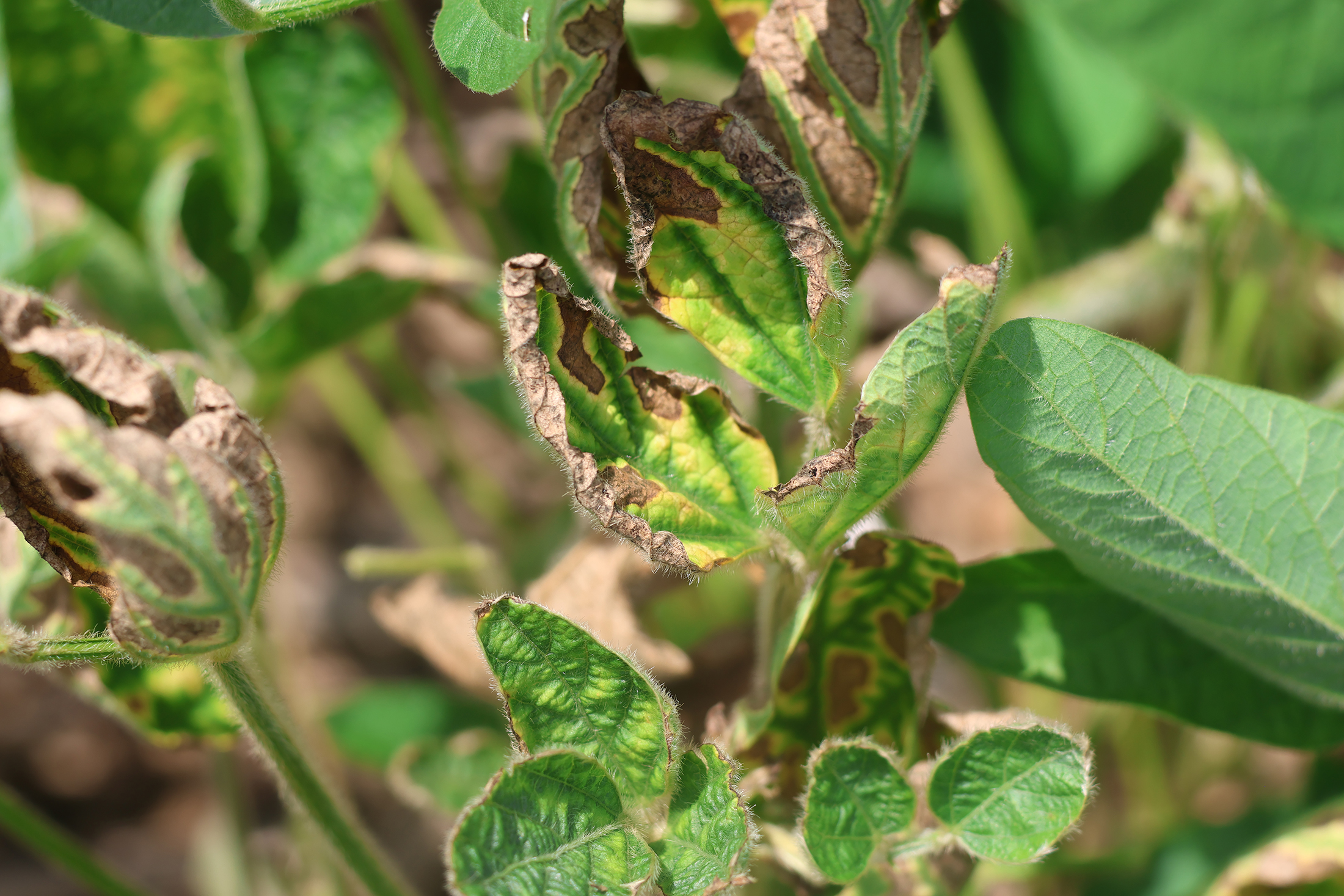
Testing will still be provided once the 100 slots are filled, but it will no longer be free. Pictured at top, Soybean leaves may show yellow spots on upper canopy leaves. Symptoms may resemble those of sudden death syndrome. Disase typically appears in nonuniform patches within fields. (Photo courtesy of MU Extension state plant pathologist Mandy Bish.)
Blake Barlow, Missouri Soybean Merchandising Council senior director of research and agronomy, noted how efforts ramped up once initial tracking showed the true scale of the problem.
“When we started screening we realized it (RCR) was a much bigger problem than we initially thought,” Barlow said. “When that got around several states, USB met and saw it was a major issue, so they released money for farmers to test samples if they suspected red crown rot.”
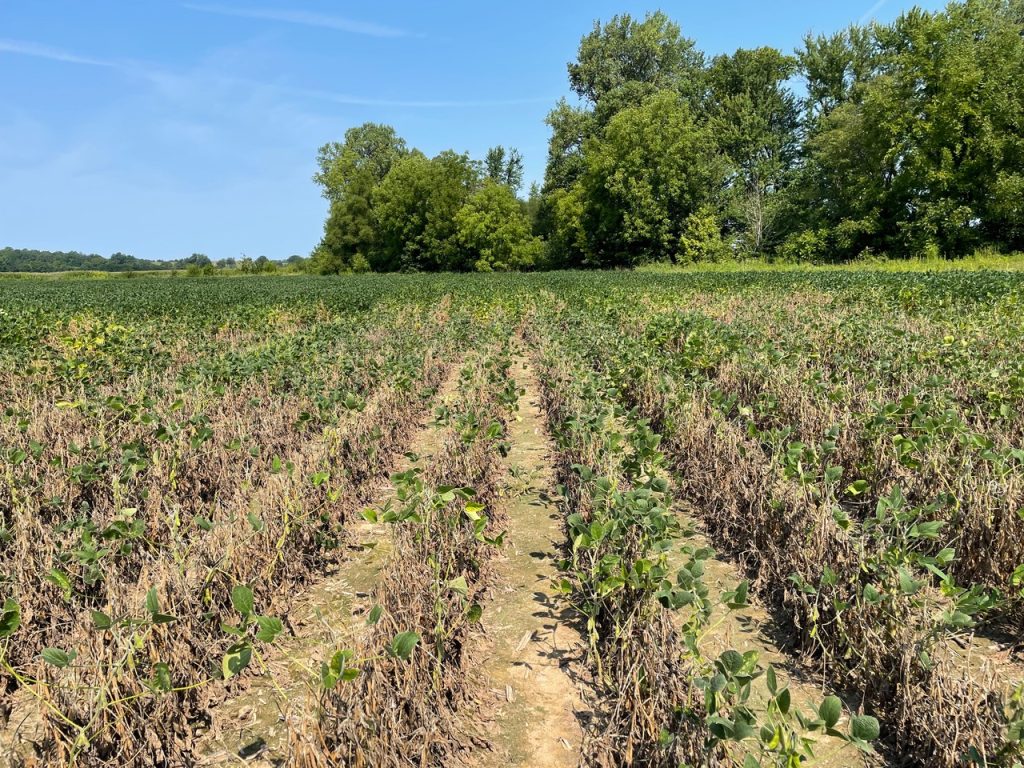
RCR was initially identified in the U.S. during 1972 in North Carolina. However, it began to affect the Midwest several decades later after it appeared in an Illinois field in 2017. Since then, it has quickly spread across the Corn Belt and was officially confirmed to be in Missouri in 2024.
It is a currently uncurable soilborne fungal disease that’s caused by calonectria ilicicola. symptomatic plants have several identifiable traits.
- White fungal growth (mycelia) that is visible on the root of the plant
- Yellow and/or brown spots that grow between the leaf vein on upper canopy leaves
- Red, pin-sized balls (perithecia) on the roots or crown. These usually form later in the season.
These symptoms tend to begin showing up at the R3 reproductive stage. Barlow emphasized the importance of early detection.
“Since this is a soilborne pathogen, once it’s in the soil, it’s very hard to get rid of,” Barlow said.
The primary challenge for farmers is that the disease closely mimics other common regional threats, such as sudden death syndrome and brown stem rot. Since the leaves develop nearly identical yellowing and browning patterns, visual scouting is rarely enough to verify the problem.
Peng Tian, director of the MU Extension Plant Diagnostic Clinic, gave advice on how to distinguish RCR from other diseases.
“Look for signs and symptoms at the base of the stem,” Tian said. “Infested plants will have a red color at the base of the stem, and later in the season the fungus will form tiny red spheres called perithecia in the same region. This distinguishes RCR from SDS and other diseases that cause identical leaf symptoms.”
Ideally, in both the short and long term, the study will provide a dual benefit by helping map the spread of RCR while offering immediate, practical solutions for farmers.
“The biggest impacts this study or testing will offer is one, let us know how widespread it is, and two at the farmer level we’ll be able to say ‘leave those fields till last’ so we can stop the spread of soil from field to field,” Barlow said. “If we can isolate all the fields as much as we can, we can help stop the spread.”
Some management practices may reduce severity:
- Plant early: planting into cooler soils
- Sanitation: cleaning equipment when leaving an infected field
- Crop rotation: rotating to a non-host crop such as corn for at least two years to reduce inoculum in the soil.
For questions, visit https://muext.us/PlantClinic or contact the clinic at 573-882-3019. Growers can follow the spread of red crown rot and other plant diseases at the Crop Protection Network website.
Chase Pray is an intern for High Plains Journal and he can be reached at [email protected].