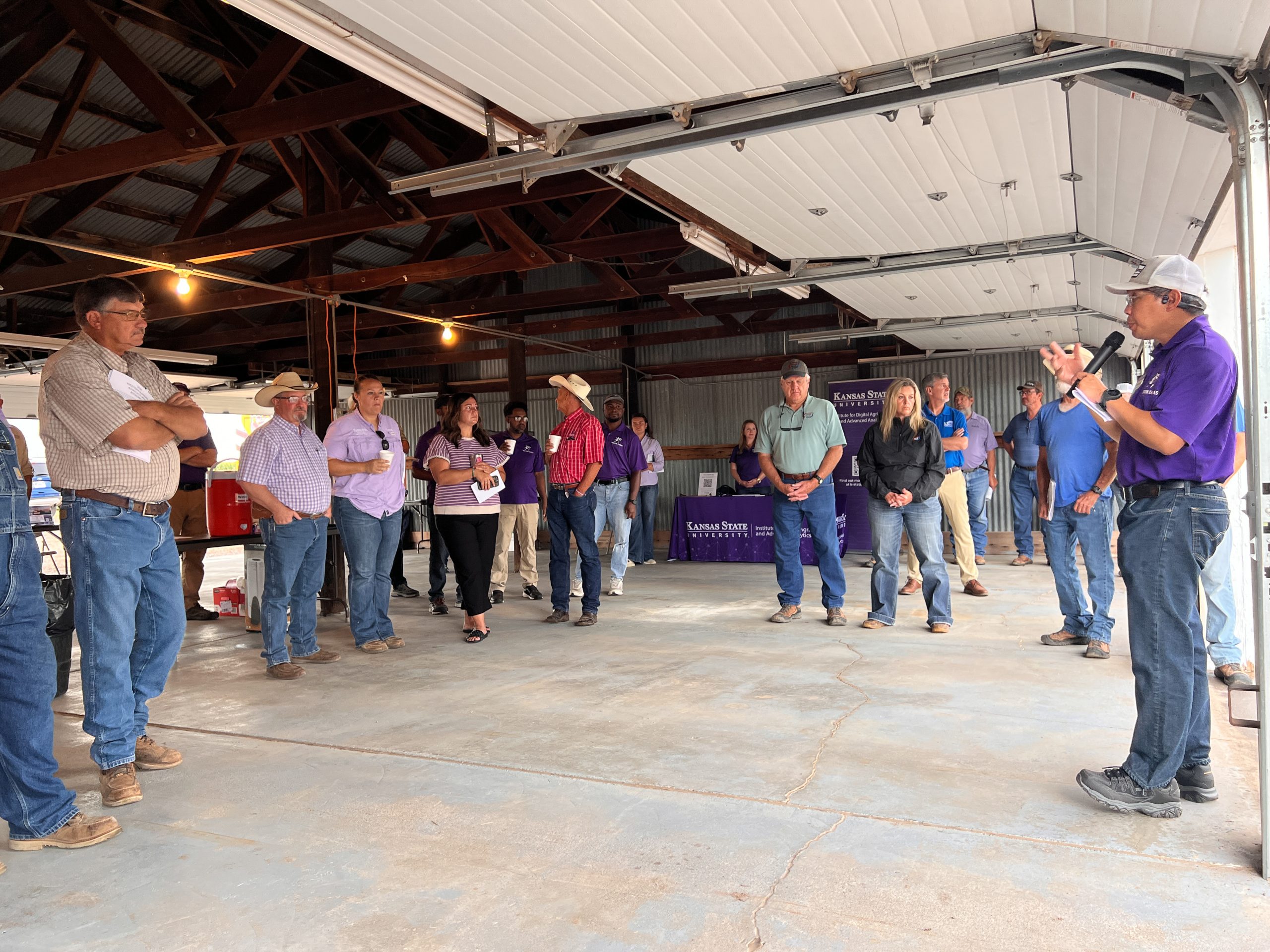
Late August rain showers didn’t dampen the spirit of those attending the annual Fall Field Day at Kansas State University’s Southwest Research and Extension Center in Garden City recently.
“Typically, it’s pretty warm when we come out here, and it’s a nice cool day,” Brian Olson, professor and head of the Western Kansas Research Extension Centers said.
Olson said Kansas State University recently opened its Agronomy Innovation Center on campus and he’s looking forward to other facilities opening in the coming weeks.
“That’s going to be a great asset as we look at moving crop production research forward, especially with those undergraduate education experiences,” he said.
Partnerships are important too—especially the partnerships with farmers who utilize the research centers too.
“It’s things like this—it’s about partnerships, partnerships with industry, partnerships with our farmers to learn what kind of research they want for us to dive into, and definitely appreciate that,” Olson said.
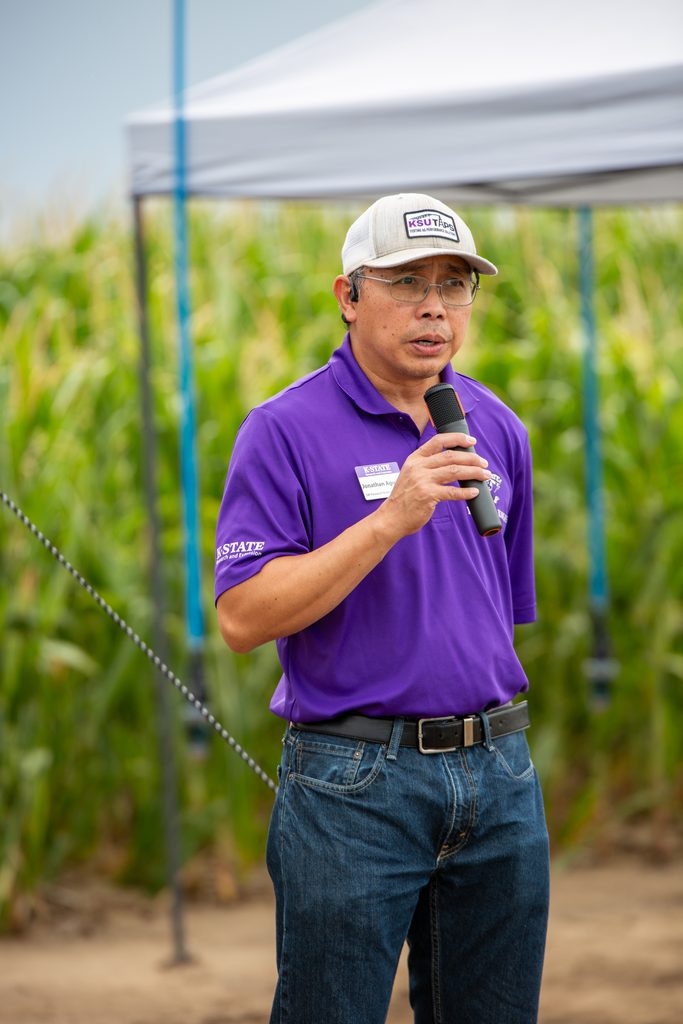
Jonathan Aguilar, professor at the SWREC in Garden City, said his team has been preparing for this field day since March.
Aguilar challenged attendees at the start of the tour.
“Since we really prepare this for you, we challenge you—ask questions. Is there anything that we are not trying?” he said. “Are we not addressing the needs of, particularly for the farmers here in this region? That’s the reason why we are here is to actually try to do the research of the things that is needed in this region.”
Field tour
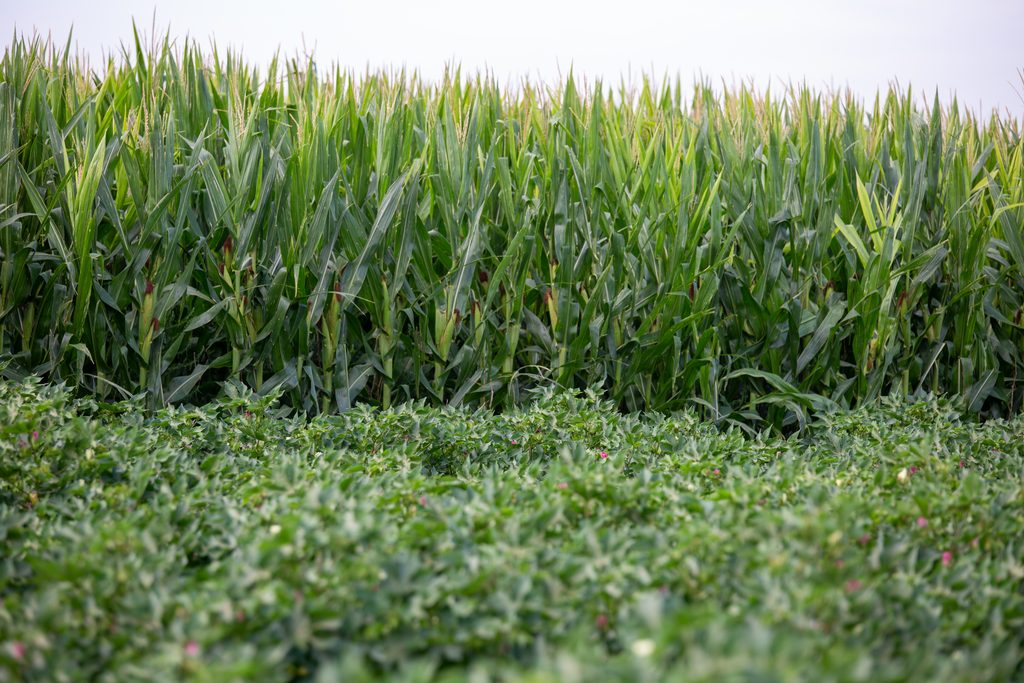
One of the fields on the tour was the Finnup field, where Aguilar discussed water dynamics on a corn-cotton rotation program. Graduate students also discussed some of their projects, and one was real-time drone streaming for precision agriculture. In this location, with the irrigated fields, one particular project included a tie with the Foundation for Food and Agriculture Research.
Aguilar said researchers have been trying to in the last six or seven years to plant irrigated cotton.
“We have been trying the irrigated cotton partly because one of the issues that we found for the cotton is that it is using less water in general,” he said. “During the time about 2017, our research advisory committee asked us, ‘Are you doing anything about cotton, irrigating cotton?’”
Aguilar said his team reached out to colleagues in Texas to find out what they needed to know about growing irrigated cotton.
“One of the things that we did recently here is trying to see if what we call the crop coefficient, the way that the crop is growing and how much water it is using,” he said. “It is different from what we are seeing with the literature that was developed in Texas and in California, so we are trying to hone those numbers and try to make sure that those numbers are applicable to those folks that are using it now with the irrigation schedule.”
The other thing that was asked of researchers at SWREC was about soil health.
“This is where our project here with the FFAR are increasing water productivity through soil carbon and sustainability of multi-crop systems using field scale research,” Aguilar said. “In short, we are trying to look at it from a systems point of view, not just the water. We are looking at the soil. We are looking at the rotation. We are looking at the nitrogen application and see what is going on.”
With this project, there are partners in locations in Iowa, Minnesota, Illinois, Ohio, and Nebraska. Those projects are looking more at corn and soybeans, but Aguilar wanted cotton in the mix in Garden City.
“Partly because we lack the acreage for soybeans in this region, and then we also try to change in terms of the cover crops,” he said. “In some areas they have a suite of cover crops that they are growing in between the season. Here we change it into rye because that is something that is available for many farmers.”
Researchers did try wheat the first year, and it wasn’t as good as the rye that was grown the second year.
“We have this also in such a way that there’s a continuous corn, there’s a continuous cotton, there’s a rotation of corn and cotton,” he said. “And then you have nitrogen application as a pre-planting, and then we applied it through our irrigation system that has capability of fertigation.”
Aguilar takes great pride in the irrigation system’s ability to apply nitrogen in one spot and shut it off as it moves and move it to another area.
“It is able to check for the application of the nitrogen,” he said. “And then in the conventional field, there are plots here that are tilled, and there’s also no-till and strip tilled. So again, we were looking at a very wide variety of things that are going on in this field.”
Students are also gathering data in the fields, and in the Finnup location research is focused more on water dynamics as it has soil moisture sensors in some locations.
“When we’re dealing with about 100 plots here, sometimes we try to identify where we could have the most of our soil moisture sensors because soil moisture sensors are not cheap,” he said. “If you’re looking with a plot with multiple replications, it gets to about almost $100,000 just to put sensors just in this field.”
They also have some measurements tracking greenhouse gas emissions, as well as monitoring in some locations.
“There are plots that are part of this project that are very close in terms of the water level,” he said. “We said that we don’t need water monitoring here, because in this particular field we are looking at about 150 feet below ground before we get those water levels,” Aguilar said.
They also took a look at weeds. The seed bank showed a correlation between rotation and the bank and cover crop biomass.
“When we grew the rye, we also take some samples out of it and then analyze them,” he said, noting soil organic carbon. “We have already taken our initial measurements here, and then year three and year five, we are going to look at it again and see if there’s any benefit or if there’s any difference throughout those years.”
In the cotton fields, Aguilar and his team noticed that if the cotton variety was drought resistant, the plants were able to go through the heat or without any rain because they have such a complex root system.
“They are not only getting their moisture right on the top, but they also have the tap root so that it’s if it doesn’t rain and we don’t get the timely rainfall, they are actually going to mine the water from the tap root,” he said. “And they are able to survive at least a little bit longer than what a typical corn or other crop would be.”
Aguilar appreciates being able to see the difference and to be able to understand how the water dynamics are working in the fields with the cotton varieties.
Kylene Scott can be reached at 620-227-1804 or [email protected].