You never know what you have until it’s gone.
That old adage can apply to just about anything. In my case, as I was researching and writing the cover story for this issue of High Plains Journal, it was water. Where would we be in the High Plains without it?
Nearly my entire life I’ve lived in a rural area, with the exception of college and a year-long stint in Woodward, Oklahoma, are the only times I’ve lived in town. I only had to pay a water bill for those couple of years. It wasn’t much back then, but it made me think about it every time I turned the faucet on or left the water running.
When we put our house in at our place near Dodge City, we had to dig a well. There was an old well from a house that was long gone, but it sadly wasn’t operational any longer. We told the well driller that we wanted the well in a certain spot and he dug a couple of test spots to see where water actually was. I’m pretty sure we had a water “Witcher” come out, and he did say one of our spots had water.
What we weren’t prepared for was the depth the well would have to go to get water and what it would cost. I’d have to dig up the old documents to see for sure, but I remember it was 300 feet to even find water. As with any new well, we had trouble with sediment and have killed our fair share of washing machines in the 16 years we’ve lived here.
When I was talking with Jim Butler of the Kansas Geological Survey for my cover story for this issue, he told me that in all the years that all users have been pumping from the aquifer; it has been drawn down about 60%. I’m no scientist, but that’s concerning.
According to the National Oceanic and Atmospheric Administration, the Ogallala Aquifer is the largest freshwater aquifer in the United States, underlying 174,000 square miles across eight states: Colorado, Kansas, Nebraska, New Mexico, Oklahoma, South Dakota, Texas, and Wyoming.
Most of the aquifer is in Nebraska, western Kansas, and the Texas Panhandle. Those areas aren’t as heavily populated as some areas, but are primarily agricultural land, so farmers tend to get most of the blame for depleting the aquifer.
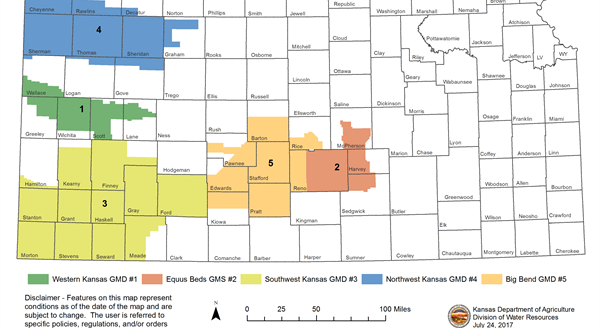
Of my three sources for the cover story—all of them told me Kansas had some of the most extensive and complete set of water data. And each organization is working to improve that and fill in any gaps. Butler said KGS said they have a network of about 1,400 wells across the aquifer that measures water levels each January.
“We have a good idea of how much is being taken out and how much that has affected the aquifer,” he said.
The data they collect can help advise producers in a certain area to reduce pumping levels by a certain amount or percent.
“This is going to be the impact on the water level decline rate, and under certain conditions the water levels could stabilize for the next decade or two,” Butler told me.
I don’t know about you, but I don’t like being told what to do. I suspect many farmers and ranchers don’t like being told how to do their jobs either. Many farmers can see a drop in yields right in the field as they harvest their crops. Later on, they can make changes to planting decisions to help bring production up.
I’ve been to many meetings to help farmers make more informed production decisions, whether it be “water sipping” sorghum varieties or irrigation technologies they can implement in the field. Many are turning to precision technology that helps them recognize where crops need water in the field and irrigate selectively.
Recently I saw a post on social media about the proposed 6,000-acre data center in a neighboring county. The post said agriculture in the area of the proposed center used billions of gallons of water a year, while the proposed data center would only use 600 million gallons a year. An 80% reduction. That figure alone will get some attention.
I do know I don’t like the thought of taking that kind of acreage out of production for a data center. I know the reliability of precision technology farmers are using needs data. I know the drones being used to check cattle and spray fields need data. While I may not know how it works, I do know ag needs technology. But they also need land. There’s no telling who will win the battle.
As with anything, people are resilient and can be adaptable when it comes to change. Some of us, me included, might take a little longer to adopt something new. But I do know one thing; farmers and ranchers help produce some of the safest, most wholesome food, fiber and fuel on the planet. They can only do that if there is agricultural land, so we have to be careful what we wish for.
Kylene Scott can be reached at 620-227-1804 or by email at [email protected].