AI and autonomous ag machines share a tie
When it comes to technology in agriculture, there is no shortage of topics and that includes artificial intelligence and autonomous equipment.
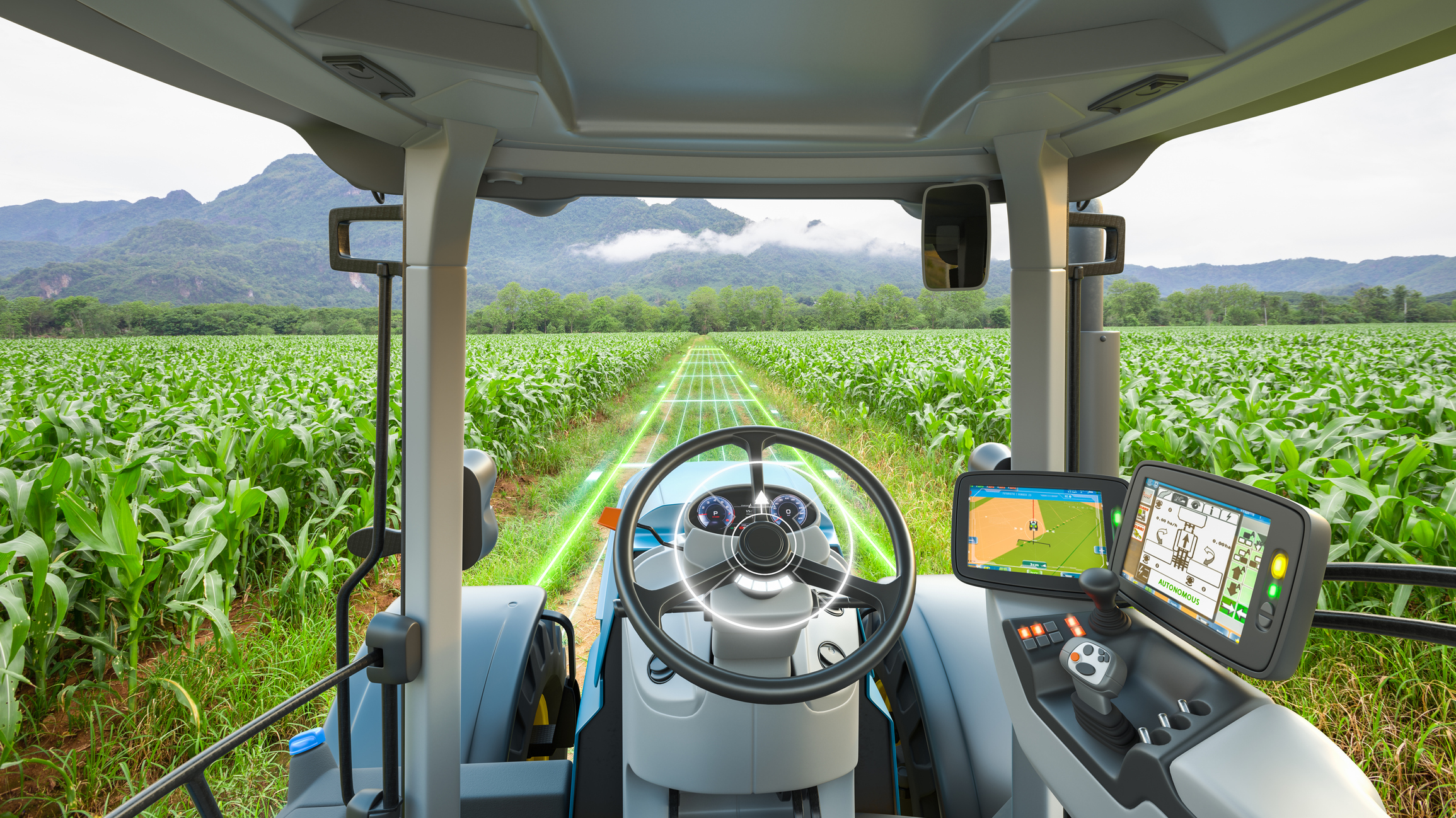
Farmers and ranchers, who have a long history of integrating technology, understand that investments in such practices have to be profitable and increase efficiency. While the headlines in the past year have been about data centers and their impact, there is overlap with what farmers have already been doing. Pictured above is a 5G autonomous tractor working in corn field, Future technology with smart agriculture farming concept. (Photo courtesy ISTOCK. Credit Kinwun.)
Alex Thomasson, a professor and director of the Agricultural Autonomy Institute at Mississippi State University, was a featured presenter on the Ames, Iowa-based Council of Agricultural Science and Technology’s webinar, noted that precision agriculture has been a part of the economic landscape for many years.
John Deere’s See and Spray system uses artificial intelligence to selectively apply herbicides only where weeds are detected, he said. The University of Arkansas studied the use of more weed-specific herbicides in soybean trials, and researchers’ studies suggest that it’s fairly common for a herbicide reduction of about 50%, so value is being created in that context.
Thomasson and Andres Ferreyra, along with other authors, wrote about AI in agriculture about 18 months ago. Ferreyra is a data asset manager with Syngenta.

“When I use the term AI, I’m talking about the field of computing and focused on simulating human intelligence, and in that, I’m including perception, learning, problem solving, and decision making,” Thomasson said.
Vast data sets
AI is also used to predict outcomes based on vast data sets, he said, to support decisions and ultimately to automate actions. Historically, the concept of digital agriculture was about collecting, storing, displaying and communicating information based on data, but AI interprets the information.
“The statistics that we developed over time, AI will interpret that information,” Thomasson said. “It will identify patterns in the data, it will predict outcomes and it will even recommend actions.”
It does not mean robots, necessarily, as it can also apply to irrigation systems that will automatically turn on a system based on the artificial intelligence predictions, Thomasson said.
Artificial intelligence in agriculture is a demanding environment, he said, citing weather conditions and connectivity that can vary from region to region—even from field to field.
“Agriculture is a biological system, and we know that biological systems are inherently variable,” Thomasson said. “Agriculture takes place outdoors under the climate and we know that weather changes continuously. We know that there are pests in agriculture, diseases, weeds, and insects, and those are unpredictable, and their prevalence varies from one farm field to another.”
The same can be said of soil conditions, he added.
When evaluating fields, farmers have to make decisions on applying fertilizers and that can vary, he said. That is why data has to be highly accurate.
Safe and reliable a must
Also, AI systems used in agriculture must be safe, reliable and economically practical, Thomasson said.
The positive developments are starting to show.
“AI is taking us to the point now where we can have plant level detection and AI can identify individual plants at a particular location very quickly,” Thomasson said. “If we are able to do that then we can have targeted inputs.”
That development can then key into autonomous equipment for field operations, he said.
In livestock, it could mean greater observation.
“We can do things that humans have never really been able to do, and that is continuously, 24 hours a day, monitoring health and behavior of animals,” Thomasson said. “That is helpful when you are talking about detecting disease early enough to deal with it, or detecting animal stress, or even detecting reproduction events.”
Reliable agricultural AI depends on high-quality data and that is scientifically credible, he said. Digital infrastructure—like broadband connectivity—is a must because AI depends on large volumes of data and the connectivity allows data to move from one place to another.
Global positioning systems or a global navigation satellite system are required, too, Thomasson said. A large-scale computing system is needed.
“We also need interoperability—that is thinking about equipment and software that can exchange and correctly interpret information,” Thomasson said. “We also need validation and trust in our AI system that comes from rigorous field testing.”
Human oversight crucial
He added that cybersecurity has to be a focus, as is human oversight.
“This is a new technology that we’re dealing with, and the agricultural workforce in general does not have the capability to work with it well,” Thomasson said. “Workforce development is going to be essential to have people who can evaluate, supervise, maintain, and use AI systems effectively. Agricultural AI is only as good as the (validated) data.”
Data cannot be fragmented, which can occur in normal ag operations, he said. For example, a farmer may use one machine for planting and another for harvesting, and as a result the data generated by each machine may not be easily integrable. The data can vary by crop and between regions.
Another need is establishing benchmark datasets and common evaluation methods to reduce duplication and improve the scientific credibility.
“Independent field validation is important as AI takes on greater decision-making responsibility,” Thomasson said. “If we start using autonomous machines in agriculture it’s very important that these machines are doing what we expect them to do.”
Thomasson and Ferreyra both noted that demands for AI can compete with, or complement, agricultural and community needs. Thomasson said site selection for data centers, utility investment, permitting and water-use decisions have implications in agriculture, too.
For AI to be successful in agriculture, the technology should expand capability and improve growers and industry in general without necessarily reducing choice, Thomasson said.
Resources including land-grant universities, Extension services, community colleges and the industry itself are crucial, he said.
“Policy will influence infrastructure standards, competition, workforce preparation, and trust,” Thomasson said. “We want to capture AI’s benefits while recognizing and managing its problems.”
Ferrera said AI has increased significantly in recent years ahead of production agriculture, but it is integrated in other aspects of agribusiness. One example is with animal processing. Because of the complexities in the operation, AI tools draw attention to managers that something has or predicts that something could go wrong without corrective action.
In the poultry processing industry, where supervisors watch for misshapen wings or bruising, technology in cameras and image processing models associated with AI models can improve efficiency, Ferrera said.
He said having expectations of what AI can do and not do is a topic the ag industry is taking seriously, too.
Dave Bergmeier can be reached at 620-227-1822 or [email protected].