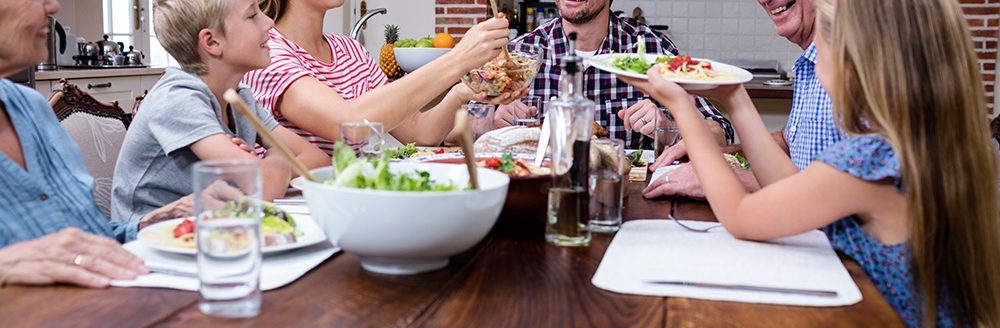
Families juggling busy schedules often put mealtime low on the priority list, but experts say cooking at home can pay off in healthier habits, stronger relationships and even reduced stress.
Christina Holmes, a family and consumer sciences specialist in Kansas State University Extension’s southeast region, said the key to at-home meal prep is being intentional.
“This time of year is especially busy for families as they juggle work, athletic practices, track meets, and various end-of-school-year activities,” Holmes said. “With so many evening commitments, family dinner can easily become an afterthought.”
Listen to an interview by Jeff Wichman with Christina Holmes and Cloe Mills on the weekly radio program, Sound Living, produced by K-State Extension
Holmes said even small changes — such as adding one extra home-cooked meal per week — can have meaningful benefits.
“Making it an intentional effort to plan ahead to eat more meals at home can be beneficial for the family’s health, for your finances, and reduce stress throughout the week,” she said.
Research highlighted in the publication Healthy Connections: Family Meals in a Snap – available online from the K-State Extension bookstore — shows that families who eat at home tend to consume more fruits and vegetables and have better control over portion sizes, calories and sodium.
“When you eat meals at home, you have a better control of what you’re eating and how much you’re consuming,” Holmes said. “Sometimes, when you go out to eat, they give you more portions than what you actually need, and it’s tempting to overeat.”
Cloe Mills, an intern in the southeast region and a graduate student in dietetics, said home cooking also provides transparency about ingredients.
“One of the biggest benefits of eating at home is knowing what’s actually going in your food,” Mills said. “When you’re eating out, much of what you are eating is processed foods, which generally have much higher sodium, along with higher calories and higher saturated fats.”
Beyond nutrition, Holmes said family meals can positively affect emotional and social well-being, particularly for children.
“When we’re consuming those meals at home, we’re seeing decreased rates of depression and violence in adolescence, along with decreased risk of disordered eating patterns,” she said. “A lot of that comes from…sitting with your family at the table and spending that time together.”
Involving children in meal preparation can also support development. Tasks like measuring ingredients, problem-solving substitutions and communicating in the kitchen help build life skills.
“It gives them experience with fractions, communication skills and problem-solving,” Holmes said. “It also gives them the opportunity to develop a relationship with their parent or guardian.”
Still, experts acknowledge that cooking at home can feel overwhelming. Holmes encourages families to start small and build gradually.
“If the family sees meal planning and meal prepping as a burden, it’s not going to be something that’s sustainable long term,” she said. “Focus on one meal at a time.”
Planning ahead is another key strategy. Holmes suggests reviewing the family’s weekly schedule to identify busy nights and plan accordingly.
“It’s not realistic to prepare a gourmet feast on a night that you’re not going to get home until 8:30,” she said. “So look at those evenings and plan something quick or prepare ahead of time, like using a slow cooker.”
Leftovers can also simplify mealtime. Preparing larger portions or double batches allows families to reuse meals throughout the week or freeze them for later.
“You’re only spending time in your kitchen once to feed your family twice,” Holmes said.
Stocking a pantry with staple ingredients and nonperishable items — such as canned goods and frozen vegetables — can make it easier to prepare meals quickly while staying on budget. Holmes also recommends shopping sales to stretch grocery dollars.
Mills said setting realistic goals is essential for long-term success.
“If you try to start out with a huge goal and it doesn’t go well, then you feel less motivated to continue,” she said. “Start with a small goal, and the more you do it, the more comfortable you become.”
She added that involving children in age-appropriate tasks — from choosing recipes to writing grocery lists — can make the process more engaging and meaningful.
And remember: Home-cooked meals do not need to be elaborate.
“It doesn’t mean you have to spend lots of time preparing a gourmet meal,” Holmes said. “We want to focus on the time together and trying to get a variety of food groups on the plate.”
More information on nutrition, child development and many other topics is available at K-State Extension offices in Kansas.
PHOTO: Young family with little kids cooking at home together. (Adobe Stock-#327423655 │ fizkes)