Life is better with a clothes dryer
When it comes to modern amenities, one of the most underrated appliances might be the clothes dryer.
I became the latest High Plains resident to find out the hard way when the dryer bell chimed to signal my laundry was finished. When I opened the door, the clothes were still wet. Fortunately, the weather in Dodge City has been warm enough that I could put the laundry on a clothesline to dry.
What to do? I called an appliance repairman on a friend’s recommendation, and he was able to fix the problem. The heating element had failed.
For the few days I didn’t have a dryer, it got me thinking about years ago. Clothes washers and dryers have been around long enough that they are probably no longer considered a luxury, but a necessity.
For the most part, I can remember my parents always having at least a washer, and by the late 1960s they had a washer and dryer set. I know the generation before them used hand-cranked washers and hung clothes on clotheslines. I can remember my grandmother telling me that during the Great Depression, aptly called the “Dirty Thirties,” having dry clothes was a challenge because of all the dust.
Washing machine history
According to Speed Queen’s website, “We owe the invention of the washing machine to Jacob Christian Schäffer (1767). Thirty years later, an American, Nathaniel Briggs, obtained the first patent for a washing machine. It involved pouring hot water into a tank, turning a lever to wash the clothes and then wringing them between two rollers. The tank was then drained using a tap.”
In 1905, the first drum washing machines appeared. They were still hand-operated, but the steel tank allowed for a coal burner to be included.
Around 1920, the first electric machines were introduced. Only the turning mechanism was electric. The remaining controls were still manual.
Dryers
According to WashCycle.com, the first electric dryer was invented in the early 20th century. Inventor J. Ross Moore was tired of hanging his clothing outside, especially during the winter. To help keep his wardrobe out of the freezing weather, he built a shed to house his clothes while they dried. In addition, he added a stove. The clothing would hang on the line in front of the fire and dry. This was the beginning of the development of electric dryers.
For the next three decades, Moore worked to build a gas and electric unit, but he couldn’t find anyone to help manufacture his idea. The drum-type model was eventually picked up by Hamilton Manufacturing in Wisconsin. The new dryers were sold under the name June Day beginning in 1938.
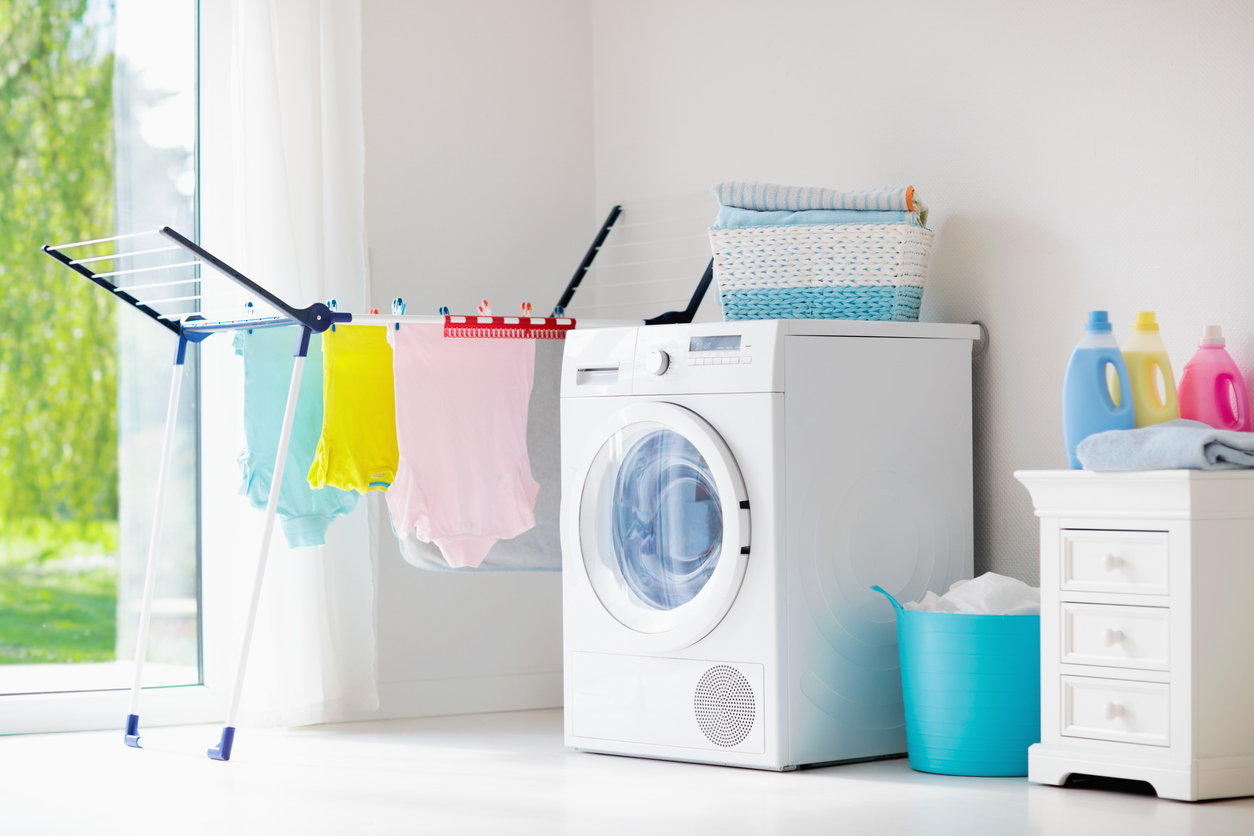
Dryers were growing in popularity during the 1950s; the website notes but did not come into their own until the 1960s. (Photo above is courtesy of iStock.)
The earliest washer-dryer set my parents had, thanks largely to Mom’s influence, came when they bought a set from Jerome Heim at Hoxie Appliance in Hoxie, Kansas. It was state-of-the-art at the time but simple by today’s standards.
However, the set was simple enough that Dad and my older brothers, who are far more mechanically inclined than I am, could fix it. Those machines survived several moves and flights of stairs.
While there are still good brands and reliable appliances available today, my repairman told me that a once-in-a-lifetime purchase is highly unlikely. The silver lining, in my case, was that parts were available.
My brothers and friends always said to fix the dryer first, but when the washer goes, that’s when you have to consider buying a new washer-dryer set. I’m not looking forward to that day.
I am spoiled, and I admit it. As I thought about celebrating the nation’s 250th anniversary, it made me pause while my dryer was out. I can remember seeing many clotheslines when we were marking the Bicentennial.
We have come a long way, with a few changes, and the dryer was something I took for granted until I didn’t have it for a week.
Even a home appliance can make me think about how fortunate I am.
Dave Bergmeier can be reached at 620-227-1822 or [email protected].