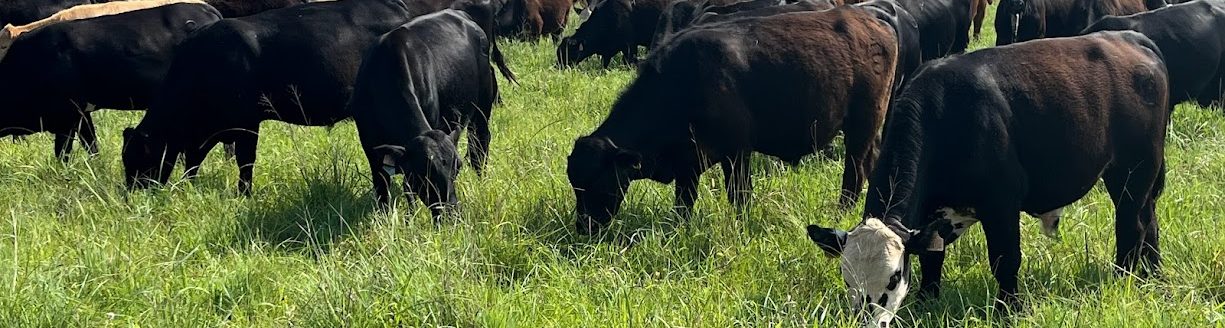
Mizzou’s agriculture programs address industry challenges through research and outreach
When Missouri farmers encounter a new crop disease, threat to their livestock or environmental challenge, many of the solutions to their problems begin at the University of Missouri.
Through research conducted by MU Extension and by students and faculty at the College of Agriculture, Food and Natural Resources, the university is able to help producers quickly respond to emerging challenges.
For nearly a decade, Vice Chancellor of Agriculture and Dean of CAFNR Christopher Daubert has guided the college’s teachings and research mission. While MU Extension operates under its own vice chancellor, Chad Higgins, Daubert said the Agriculture and Environment Extension program is a high-performing collaboration between the units. MU Extension plays a vital role in fulfilling the university’s land-grant mission by extending knowledge and solutions to communities across Missouri.
“We teach, we do the research and then we share solutions to pressing issues and challenges to the farmers and ranchers of the state,” Daubert said. “Extension extends the university so that we consider all residents of the state of Missouri to be our students.”
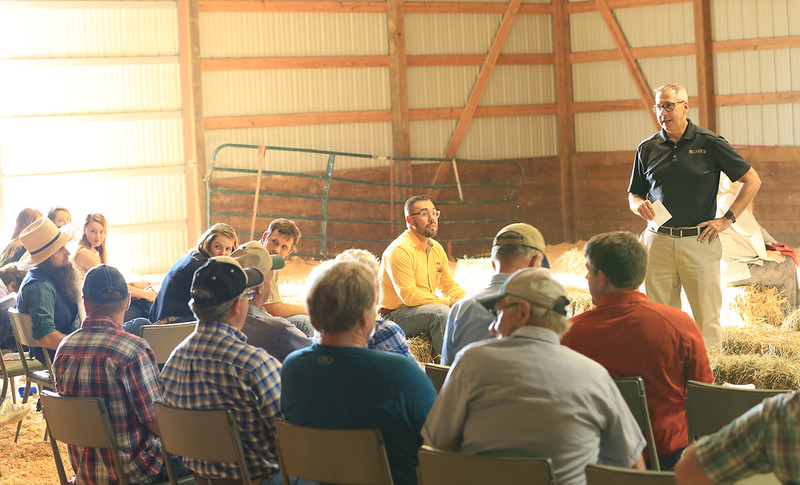
Pictured at top is CAFNR Vice Chancellor and Dean Christopher Daubert talks to attendees of the Thompson Research Center Field Day, which took place Sept. 24, 2025, in Spickard. (Photo by Logan Jackson, Courtesy of CAFNR.)
But to properly address agricultural challenges, CAFNR and MU Extension need to understand the problems producers are facing firsthand. Daubert said that starts with maintaining strong relationships with Missouri’s farmers, ranchers and agricultural partners.
“We do a lot of listening, and we also do a lot of boots on the ground, interacting with Missouri’s farmers and ranchers so we can have strong partnerships and relationships with all aspects of Missouri agriculture,” Daubert said.
Breaking down funding
MU Extension’s work is made possible by a combination of federal, state and local funding. In fiscal year 2025, the program reported a total budget of roughly $76.8 million, including $11.5 million from federal capacity grant funding. Since federal funding is dependent on state matching, Daubert expressed gratitude for the state’s continued investment into the program.
“The state of Missouri does a terrific job providing us with the support for our Extension programs,” Daubert said. “I’m appreciative and thankful to the state for recognizing the importance of Extension and funding it really, really well.”
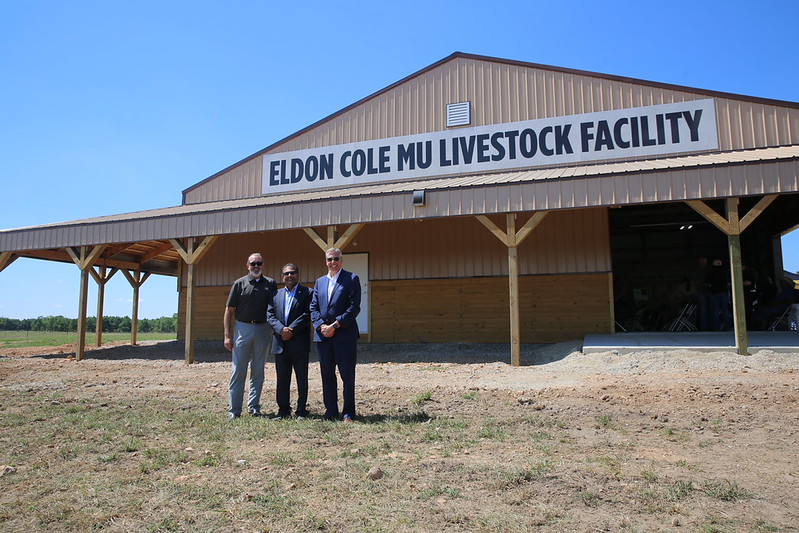
Research efforts are supported separately through the Hatch Act, a federal program that provides funding for agricultural research at land-grant institutions.
“Those dollars support research activities on our campus, but they also support the Missouri Ag Experiment Station,” Daubert said. “That includes all of the facilities that we operate like research centers and farms across Missouri.”
Preparing the next generation
CAFNR’s work extends far beyond solving current agricultural problems. Preparing future agricultural leaders remains one of the college’s most important responsibilities.
“CAFNR does such an amazing job in preparing students for meaningful careers that serve agriculture and the industries that are so critically important to our state,” Daubert said. “Working with and preparing students has been the most meaningful part of my time in Columbia.”
Additionally, the college has seen continued growth in student enrollment. In recent years, CAFNR has had consecutive record freshman classes. Daubert credits important initiatives like scholarships in making agricultural education more accessible.
“One-hundred percent of the students who are eligible and apply for our scholarships are given a scholarship,” Daubert said. “As a result of our ability to give a lot of scholarship money, more than 50% of the students who I shake hands with at graduation walk across that stage with zero debt.”
CAFNR also focuses on providing students with hands-on experiences through its R.I.S.E. initiative. R.I.S.E., which stands for research, international, service and experiential learning, is part of CAFNR’s strategic plan that aims to ensure students make the most of their education.
“We believe through those active learning experiences that our students are better able to apply what they’re learning in the classrooms,” Daubert said. “R.I.S.E. is just one of CAFNR’s many opportunities to best prepare our students to serve the biggest industry in the state of Missouri — agriculture.”
Adapting to a changing industry
As producers become more connected and well-versed with newer technologies, CAFNR and MU Extension are simultaneously ensuring that students, faculty and researchers are knowledgeable in and are developing skills needed to navigate the field in the future.
With applications like artificial intelligence becoming increasingly common, Daubert highlighted the importance of ensuring that potential future agricultural leaders understand how to use the technology responsibly.
An example of that effort is the Digital Agriculture Research and Extension Center, or DAREC, a 50-acre site where faculty, staff and students work with emerging technologies such as AI and drones to try to address challenges currently affecting Missouri producers.
“I think to deny its existence is short-sighted,” Daubert said of AI. “Whenever we think about how best to apply these developing tools and technologies, we work closely with our partners in the industry that we serve, and the industry has responded in a big way. They expect our students to be well versed in AI.”
Continuing to serve Missourians
As he looks toward the future, Daubert believes CAFNR and MU Extension are in a great position to continue increasing their impact and serving producers across Missouri.
“I think our best days are yet to come,” Daubert said. “The future is really bright for CAFNR, MU Extension and Missouri agriculture.”
Chase Pray can be reached at [email protected]