Politics, technology and perception reshaping animal agriculture
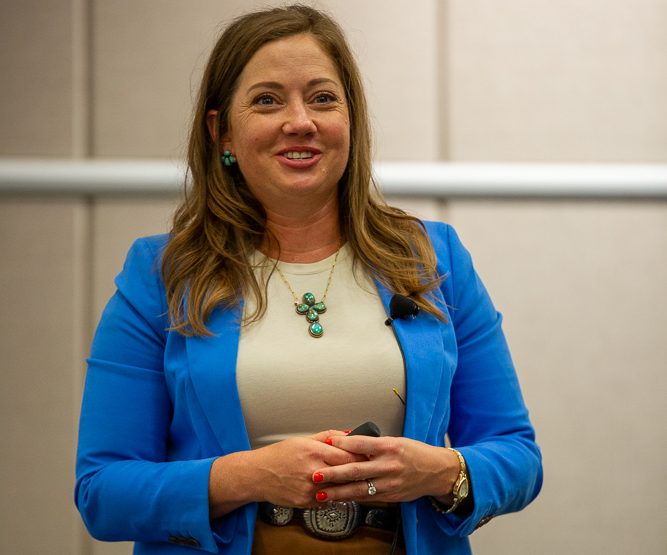
Chelsea Good told attendees at the recent Crops and Cattle Convention in Kansas City, Missouri, that politics, technology and public perception are shaping animal agriculture.
Good is the founder of Good & Associates, a multi-client firm specializing in issue management, government affairs, strategic communications, and industry relations for the agriculture industry. Her clients include businesses and associations spanning across the beef industry, dairy, pork, and crop sectors. She also is engaged in personal cattle and investing.
Good has found the livestock policy realm to be particularly interesting, especially in recent years. One example came in October 2025 when President Donald Trump posted on Truth Social about cattle ranchers. Good read the post, which said, “Cattle ranchers who I love don’t understand. The only reason that they’re doing so well for the first time in decades is because I put tariffs on cattle coming to the United States, including a 50% tariff in Brazil. If it weren’t for me, they would be doing just as they’ve done for the last 20 years. Terrible. It’d be nice if they understood that, but they also need to get their prices down because consumers are a very big factor in my thinking as well.”
She said the post was missing context about the cattle industry—“a lot of context.”
“What about the fact that we’re at 75-year low in terms of our herd number due to drought in cycles and other factors?” Good said. “What about the fact that beef demand is strong?”
There are multiple reasons cattle prices are high, and according to Good, maybe the post should not have surprised cattlemen.
“The things that he focused on in his campaign was affordability, right? Is beef more expensive today than it was a couple years ago? Undoubtedly yes,” Good said. “We have to recognize that, but I think that the fact that there is presidential-level attention and a call out, and honestly, kind of a shot over the bow at producers in particular, politics is in the barn yard.”
Connections need to be made from a producer perspective now to help counter-act misconceptions, Good said.
“This is not just about how the food is raised; it’s also about that end product,” she said. “And I think as we get more and more removed from agriculture, that becomes a part of how we talk about animal agriculture and what we do every day.”
The federal government is involved in the livestock sector—for example—with the Make America Healthy Again movement.
“Honestly, I’ve seen it get some mixed reactions, particularly from animal agriculture. I’ve been in a room where (Robert F) Kennedy (Jr.) has spoken and seen livestock producers getting excited about things like encouraging whole food and encouraging more protein production,” she said. “But there are other components about MAHA that are a little bit concerning, are they not?”
Regulatory
On the row crop side —the crop protection tools and pesticides—there’s been components of MAHA movement push back on tools that Good calls “fundamentally necessary” to produce crops in the United States.
“Particularly, a little bit ironically, in a no-till environment, which I think doesn’t necessarily connect with some of their other talking points,” she said.
Ballot initiatives
State ballot initiatives have also come into play in recent years. One such one was Proposition 12 in Denver that would have made it illegal to slaughter livestock in the City or County of Denver, Colorado
“Why does that matter? Not only would it have set a bad precedent, but there is a single large slaughter facility in Denver—Superior Lamb, the largest lamb facility in the United States,” she said. “Thankfully, that ballot initiative failed. But I think part of the strategy and how animal ag was effective in pushing back against that ballot initiative was changing a little bit of the perspective of what we talked about, and honestly, the activists in this case, I think, chose a bad target.”
Superior Lamb is an employee-owned company with “a lot of really great long-time employees who are very loyal to their business,” Good said. “Those employees will stand up and be the voices Superior needed at the time.
“I think it was by using some of those voices that a coalition across agriculture and even reaching out and inviting restaurants and some others to be a part of that coalition was able to push back on that ballot initiative,” Good said.
Another similar initiative in California tried to ban concentrated animal feeding operations, and that one was able to be defeated.
“But I think that this is a trend we’re going to continue to see, especially in some states’ population centers where very few parts of the state can make up a vote that really overrides the rural communities or the rural components of the state,” she said. “Environmental regulations are not new for animal agriculture or agriculture, but I think that just another example of how politics are very relevant to what we deal with day in and day out.”
Trade policy
There are also implications from trade and tariffs.
“It feels like every other day we’ve got a new tariff announcement or a new trade announcement, and obviously that impacts all parts of agriculture,” Good said. “I think the big picture for me is that we’re in a political environment that there’s a focus on food and production ag, and that’s a focus that doesn’t go away. It’s a focus that we maybe need to think about or lean into a little bit. But at the same time that we’ve got this external focus on animal ag coming from the administration and politics.”
Technology
Technology has accelerated the pace of change in ag and animal agriculture, according to Good.
“I think animal agriculture has a great history of always working to be better, always working to improve, working on things like genetics and nutrition to make the best absolute products that we can,” she said. “But we’ve gotten technologies in recent years that have really helped us accelerate along the way. I think genomics is a great example, especially in dairy production.”
Other examples are virtual fencing, sensors, and wearable technology. Improvements in internet coverage have helped many of these become needed and wanted tools, especially in areas where the terrain isn’t always kind.
Robotics can benefit both crop and livestock production, but very operation, she said, has to evaluate it to see if it is fit.
At the same time Good said it’s important to recognize that livestock significantly trails crop production as it relates to technology, especially investment in tech.
“We’ve seen a lot less investment on the livestock side,” she said. “I think that there’s a lot of different reasons for that. Some of the reasons for that, though, are probably structural.”
Livestock producers need data on their animals as they go through the production cycle, and some aren’t thrilled to share the information.
“I’ve seen a lot of resistance, honestly, both directions from producers who say, no that’s my information. If I’m selling the animal, I’m not selling that along with the animal,” she said. “From the harvest side, I know producers that would love to get better carcass data and information, and if they’re not going to retain ownership, they’re not experiencing processors being willing to share that information back”
That’s a major challenge as it relates to beef cattle; however, the opposite is true in the poultry and swine areas as they’re mostly totally integrated.
“It’s really hard to get an early adopter, someone to come in and take on a new technology because their systems are so big and so integrated that taking that risk is really challenging, and so it’s hard to get into animal agriculture,” she said. “I also think that one of the challenges is knowing what the true needs are, and sometimes the true needs are a little less flashy than you want them to be.”
Opportunities in technology are great, and there are a lot of areas in animal agriculture that can continue to see investment and growth.
“Animal health being the main one, and when I talk about that, there’s lots of different ways to look at that,” she said. “But new chemistry in animal health is something that we haven’t seen in a long time and is something that could be very valuable.”
Valuable perception
Public perception in animal agriculture is particularly interesting to Good, mostly because of the dichotomy of two very different things. Positive is farmers and agriculture lead the Gallup poll as the most trusted profession.
“Sixty percent of people responded either favorably or very favorably to how they feel about farmers and agriculture,” Good said. “I think that is great news. You add that with a 22% neutral rate, and there really is a lot of trust inherently in agriculture and farming. The challenge becomes is that doesn’t translate to all sectors of our industry.”
Skepticism comes in as consumers tend to see large food companies differently.
“The words you’re going to see talked about in this space—factory farming or corporate farming—they somehow see those things differently, and so I think that there is skepticism there that we need to be aware of, and we need to be thoughtful about,” she said.
Good believes politics, technology and perception all relate to one another, and in her opinion, advocacy should be part of every person’s job.
“I know that’s hard to hear because you probably already have jobs, right? Particularly if you’re a producer, that is a full-time job,” she said. “But I’m here to say that I think that we don’t make a difference in the perceptions, whether it be on Capitol Hill or with your average consumer, unless we have faces of real farmers and ranchers that are active in those conversations.”
She believes consumers will continue to care about where their food comes from.
“I think that is going to continue to be an area where they’ve got questions and they want answers,” Good said. “And I think that we, as animal agriculture, as individuals and coming together have a bit of a duty to engage in that conversation.”
Kylene Scott can be reached at 620-227-1804 or [email protected].