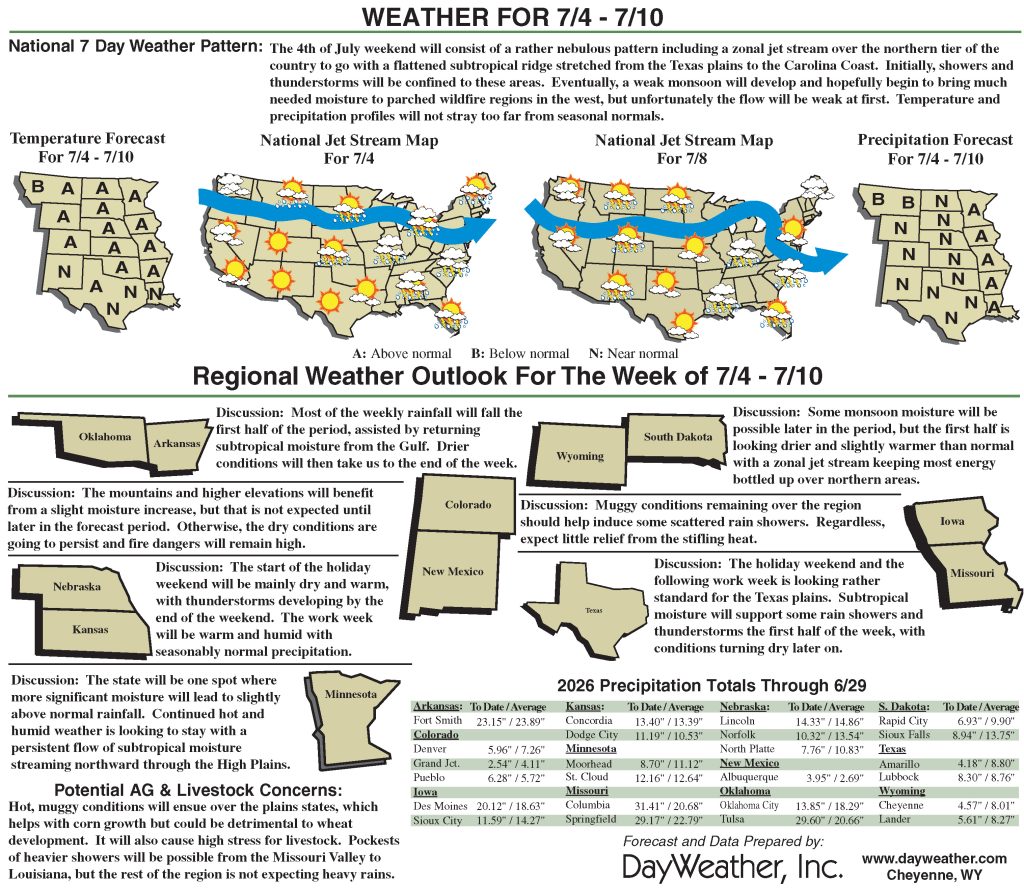
Active weather created downpours on the Plains
Active weather delivered heavy showers and locally severe thunderstorms east of the Rockies, with a few exceptions.
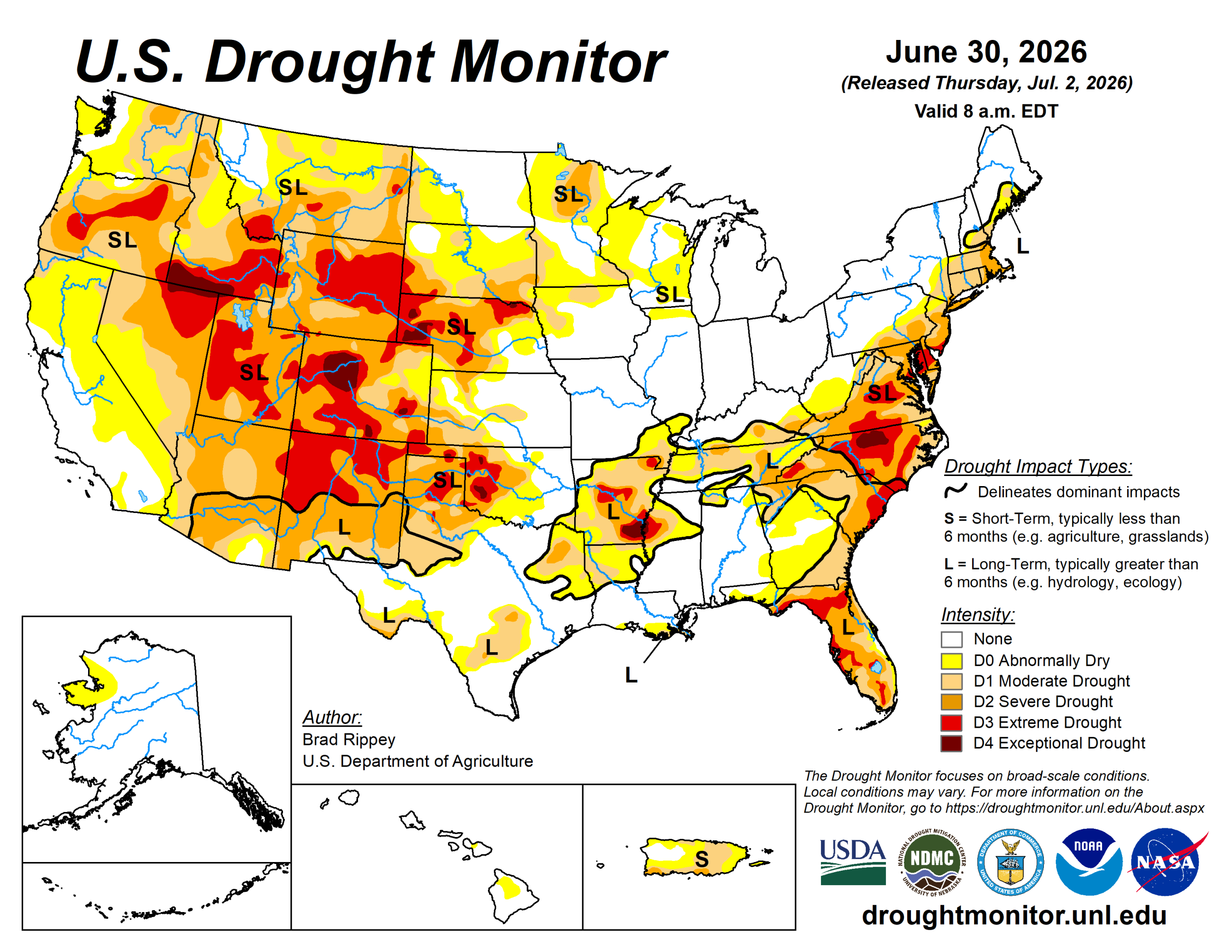
Some of the heaviest rain, locally 4 to 8 inches or more, fell from portions of the central and southern Plains into the Ohio and Tennessee Valleys, leading to pockets of flash flooding and lowland flooding. At least five flood-related fatalities were reported in Kentucky and Tennessee.
Exceptions to the wet pattern included the western Gulf Coast region, parts of the Southeast, and an area stretching from the east-central Plains into the lower Great Lakes region. At the start of the drought-monitoring period, hot, dry weather dominated the West. However, a pattern change soon delivered cooler weather across the western U.S., along with widespread Northwestern precipitation.
Wet snow blanketed some high-elevation sites in the northern Rockies. During the transition from hot to cool weather, gusty winds and low humidity levels favored wildfire ignition and rapid expansion, especially in portions of the eastern Great Basin and Four Corners states. At the end of June, more than a dozen active Western wildfires had scorched more than 10,000 acres of vegetation apiece, with the largest being the 94,000-acre Cottonwood Fire near Beaver, Utah.
On June 28, three federal firefighters died in the Knowles Fire, west of Grand Junction, Colorado.
South
The South experienced a second consecutive week of widespread reductions in drought coverage.
In fact, flash flooding and lowland flooding plagued some of the hardest-hit areas, including the Arklatex and the southeastern corner of Oklahoma, where 2-week rainfall totals locally exceeded 10 inches. Much of the northern tier of the region, from Oklahoma to Tennessee, also received multiple rounds of heavy rain.
Although mostly dry weather prevailed in south-central Texas, some additional improvements were introduced, as impacts of recent downpours on long-term drought became more apparent.
Midwest
Torrential rainfall struck the southern tier of the region, easing or eradicating drought. By June 28, the U.S. Department of Agriculture indicated that topsoil moisture in agricultural regions was rated 39% surplus in Illinois, along with 37% in Missouri and 34% in Indiana.
Midwestern summer crops remained mostly in good shape, with roughly two-thirds of the U.S. corn (67%) and soybeans (65%) rated in good to excellent condition on June 28, according to USDA. However, patchy dryness and moderate to severe drought existed across the upper Midwest, with rain trimming drought coverage in some areas but bypassing others.
High Plains
Like other areas in the central and eastern U.S., a patchwork quilt of showers provided drought relief in some areas. Some of the heaviest rain, occasionally accompanied by thunderstorm-driven high winds and large hail, fell in portions of all six states in the region.
However, southeastern Nebraska was one area that missed all the rain. One of the most impressive outbreaks of severe weather occurred on the night of June 28 to 29, when a swath of wind damage stretched from northwestern Nebraska into southeastern North Dakota and beyond.
An unofficial wind gust to 131 miles per hour was clocked in Hyde County, South Dakota, while a gust to 112 mph was recorded at a mesonet station near Ree Heights in Hand County, South Dakota. Despite all the rain, the U.S. Department of Agriculture reported that rangeland and pastures continued to struggle. On June 28, statewide rangeland and pastures were rated 66% very poor in Nebraska, along with 63% in Colorado.
West
During the transition from hot weather to cooler conditions, gusty winds fanned recently ignited wildfires across portions of the eastern Great Basin and the Four Corners states.
Fire ignition and spread was also abetted by dry thunderstorms, low humidity levels, and near-record to record-setting dry fuels. Pockets of worsening drought were observed in the Four Corners states, including a notable expansion of extreme drought across the northern half of New Mexico.
In the Northwest, however, heavy precipitation—including high-elevation snow—eased drought from central Idaho into western and northern Montana. Less significant precipitation fell in the Pacific Northwest. According to the U.S. Department of Agriculture on June 28, Western States reporting rangeland and pastures rated at least one-half very poor to poor included Colorado (63%), while states with topsoil moisture more than one-half very short to short were Colorado (89%), Wyoming (81%) and New Mexico (68%).
Looking ahead
Hot, humid weather will persist through the Independence Day weekend in most areas along and east of a line from the southern High Plains into the upper Midwest.
Some of the most extreme heat will affect the middle Atlantic States, parts of which will experience multiple days with triple-digit (100-degree) heat. Although the Midwest will remain hot, temperatures in most areas will barely reach stressful thresholds (95 degrees or higher) for corn and soybeans entering the weather-sensitive reproductive stage of development.
Furthermore, many Midwestern crops are progressing through the hot spell with adequate to locally surplus soil moisture. Meaningful precipitation during the next five days should be limited to parts of Florida’s peninsula and the upper Midwest; both areas could see 1 to 4 inches, with locally higher totals. Other areas of the central and eastern U.S. should receive spotty thunderstorms, while little or no rain will accompany a Western warming trend.
The National Weather Service’s 6- to 10-day outlook for July 7 to 11 calls for the likelihood of hotter-than-normal weather nationwide, except for near-normal temperatures along and near the Pacific Coast, extending as far south as central California.
Meanwhile, odds will be tilted toward near- or above-normal rainfall across most of the country, with drier-than-normal conditions expected to be limited to the Great Basin and environs.
Brad Rippey is with the U.S. Department of Agriculture.